A high quality web hosting provider needs to have three things:
- Fast, secure technology that has what your website needs to run well
- Hosting options that give your business room to grow
- Fast access to customer support that knows what they’re talking about, and a huge catalog of nuanced self-help content
InMotion and SiteGround, our two top picks, are both excellent options. We think most small businesses will be really happy with what they have to offer.
DreamHost, Bluehost, and HostGator are also very popular and generally well regarded — there are just enough little issues that keep them from being our overwhelming favorites.
We also looked at GoDaddy. We recommend avoiding hosting your small business’s websites on GoDaddy. You can absolutely do better.
| InMotion |
SiteGround | DreamHost | Bluehost | HostGator | GoDaddy | |
|---|---|---|---|---|---|---|
|
|
|
|
|
|
Sign Up | |
| Quicksprout pick | Quicksprout pick | Honorable mention | Popular | Popular | Don’t recommend | |
| Shared hosting plans |
|
|
|
|
|
|
| 24/7 customer support |
Chat |
Chat |
|
Chat |
Chat |
|
| Free trial |
|
|
|
|
|
|
| SSD storage |
 |
|
|
|
|
|
| Free SSL certificate |
|
|
|
|
|
|
| SSH Access |
|
|
|
|
|
|
| Email hosting |
|
|
|
|
|
|
| Operating system |
|
|
|
|
Windows |
Windows |
Our top picks for small business web hosting
InMotion Hosting
- Quicksprout pick
- This host is all-around excellent and great for beginners
InMotion is an all-around provider with a solid reputation: the Subaru of web hosts. It has a lot of plans to choose from across the traditional range of hosting options — shared, managed WordPress, VPS, and dedicated servers — and it prioritizes fast loading times with SSD storage, PHP 7, custom server caching, and two US-based servers. We also appreciate its rigorous security protocol: servers have custom firewalls and DDoS protection, it includes malware protection, and SSL certificates are free on all plans.
Where InMotion especially stands out is in its customer support, which caters to all levels of users. Its knowledge center is recognized as one of the best in the business, with thousands of help articles, FAQs, forums, training videos, and guides to help even the most entry-level administrator feel in control. You’ll see InMotion support staff respond to specific questions in each article’s comments section, and there’s even a community support subsection, where one-off questions are answered by InMotion super users. The US-based customer service team is available 24/7 across live chat and email and phone, and InMotion offers a whopping 90-day money-back guarantee — one of the longest available.
InMotion staff answers user questions in the comments of their support center’s articles.

We think most small businesses will be happy on one of InMotion’s Business shared hosting plans, which include a free domain; unlimited storage, bandwidth, and email; and one-click installation of more than 400 apps. When you’re ready to upgrade, InMotion has a straightforward approach. As you move up the food chain, you won’t get upsold on additional features or slicker tools. You’ll just get more power — 2X the performance with each upgrade. What other hosts consider add-ons, InMotion offers even on its lowest-tier plans, including automatic backups and one free restore every four months, plus three free website/database migrations. The only extra perk the highest-tier shared hosting plan offers is an uptime guarantee: for every month InMotion’s server performance dips below an average 99.999% uptime, you’re eligible for a free month of hosting.
InMotion is initially slightly more expensive than competing web hosts. Its shared hosting plans start at $6–7/month and managed WordPress hosting starts at $7–8/month. But InMotion is one of the only web hosts that doesn’t offer promo pricing, where a plan jumps up in price after your first contract. Long-term, there’s a good chance InMotion will be more cost efficient.
SiteGround
- Quicksprout pick
- An outstanding reputation and robust functionality
If InMotion is Subaru, SiteGround is Tesla: cutting-edge, powerful, and enormously well-respected. Its accolades are impossible to ignore: it’s one of WordPress’s three recommended web hosts and is the go-to for Reddit users, plus it has twice as many five-star reviews than any other provider on WhoIsHostingThis.
SiteGround is widely considered to a technology leader, especially when it comes to shared hosting — it’s often among the first hosts to provide access to developing tech to its customers. At this point, SSD drives, custom caching, CDN technology, NGINX, and PHP 7 are included to maximize speed on all levels of plans. SiteGround’s commitment to security is also no joke, with CHROOT account isolation, custom AI to counter brute-force attacks, and an in-house DevOps team to code proactive patches.
InMotion’s customer support is tough to beat, but SiteGround gives it a real run for its money. Customer support is available 24/7 across all channels — phone, chat, and email — and its knowledge base is rich and well-organized. SiteGround is probably the most transparent web host around regarding uptime: it has a 99.9% annual uptime guarantee (or you get a month of hosting free) and posts both its annual average and the previous month’s uptime right on its site.
SiteGround’s annual uptime compared to last month’s.

As one of WordPress’s recommended web hosts, it might come as no surprise that managed WordPress is built straight into all of SiteGround’s shared hosting plans — it’s not considered an upgrade, like it is with InMotion. If you’re a WordPress user, this is undeniably a perk: core updates are automatic, all plans are WP-CLI enabled for easier management, and security is tailored to counter WordPress-specific vulnerabilities. This isn’t to say that you can’t get those things on a standard shared hosting plan with InMotion — they’re just going to take more manual labor.
With SiteGround, upgrading your shared hosting plan gets you access to more: more power, yes, but also more tools and functionality. SiteGround is particularly well-known for its highest-tier shared hosting plan, GoGeek. On GoGeek, premium site caching will increase your site’s speed, you can make site-wide backups on demand (plus free restores), and you have access to pre-installed Git and WordPress staging. Pretty cool stuff, although potentially more than your small business needs.
SiteGround is designed to meet the needs of customers who are straddling the line of small business. It leaps from shared hosting straight to an $80/month cloud hosting solution or a $279/month dedicated server, skipping over the more traditional VPS stepping stone. And while SiteGround’s promo pricing is extremely reasonable, starting at $4/month, it triples at the end of your first contract. Yowch.
3 other web hosts for small businesses to consider
DreamHost
Another WordPress recommended web host, DreamHost also integrates managed WordPress hosting into is core shared hosting packages (as well as its super-speedy, cloud-based WordPress hosting plan called DreamPress). DreamHost stands out for having a completely customized back end instead of the universal cPanel most other Linux-based hosts use. Think of it like Apple versus Android: DreamHost customers love it, but it’s not a compatible solution should you ever switch hosts.
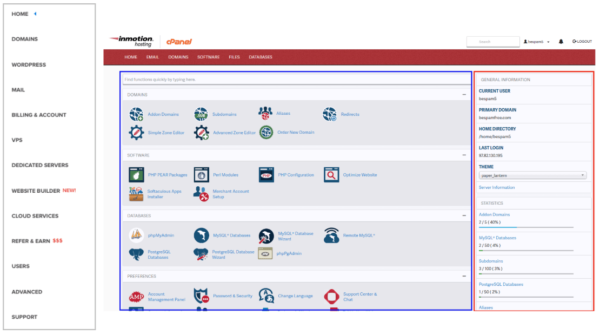
DreamHost’s sleek custom control panel menu (left) compared to InMotion’s cPanel (right).
Dreamhost is a sleek web host with a traditional upgrade path: shared hosting to managed WordPress hosting to VPS to cloud hosting or a dedicated server. Customer service is a little less traditional: email support is available 24/7, but live chat is only on during business hours, and you actually have to pay about $10 to get technical support over the phone. That said, the free trial period is the longest in the business — 97 days. Shared hosting plans start at $3/month, and since Dreamhost doesn’t do promo pricing, it won’t jump after your first contract is up.
Bluehost
The third and final WordPress-recommended host, Bluehost is a hugely popular option that builds in managed WordPress hosting to all its shared hosting plans. Its knowledge base is kind of a disaster — we recommend going straight to the search bar; browsing is pretty much pointless — and even though customer support is available 24/7 across phone, live chat, and email, it’s been under fire in recent years. Poor customer support is one of the biggest reasons Bluehost has only one star on Trustpilot, and less than half of customers rate it five-stars on WhoIsHostingThis.
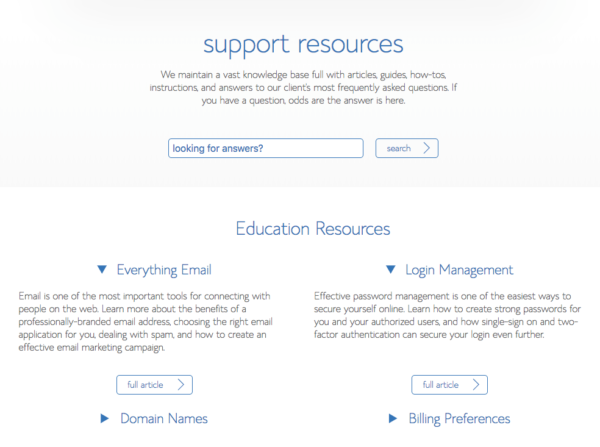
Bluehost’s knowledge base is frustrating to browse or get answers fast.
Shared hosting with Bluehost starts at $4/month for your initial contract. Bluehost is a standout for offering five(!)-year contracts, which could lock you into some really low prices.
Hostgator
Another big name in small business web hosting, and it’s a bit of a mixed bag. We were surprised at how thorough Hostgator’s self-serve knowledge base is (despite a certain mid-90s design aesthetic) but disappointed it doesn’t offer any sort of email support — just phone and live chat. Hostgator tends to rank highly on tech publications like PCMag, but customer reviews are pretty dreadful: it has only one star on Trustpilot. If you’re interested in trying HostGator, we recommend taking full advantage of the 45-day money-back guarantee.

HostGator’s support center is surprisingly robust and useful, despite its outdated appearance.
HostGator does offer Windows hosting in addition to Linux, as well as a variety of options to upgrade, including cloud hosting, VPS hosting, managed WordPress, and a dedicated server. Shared hosting plans start at $3/month.
A web host to avoid
GoDaddy
You can do better. Even though it offers Windows operating system and a wide range of plans across shared, managed WordPress, VPS, cloud, and dedicated servers, too many features (SSL certificates, SSD storage, site backups and restores) are only included in higher-tier plans or as add-ons. If that isn’t enough, its customer support is lacking, with no email and limited hours on live chat, plus a poorly organized knowledge base. The user reviews are also telling: two stars on Trustpilot and only 27% of users rate it 5 stars on WhoIsHostingThis.
How to find the best web hosting for small businesses
Customer support
Small business owners don’t always get the luxury of an IT department (or even a web administrator) on staff. Often, your web host’s customer support — and the self-service help articles, tutorials, and blogs it provides — act as the stand-in. That’s why we make technical support one of the highest priorities for small businesses. It’s like health insurance: it doesn’t matter how robust a plan is if you can’t settle a claim.
| InMotion |
SiteGround | DreamHost | Bluehost | HostGator | GoDaddy | |
|---|---|---|---|---|---|---|
| Money-back guarantee |
|
|
|
|
|
|
| Phone |
|
|
|
|
|
|
| Chat |
|
|
|
|
|
|
|
|
|
|
|
|
|
|
| Percentage of 5-star user reviews on WhoIsHostingThis |
(549 total reviews) |
(1954 total reviews) |
(251 total reviews) |
(480 total reviews) |
(572 total reviews) |
(584 total reviews) |
| Trust Pilot | ★★★ (108 reviews) |
★★★★★ (1477 reviews) |
★★★ (473 reviews) |
★ (115 reviews) |
★ (401 reviews) |
★★ (3,113 reviews) |
| CNET |
|
|
|
|
|
|
| PC Mag |
|
|
|
|
|
|
* DreamHost customers can request a callback from technical support, but will be charged $10
Money-back guarantee
Most web hosts offer some sort of free trial period. We recommend using this time to really dig into your host’s customer support — its knowledge center and especially support staff across all channels. DreamHost and InMotion both offer industry-leading money-back periods at 97 and 90 days respectively. Most other hosts give you around one month.
24/7 support
Every web host claims it, but each delivers 24/7 support in its own way. InMotion, SiteGround, and Bluehost all offer 24/7 phone, live chat, and email support. By comparison, GoDaddy offers 24/7 phone, but limits live chat to business hours and has no email support at all.
Reputation
There can be a discrepancy between reputation and rankings, and while neither can reliably predict your future experience with a web host, they provide insight on where to pay close attention during your trial period. Take, for example, HostGator. Technology publications tend to rank its products highly: it earns a score of 4.5 out of 5 on both CNET and PCMag. But it has 1 star on Trustpilot and only 37 percent of nearly 600 users give it 5 stars on WhoIsHostingThis — and nearly all of negative comments are directed at customer service.
Knowledge center
A quality knowledge center is expansive, informative, and intuitively organized. InMotion’s best-in-class support center includes everything from entry-level courses on the basics (cPanel, WordPress, email) to advanced product guides, a thriving user community, and InMotion moderators answering questions in each article’s comments section. Bluehost’s help center is comparatively a black hole of clicking around and searching to see if you stumble across an article with the information you need.
Web host specs
Every web host is likely to offer way more than what your website needs to run well. The key is making sure that it has the right stuff (it doesn’t really matter that DreamHost doesn’t support Drupal unless you use Drupal on your site). Most web hosts offer several tiers of plans across each type of hosting — shared, VPS, etc. As you ratchet up the tiers, your host can accommodate bigger, more complex websites. Higher tiers usually unlock access to premium features and tools, and often come with more add-on services included for free.
| InMotion | SiteGround | DreamHost | Bluehost | HostGator | GoDaddy | |
|---|---|---|---|---|---|---|
| Lowest Tier | Launch | StartUp | Shared Starter | Basic | Hatchling | Economy |
| Initial price | $6–7/month | $4/month | $3–5/month | $4–6/month | $3–11/month | $3–8/month |
| Normal price | $6–7/month | $12/month | $3–5/month | $8–9/month | $11/month | $8/month |
| Bandwidth | Unlimited | ~10K visitors/month* | Unlimited | Unmetered | ~7-8K visitors/day* | Unmetered |
| Storage | Unlimited | 10GB | 50GB | 100GB | Unmetered | 100GB |
| Number of sites | 2 | 1 | 1 | 1 | 1 | 1 |
| InMotion | SiteGround | DreamHost | Bluehost | HostGator | GoDaddy | |
| Middle Tier | Power | GrowBig | -- | Plus | Baby | Deluxe |
| Initial price | $8–10/month | $6/month | -- | $6–8/month | $4–12/month | $5–11/month |
| Normal price | $8–10/month | $20/month | -- | $11–13/month | $12/month | $11/month |
| Bandwidth | Unlimited | ~25K visitors/month* | -- | Unmetered | ~7-8K visitors/day* | Unmetered |
| Storage | Unlimited | 20GB | -- | Unmetered | Unmetered | Unmetered |
| Number of sites | 6 | Unlimited | -- | Unlimited | Unlimited | Unlimited |
| InMotion | SiteGround | DreamHost | Bluehost | HostGator | GoDaddy | |
| Highest Tier | Pro | GoGeek | Unlimited | Choice Plus | Business | Ultimate |
| Initial price | $15–19/month | $12/month | $8–11/month | $6–8/month | $6–17/month | $8–17/month |
| Normal price | $15–19/month | $35/month | $8–11/month | $15–17/month | $17/month | $17/month |
| Bandwidth | Unlimited | ~100K visitors/month* | Unlimited | Unmetered | Unmetered | Unmetered |
| Storage | Unlimited | 30GB | Unlimited | Unmetered | Unmetered | Unmetered |
| Number of sites | Unlimited | Unlimited | Unlimited | Unlimited | Unlimited | Unlimited |
| Operating system | Linux | Linux | Linux | Linux | Linux Windows |
Linux Windows |
*SiteGround and Hostgator both offer unmetered bandwidth, but provide recommended traffic thresholds
Storage
The size of your website — how many gigabytes of content and programs it contains — determines how much room on a server your site takes up. Some web hosts put a cap on website storage, especially on lower-tier plans: SiteGround’s lowest tier maxes out user storage at 10GB; Bluehost’s cap is 100GB. Other plans advertise “unlimited” or “unmetered” storage and bandwidth — there’s no hard cap on what your site is allowed to use.
A note on unlimited: As Hostgator puts it, unlimited doesn’t mean infinite. Every web host will throttle your site or suspend your account if you’re using so much storage or bandwidth that it is negatively impacting the performance of other sites on your shared server. This is designed to protect your fellow shared customers from sluggish performance that’s out of their control (we don’t get to pick our neighbors) but it’s a seemingly alarming clause that’s built into every host’s terms of service. Don’t worry about it too much. Most websites will never experience throttling or service suspension. Bluehost claims that 99.95 percent of its 2 million websites stay within “normal” usage.
Bandwidth
Bandwidth is how much of the server’s information pipeline your website is using to send and receive data to your visitors. Most web hosts provide unmetered bandwidth, but like with storage, you can’t hog so much that the other users on your shared server are getting poor site performance. Traffic is the easiest way to predict bandwidth, which is why some hosts offer approximate visitor thresholds. SiteGround’s shared hosting plans are designed to accommodate 10,000–100,000 monthly visitors, depending on the plan, while all of HostGator’s shared plans can support between 7,000–8,000 visitors per day (or about 200,000–250,000 visitors per month).
Number of websites
If you’re launching more than one website on the same web hosting plan, it’s important to remember that storage and bandwidth are measured all together — not per site. For example, SiteGround’s middle-tier plan, GrowBig, can host an unlimited number websites, but offers 20GB of storage and can accommodate around 25,000 monthly visitors total. If you have 10 sites hosted on a GrowBig plan, and the videos you post on site number two always go viral, that site may use up the bandwidth allotted for your other nine sites too.
Supported technology
Make sure the programs, features, and apps you’re using (or plan to use) are compatible with your host. The vast majority of websites are built on WordPress, and virtually every web host will work seamlessly. But what if your site uses Magento? Is any of your site coded in Perl or Python? Double check that your host is compatible with what you want to use, and dig into the knowledge base and customer support around those things, too. If a host advertises its compatible with Joomla, it’s not much use if there is no documentation or experienced staff to help you out when you hit a snag.
The other thing to double check is which operating system your site uses. Linux is the most common, but if your site runs on Windows OS, it will be a no-go. InMotion, SiteGround, DreamHost, and Bluehost are Linux-only. HostGator and GoDaddy have both Linux and Windows servers.
Room to grow
The cheapest web hosting is shared hosting. That’s where lots of small businesses start out before upgrading to VPS hosting, cloud hosting, or a dedicated server. Some hosts include a managed WordPress hosting option as well, which may be considered an upgrade and hosted on VPS or cloud servers. Others, including SiteGround and InMotion, keep their managed WordPress plans on shared servers.
You’ll know you’re ready to upgrade when your website is utilizing too much storage or bandwidth on your current plan — your host usually gives you a couple of days heads-up via email when this happens. More robust plans can accommodate bigger, more heavily trafficked sites. They also include access to more technical features.
No web host wants to put a ceiling on your website’s growth
| InMotion | SiteGround | DreamHost | BlueHost | HostGator | GoDaddy | |
|---|---|---|---|---|---|---|
| Shared |
|
* |
* |
* |
|
|
| Managed WordPress |
|
|
(cloud) |
(VPS) |
(cloud) |
|
| VPS |
|
|
|
|
|
|
| Cloud |
|
|
|
|
|
|
| Dedicated |
|
|
|
|
|
|
*Includes managed WordPress hosting in shared hosting plan
Other web hosting features small businesses should know and look for
- Backups: It’s best practice to manually backup your sites and databases on separate machines in case you delete something important, corrupt a file, or lose everything. Web hosts also often perform complementary auto-backups for those worst-case scenarios, and can help you restore your website to what it should be (sometimes for a fee).
- Migrations: If you’re moving an existing website to a new web host, your new provider may include migration assistance to ensure it’s done correctly. This is especially convenient if you have a particularly complex website.
- Uptime: This is a measure of what percentage of time a hosts servers are online. You want as close to 100% as possible, and most web hosts boast 99.9% uptime or higher. Many offer some sort of uptime guarantee: if they drop below 99.9% uptime, you can request a discount on your hosting fees. (And as a side note: If you’re launching a new website, make sure your business has a continuity plan in case there is system downtime.)
- Email hosting: Most web hosts provide email hosting as well. This will get your a custom email address (as opposed to @gmail.com) and email storage, and often it’s included in the price of admission.
- SSD storage: SSD stands for Solid State Drive. This technology is many times faster than what’s used on normal hard drives. If you’re server uses SSD storage, your website’s content will be delivered to your visitors faster.
- SSH access: Secure Shell access means you have a secure connect straight into your account to manage files and databases — a must-have feature for the technically inclined.
- SSL certificates: A certificate for Secure Sockets Layer encryption is a signal that your website is secure and safe to submit sensitive data, including passwords and credit card info. It’s important for all websites to be SSL certified — Google considers it a trust factor — and mandatory if there are any transactions happening on your site.
- Domain registration and privacy: If you’re creating a new website, you’ll need to purchase and register a domain. Many hosts allow you to purchase and register a domain at the same time as you purchase your plan, although it’s not necessary (you can host a domain that’s been purchased anywhere on any host). We recommend always opting in for domain privacy, which is typically a $12–20/year upsell, although some hosts throw it in for free. Domain privacy will keep your personal contact information off of the WHOIS registry.
Recap: The best web hosts for small business
- InMotion Hosting: Our pick for beginners
- SiteGround: Our pick for reputation
- DreamHost: Honorable mention
- Bluehost: Popular, but not our favorite
- HostGator: Popular, but not our favorite
- GoDaddy: Avoid it (you can do better)


from Quick Sprout https://ift.tt/2Or6Xre