Wednesday, November 14, 2018

15 Free Google Tools That Will Enhance Your Marketing Strategy

When it comes to anything done on the Internet, Google is king.

It’s the most popular search engine in the world, with a global market share of 89%.

Each day, 3.5 billion searches are performed on Google. That’s more than 1.2 trillion searches annually.

With so many people using Google to search for information online, it’s more important than ever for businesses to understand the Google algorithm. That knowledge will help them use SEO tactics to drive ecommerce sales.

But Google is much more than just a search engine. The Google Play Store is the official app store for all Android devices. It’s developed, owned, and operated by Google.

Understanding the app store and how it works will help you improve the ranking of your business mobile app.

While you may know how important Google is for searches, you might not be aware of everything else it has to offer.

Google has tons of free tools available for people to take advantage of. As a business owner, you can use these resources to improve your marketing efforts.

I’ve narrowed down the top 15 free Google tools your business can use for marketing. Here they are.

1. Google Drive

Some of you might already be familiar with Google Drive. Maybe you’re using it in your personal life.

But you can use Google Drive to help you with your business as well.
google drive

It’s a great way to safely store all your marketing content in the cloud.

You can stay organized and know you can access all your documents and pictures from anywhere. This is much more effective than storing important files directly on your device or an external hard drive.

Unlike hardware that can be lost or destroyed, Google Drive is immune to accidental damages, fires, floods, and theft.

One of my favorite parts about Google Drive is the ability to access my content from anywhere, as long as there is Internet.

You can download the mobile app to manage your files on the go as well.

In addition to using Google Drive for storage, I use Google Docs and Google Sheets to work on content directly.

In fact, I’m writing this blog post in Google Docs. That way, my progress gets saved and stored automatically.

I’m sure at one point or another, you’ve lost work you were doing in Microsoft Word or Excel. Don’t get me wrong. I’m not knocking that software. I’m just saying I’ve never had an issue when working or saving content in Google Drive.

I use it to store photos as well.

If I come across an interesting or informative photo I plan to use on one of my websites, YouTube channel, or blog posts, I save it to the respective file in my drive.

If you are sharing content and collaborating with your team, you can share files with specific users. Set parameters giving them the ability to view, share, or edit the content.

The first 15GB of Google Drive storage are free.

You can upgrade to 100GB for just $1.99 per month. I can’t imagine you’ll need much more than that.

2. Google Alerts

Just as the name implies, Google Alerts will notify you about anything you create an alert for.

alerts

For example, let’s say you want to know anytime someone mentions your business online. Set up an alert, and you’ll be emailed as soon as something gets published.

Then, you can act if you see negative information posted about your brand on the web.

This is a great way for you to monitor and improve your online reputation.

But you can set up alerts for anything you want. It could be your name or the names of your top competitors.

Without these alerts, you’d have to manually search for this type of content on a daily basis, which is unreasonable and an inefficient use of your valuable time.

Google alerts even offers suggestions based on what’s trending, covering a variety of topics such as:

  • technology
  • health
  • business
  • entertainment
  • finance

You can monitor certain categories based on your industry.

3. YouTube

Back in 2006, Google bought YouTube for $1.65 billion.

There are more than 1.5 billion YouTube users across the world. It’s the most popular social media site in the world for teenagers.

In fact, 96% of teens in the US are active on YouTube, which is important if your business is targeting Generation Z.

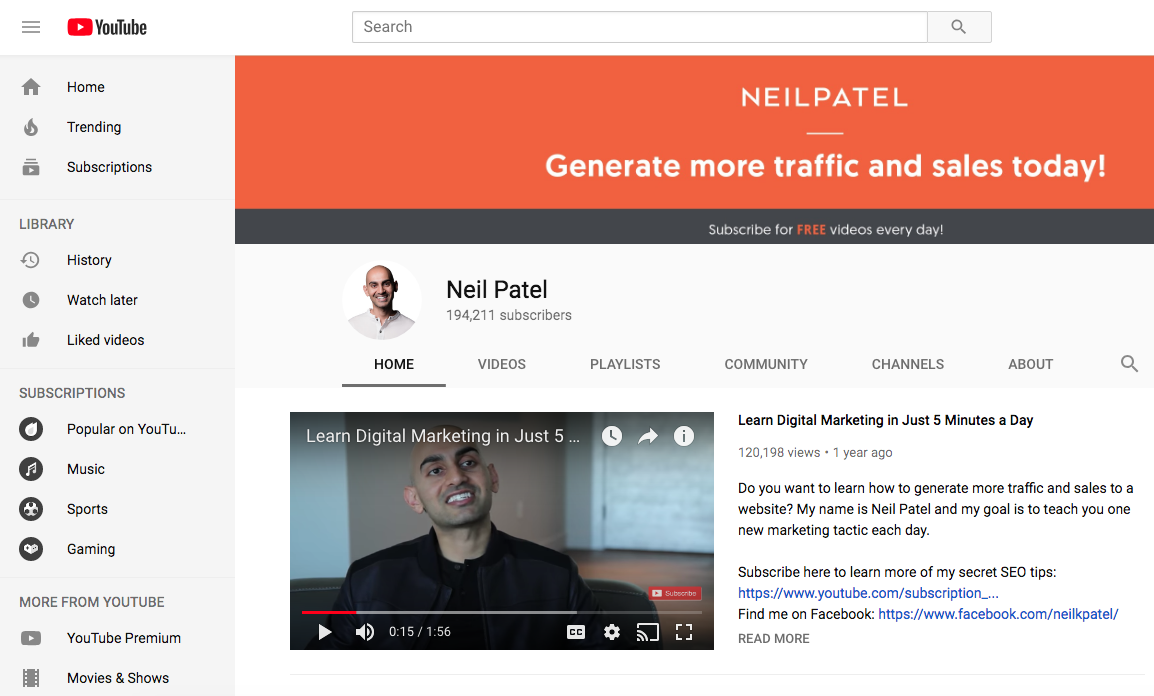
But no matter what type of business you have, what industry you’re in, or whom you’re targeting, you need to be active on YouTube. Here’s a look at my YouTube channel:
youtube

There are seemingly endless opportunities for your video content on YouTube.

For starters, your content can be found organically by users searching directly from this platform.

But once you upload a video to YouTube, you can repurpose it across the rest of your distribution channels.

Embed videos on your website. Share them in your blog content. Email them to your subscriber lists.

You can even post these videos on your social media profiles. YouTube makes it easy for you to do this directly from the platform.

For those of you who don’t have a YouTube profile, I highly suggest making this a priority for your business and video content strategy.

4. Google Analytics

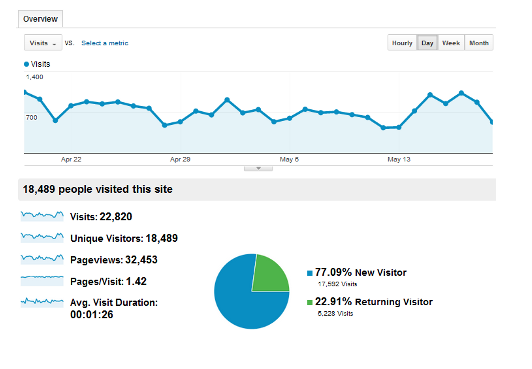
Google Analytics is the ultimate tool for understanding your website traffic.
analytics

You can learn more about your website visitors. Google Analytics will show you the demographics of anyone who navigates to your site.

This will give you a much better understanding of your target audience and whether your marketing efforts are appealing to the right group of people.

Find out the locations of these users and what language they speak.

Discover what technology they’re using. Google Analytics will show you the operating systems and web browsers they use. This tool will even tell you what percentage of your traffic is coming from mobile devices.

You’ll also learn the source of your traffic.

You’ll be able to see whether people came from a website, social media network, or search engine. You’ll also see the keywords they searched for.

Google Analytics will give you a clear understanding of your top content and help you determine whether your traffic is converting.

If you’re not taking advantage of Google Analytics, your marketing efforts aren’t being fully optimized.

5. Google Webmaster Tools

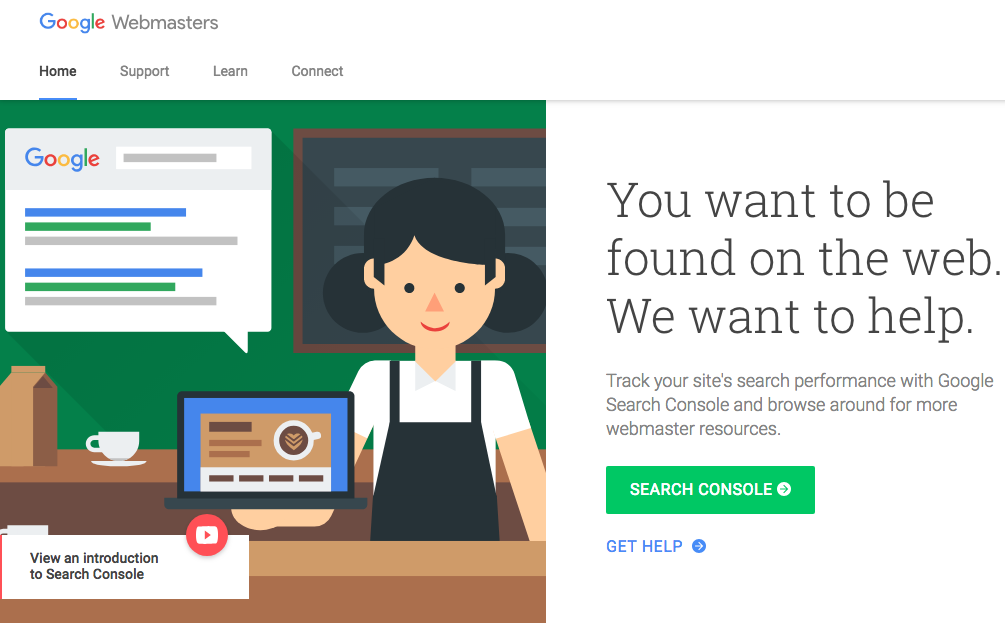
Google Webmaster Tools will help you figure out how healthy your website is for search engine discovery.
webmasters

By now, I’m assuming you know the importance of SEO and that optimizing your site accordingly will have a major impact on how you get ranked in search results.

There is always some sort of mystery behind the way Google ranks certain factors and rewards sites based on its algorithm.

But there’s no need to be left in the dark anymore. What’s a better way to find out whether your site is optimized for Google searches than with a Google tool?

With Google Webmaster Tools, you can set alerts for anything that prevents your website from being discovered in searches.

Analyze your search traffic to discover how people are finding you right now. This tool will help you fix what’s wrong with your site if you access the top issues list.

You’ll have access to testing tools and support documentation.

Google Webmaster Tools has guides and online courses that show you exactly what needs to be done to make an SEO-friendly website.

6. Google Translate

Have you ever received an email from a customer in a foreign language? You don’t need to hire a language expert or pay for expensive software to decipher what it says.

Google Translate makes it easy for you to understand them.
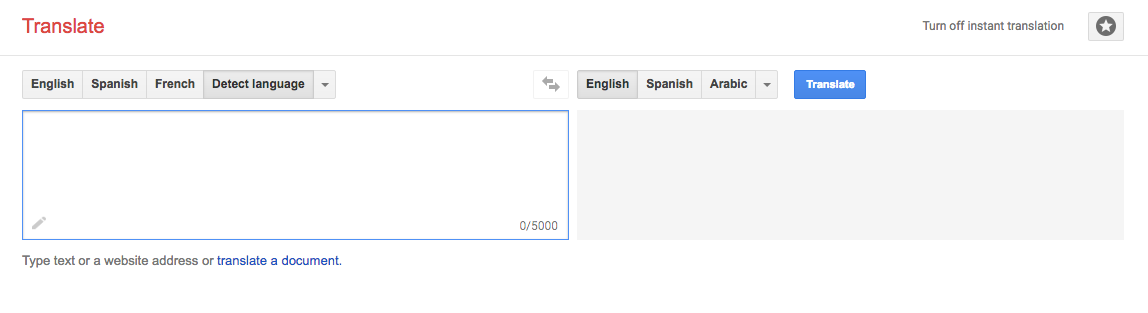
translate

This works well for any blog comments, social media messages, or even customer reviews you see in another language.

Simply copy and paste the text into this tool to get it translated to English.

You don’t even have to know what language they’re speaking to get an accurate translation. Google will automatically detect the language and take care of that for you.

This tool makes it easy for you to reply to your customers as well.

Just type what you want to say in English, and copy the translation for your reply.

Google Translate isn’t just limited to short blocks of text. It can translate long documents or a website address.

Depending on your business and target market, you may not encounter foreign messages very often. But it’s nice to have this available whenever the situation arises.

7. Google Keyword Planner

Google Keyword Planner is part of Google Ads, but it’s worth mentioning on its own.
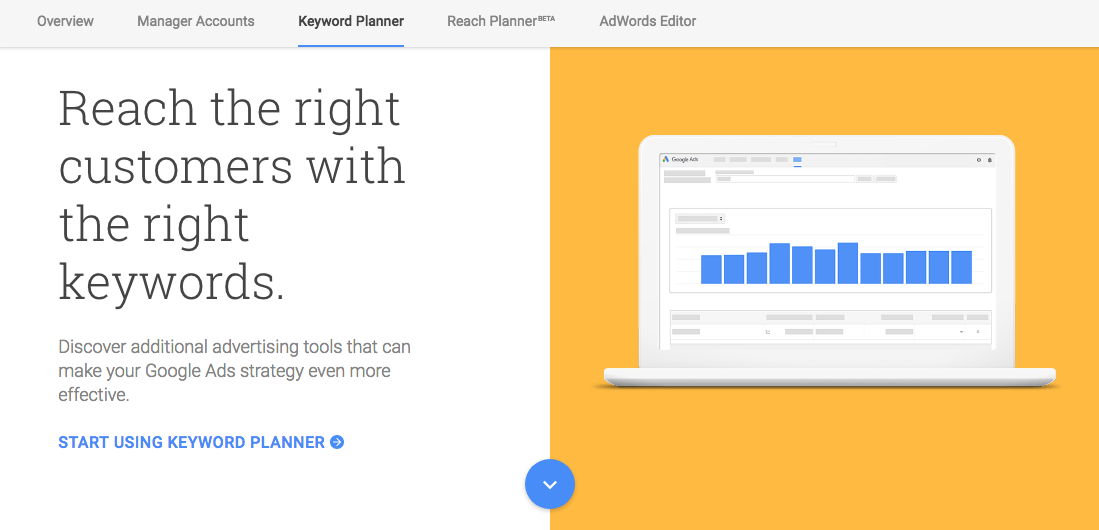
keyword planner

This tool will help you find keywords and phrases related to your business.

Discover relevant keywords and get suggestions for bid estimates based on how competitive certain keywords are.

Figure out how often specific keywords get searched for, and set a budget based on any keywords you’re bidding on.

Google Keyword Planner will help you with long-tail keywords as well.

These types of keywords won’t have as high of a search volume, but they’re much less competitive. Plus, these leads will be more qualified and therefore more likely to convert.

8. Google My Business

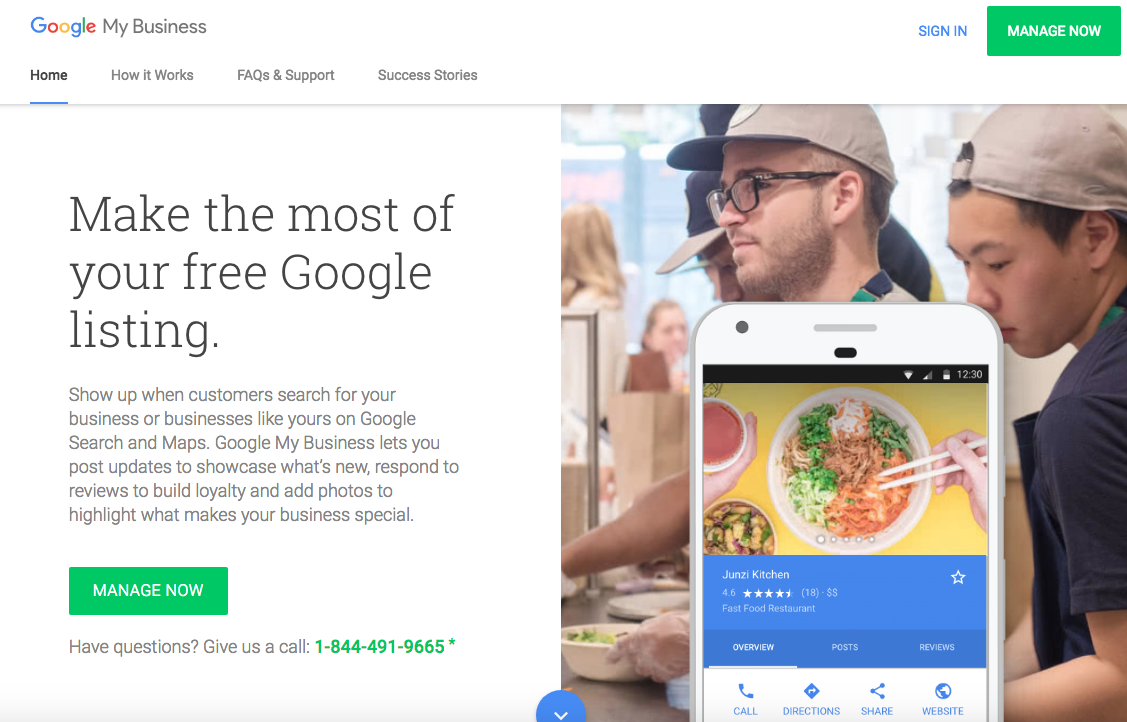
You can set up a free Google listing through Google My Business.
my business

When a customer searches for businesses on Google or Google Maps, your free listing will show up as a result.

When they click on your business, you want all the information to be as accurate as possible. All of this can be controlled with this tool.

The listing will have your phone number, website, address, and store hours.

Failure to claim your listing might result in having inaccurate information displayed about your business online. You obviously want to avoid this.

You can even promote your latest offers through this business listing as well.

Customers will be able to review your business on your Google listing. You can engage with those reviews by responding to the comments.

Thank each customer for leaving a review, and appropriately respond to anyone who may have had a negative experience.

You’ll also have access to information about how people found your business listing online: from a direct search or organic searches.

9. Google Calendar

Google Calendar is another great tool to keep you organized.

calandar

Times have changed. The days of relying on a giant calendar on your desk are over.

As business owners and marketers, we’re constantly on the go. With so many things to keep track of, it’s easy to overlook something important.

Google Calendar makes it easy for you to add events and manage your daily schedule.

Share your calendar with other Google accounts to make sure your team is on the same page with important marketing deadlines.

Set reminders and alerts to ensure you don’t forget about anything on your schedule.

10. Google Insights

For your marketing efforts to be successful, your website needs to operate and perform at a high level.

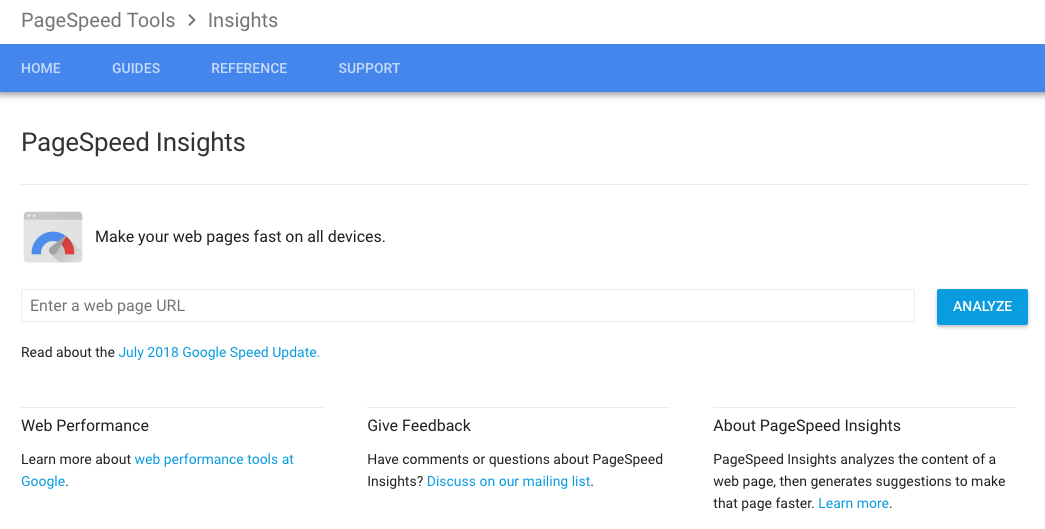
Google Insights will help you make sure that’s happening properly.
insights

This tool analyzes the content of your web pages. You’ll get information about the page loading speed.

Other tools can also help you determine your page loading speed and whether it’s optimal or needs work.

But what separates Google Insights from the other tools is the report it generates.

Google will suggest how you can make your web pages load faster.

This is crucial from a marketing perspective. You just got someone to click on a link or navigate to your site as a result of one of your campaigns. Don’t lose them because your page loads too slowly.

11. Google Content Experiments

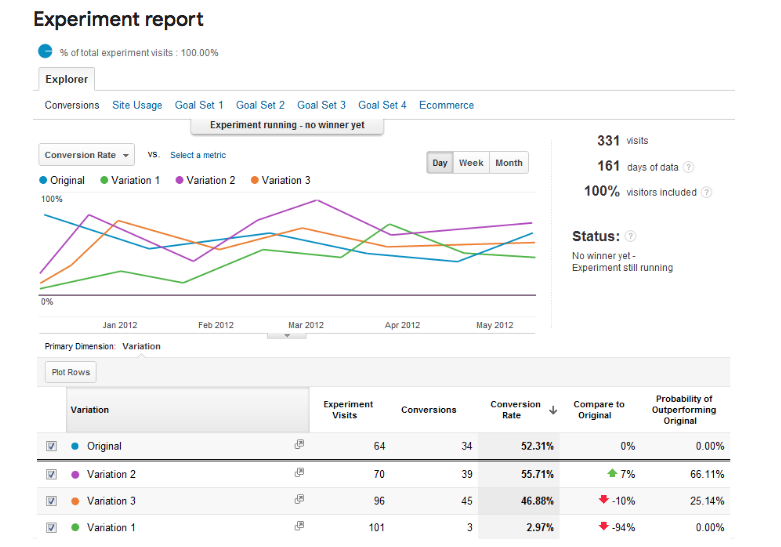
Google Content Experiments is part of Google Analytics.
experiments

As the name implies, it allows you to run experiments on different types of content.

This is a great tool for your marketing campaigns. You can run different variations of the same ad or promotion and get a report to see which one has the highest performance.

Then you can use the top ad for future campaigns and make adjustments to the ones that didn’t perform as well.

You start each experiment by selecting a goal. This helps the tool adjust the metrics accordingly based on what you want to accomplish.

The tool gives you the option to test up to ten variations of a specific landing page, so you’ll be certain that your final experiment results are as accurate as possible.

12. Google Trends

As a marketer, you need to keep your finger on the pulse. You’ve got to stay informed about what’s happening in the world around you.

Watch local and global news. Stay up to date on pop culture.

If you know what’s happening, you can come up with appropriate marketing strategies based on these trends.

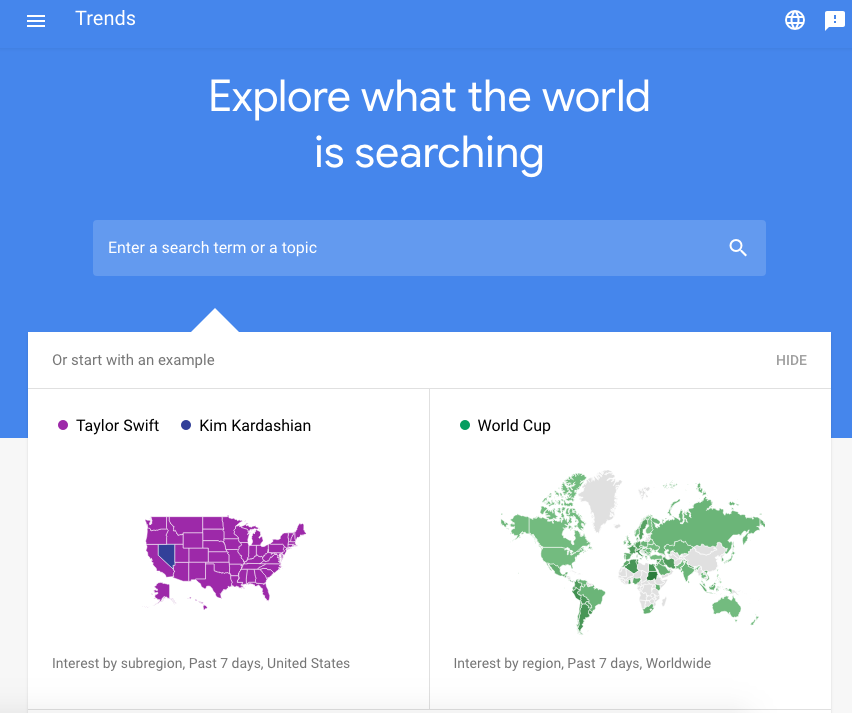
But it can be difficult to do this when you’re busy at work every day. Google Trends will make this process much easier for you.
trends

See the hottest searched topics locally, regionally, nationally, and internationally.

Search for a specific topic, such as your industry, to see how popular it is over a certain time period.

If you know what people are searching for, it will be easier for your brand to stay relevant. You can use pop culture trends or global news to create a targeted ad or promotion on social media that will gain lots of attention.

13. Google AdSense

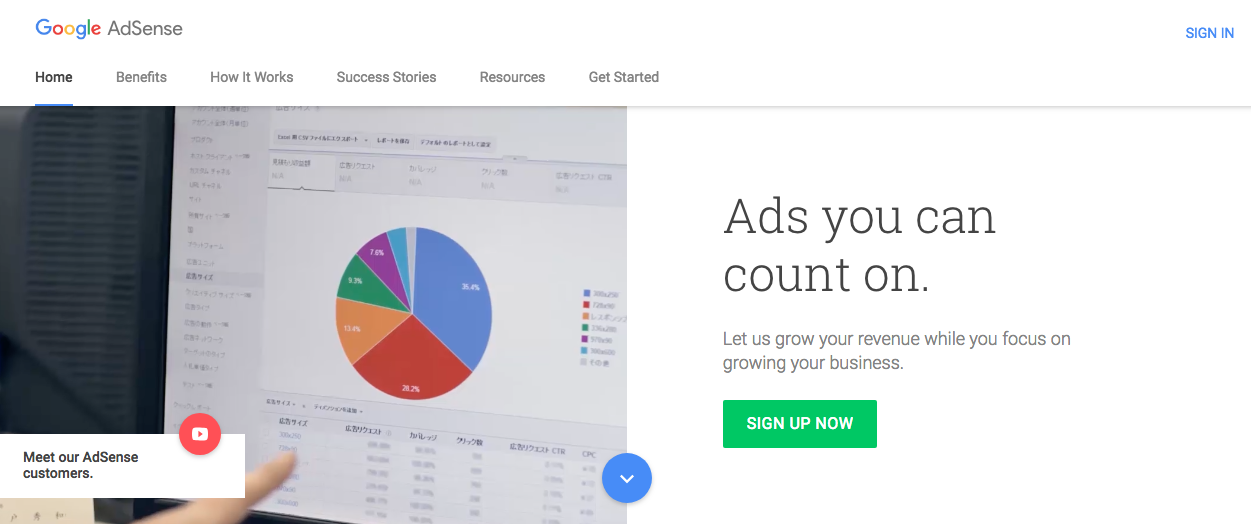
Google AdSense is free to use. In fact, you’ll get paid to participate.
adsense

Unlike the other advertising tools on this list, Google AdSense lets you run ads from other businesses on your own website.

Google makes sure that the ads meet a certain quality standard and that they’re relevant to your audience.

If you don’t like an ad displayed on your site, it’s no problem. Simply block any ads you don’t want to appear, and customize the type and location on your site that works best for your needs.

To get the most money for your ad space, Google AdSense will ensure that only the highest bids go live on your site so you can make as much money as possible.

It’s a nice way to make some extra cash while you focus on your other marketing strategies.

14. Google Blogger

You can use Google Blogger to build your personal or business blog.

blogger

If you’ve been reading my content for a while now, you know how much emphasis I put on the benefits of blogging.

Those of you who are not taking advantage of this effective marketing tactic need to start right away.

Google Blogger gives you a free domain to host your blog. While the majority of you will want your blog to be directly on your website, this is an option for newer businesses or for those trying to establish a personal brand that’s separate from your existing company.

You can use this new domain to promote your company website.

It’s easy to integrate your new blog with Google AdSense, which I just talked about.

Like I said, for the most part, you’ll want to have a blog on your company website. But Google Blogger shouldn’t be dismissed. It’s worth a spot on this list.

15. Google Voice

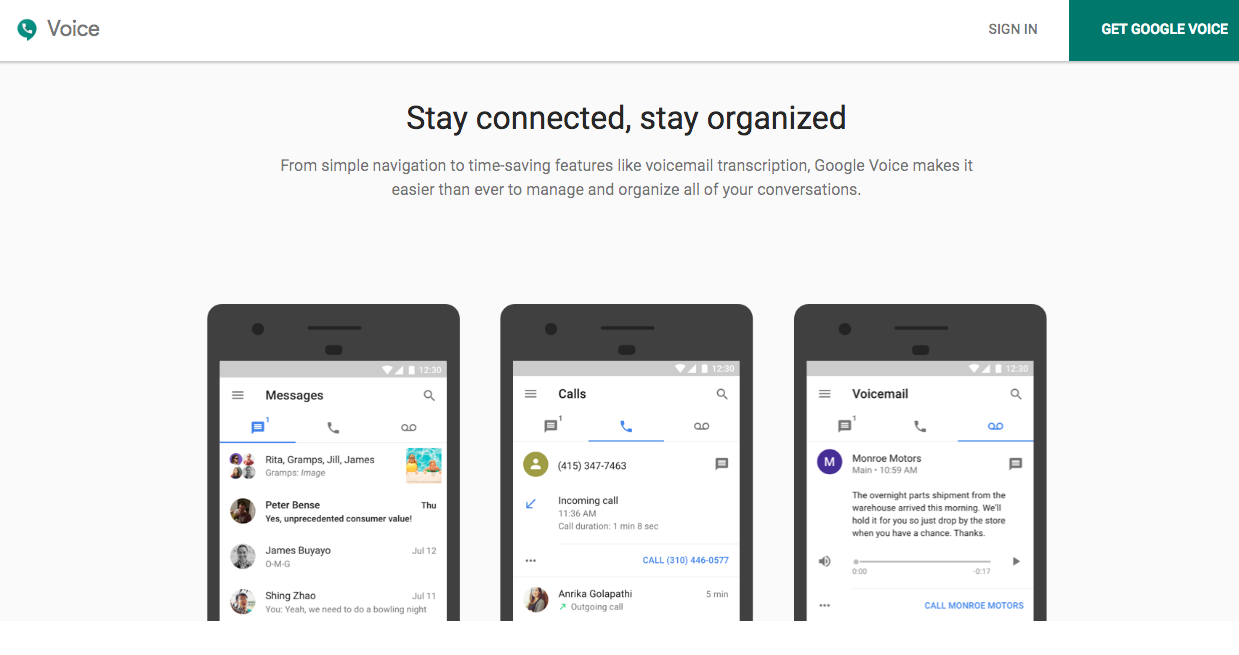
Google Voice gives you the option to stay in touch with your customers from any screen.
google voice

You can send and receive calls or texts from your phone, desktop, or tablet.

Unlike a cell phone number or landline for your business, Google Voice is free.

Google Voice also allows you to select a virtual number from nearly any area code, which is great if you’re targeting clients from a specific location.

Your leads will be more likely to trust a local number than just some random out of area caller.

The virtual number can be connected to any mobile device or landline. It’s easy to handle incoming calls from different locations. Anyone with access can answer the phone.

If you have team members in different areas, they all have the option to respond to an incoming call.

Ultimately, Google Voice is great for enhancing your customer service and communication. If you’re not satisfied with your current phone situation, it’s worth looking into this tool.

Conclusion

Google is more than just the global search engine king.

It has a wide range of free tools available to business owners who want to make improvements to their marketing efforts.

Not all of these tools are for everyone. Some of you may not need all 15 of these.

But regardless of your situation, I recommend referring to this list and checking out tools that fit your needs.

There is no risk in trying them out. After all, they’re free to use.

Which free Google tools is your company using to improve its marketing efforts?


from Quick Sprout https://ift.tt/2DmV2c8

Monday, November 12, 2018

How Topic Clusters Are Revolutionizing the Future of Marketing

To survive in today’s competitive digital landscape, businesses need to focus on their content strategies now more than ever.

You need to understand how your target audience consumes content and figure out what they’re looking for. It’s not effective to produce random content at a high rate if it’s not valuable.

Everything you publish across all your distribution channels needs to benefit your audience, or it won’t be successful.

In addition to producing high quality content, you also want to make sure it’s SEO-friendly.

The key factor of your content production needs to be relevancy: 78% of consumers say relevant content increases their intent to buy.

Your content must be relevant to your brand and relevant to your audience while still appealing to Google.

Blindly producing content without a strategy won’t help you. You need to keep up with the latest trends and see how other brands approach content marketing and SEO.

Today, and in the future, marketers must have a content strategy compatible with the way people discover new content. Creating content that doesn’t drive results is expensive and inefficient.

That’s why you need to get familiar with topic clusters.

Surprisingly, many business owners and marketers I’ve spoken to recently don’t know anything about this. That was my inspiration for writing this guide.

This is the perfect opportunity for you to gain a competitive advantage.

You can learn how to implement topic clusters today and use this tactic moving forward before your competitors have a chance to catch on.

As a result, you’ll be able to produce high quality engaging content. This will help you improve your SEO strategy, drive more traffic to your site, and increase conversion rates.

I’ll explain everything you need to know about topic clusters and how they are revolutionizing the marketing industry.

What are topic clusters?

Before we proceed, let’s start with the basics.

You may have heard that topic clusters are the future of content marketing and SEO strategies, but that doesn’t explain what they are.

Truthfully, this isn’t a very complex topic. If you guessed what a topic cluster is just based on its name, you probably wouldn’t be far off.

The idea here is you want to create a deeper penetration of certain subjects relevant to your brand, audience, and search engines.

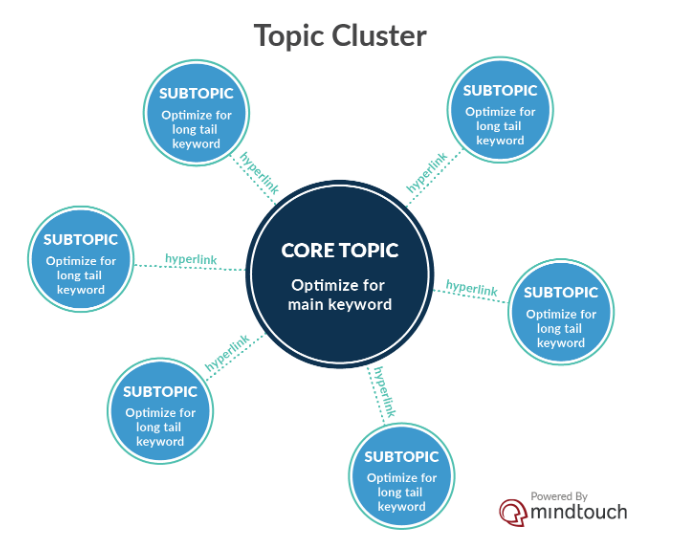
Start with one basic topic, then branch off to similar ones. You’ll create content about all of them, with the main area of focus as the nucleus.

Here’s a visual representation of a topic cluster template:

template

Clusters can be broken down into two segments.

The image above refers to them as core topics and subtopics. However, they are also commonly referred to as pillar content and cluster content.

Your pillar topics will be broad. The clusters will be more descriptive.

For example, let’s say your company sells workout supplements. You can create a topic cluster using “workout routines” as the pillar.

Clusters related to this pillar would be:

  • home workout routines
  • workout routines to build muscle
  • workout routines to lose weight
  • outdoor workout routines
  • bodyweight workout routines
  • workout routines with weights

Each cluster takes a keyword and transforms it into a long-tail keyword.

When you publish such content on your website, you’ll be able to generate lots of internal links, ultimately improving your SEO ranking.

The pillar will link to each cluster, and each cluster will link back to the pillar with internal hyperlinks.

Here’s another example of a topic cluster using “GDPR Compliance” as the pillar:

GDPR

As you can see, each cluster includes the pillar.

All of these subtopics are more specific segments of the broad subject. That’s how your audience will search for topics online. These topic clusters will increase your site visibility in search engine results.

Optimize your website architecture

The application of your topic clusters will be related to your site architecture.

You need to make sure this structure is optimized for SEO purposes. Whether you realize it or not, how you design your architecture can determine whether your site is SEO-friendly or not.

You need to think about the user experience.

Make it as easy as possible for website visitors to navigate your site and find what they’re looking for in as few steps as possible.

If your site is structured properly, you won’t have as many bounce rates, and your dwell time will be improved as well. As a result, your search ranking will increase.

Let me show you what I mean.

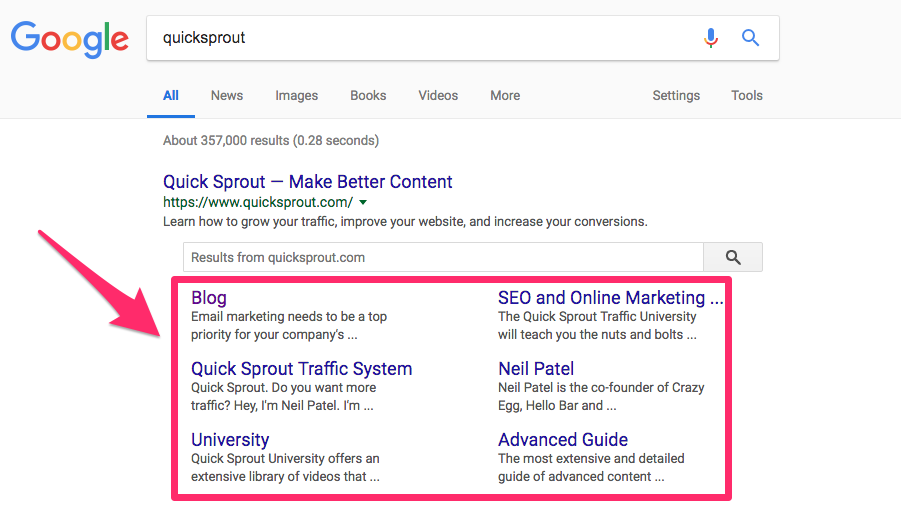
If you Google Quick Sprout, here is how it appears in the search results:

quicksprout

Check out the section I highlighted above. These are called sitelinks.

Sitelinks are subpages of a website that appear in Google SERPs. This will help a user navigate to a more relevant portion of a site, directly from the search engine.

These sitelinks create fewer steps in the conversion funnel. Users can click one of these hyperlinks instead of having to navigate to your homepage first.

Sitelinks are great for SEO purposes. However, you can’t contact Google and choose which site links get displayed unless you’re running paid campaigns with Google AdWords.

For organic search results, Google’s algorithm decides what to display. Your site structure will have a major impact on this.

You need to establish a logical hierarchy of pages and links on your site. Topic clusters will drastically improve these efforts.

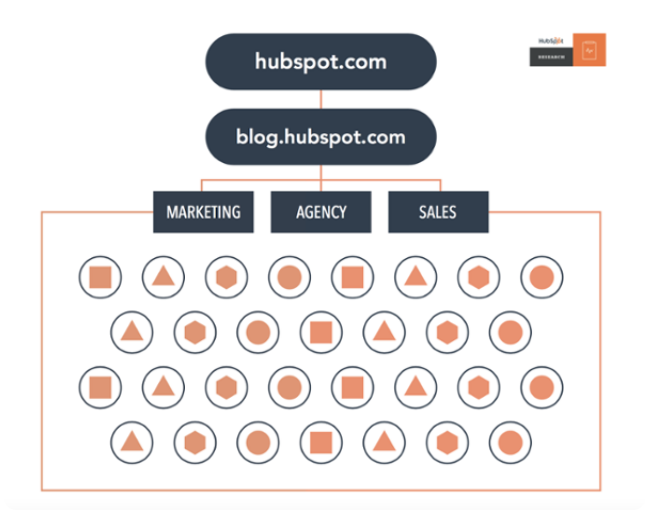
Let’s look at an example. Here’s a basic outline of the HubSpot’s website:

hubspot 1

From its homepage, you can navigate to its blog.

Once you reach the blog, you can navigate to three different topics:

  • marketing
  • sales
  • agency

All the blog posts fall into those three categories. It’s a typical architecture with a hierarchy that makes sense, but it can be improved with topic clusters.

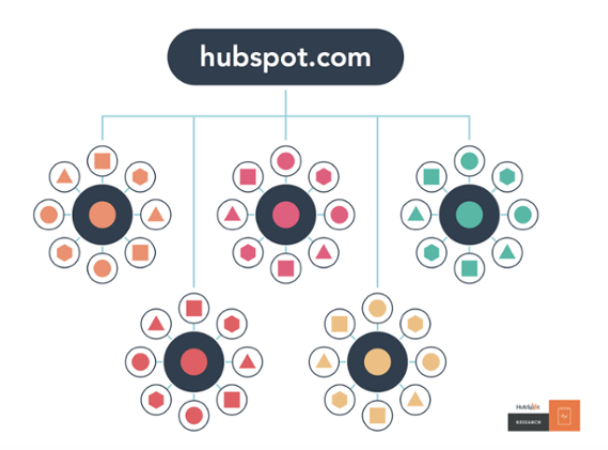
Now, let’s take a look at what this looks like with topic clusters:

hubpsot 2

This format follows the same template you saw earlier.

Each cluster has a pillar and related cluster content.

Now, when people search for long-tail keywords related to these subjects, the site’s content will be more likely seen as sitelinks in the SERPs.

Some of you may already have content published for your topic cluster strategy, but it’s not organized properly in terms of your site architecture.

You need to make the proper adjustments so that the flow follows the format of the second HubSpot image above as opposed to the first one.

Choosing the right topics

Now that you understand the basics, it’s time for you to start building topic clusters.

But before you can start producing content, you need to choose the right pillars that will drive results.

Where do you start?

Everything should begin with your target audience. Look at your current and prospective customers, and ask yourself questions such as:

  • What are these people looking for?
  • What problems do they have?
  • How does your business help solve those problems?

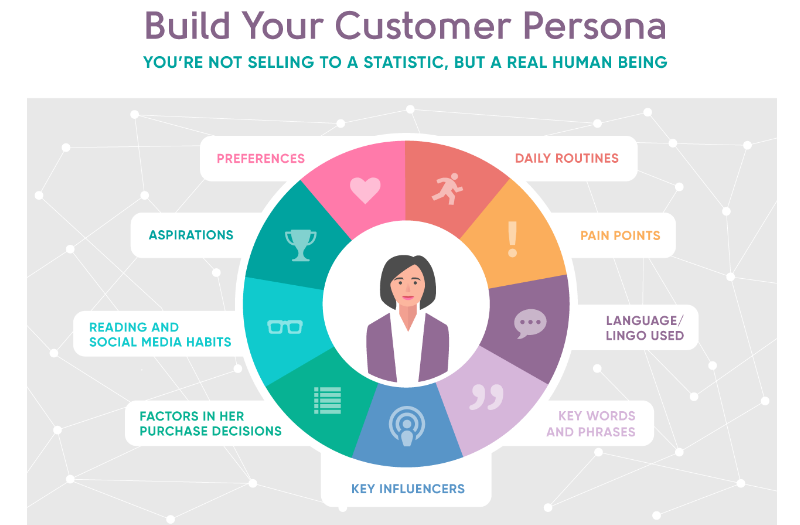
If you don’t already know the answers to these questions, it’s very helpful to start outlining a customer persona to give you a better understanding of your target audience.

customer persona

If you need further assistance with this part of the process, I have a complete guide on how to develop a customer persona that improves conversion rates.

Another way to come up with topics is to analyze your existing content.

What have you already published that has the most engagement? Your site visitors are clearly interested in it the most.

To determine your top-performing content, look at metrics such as traffic, page views, etc. and see what has been shared the most by your audience.

You can also look at which pages on your site have the highest search ranking. Topic clusters can help improve those rankings even more.

I recommend making a list of at least five main topics to start with. Those pillars will be enough for you to produce tons of content once you branch off into clusters for each one.

Conduct keyword research

Now that you have your pillars established, it’s time for you to come up with clusters.

The best way for you to approach this is by conducting keyword research.

Don’t just guess what long-tail keywords are related to your pillars. Find out exactly what people are searching for.

Many different tools and resources can help you with this task.

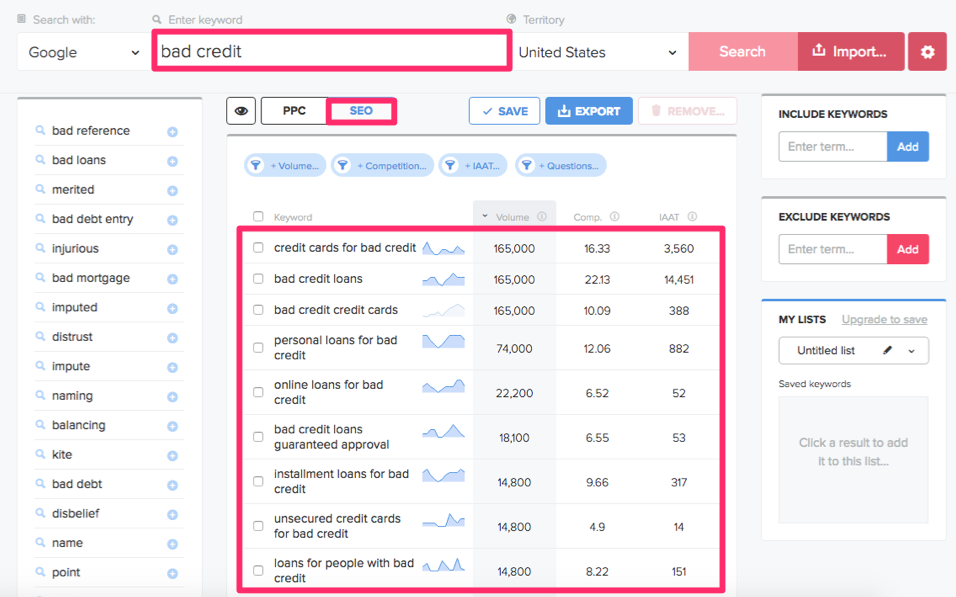
Here’s an example of how you can conduct basic keyword research with Wordtracker, which is free to use:

bad credit

Let’s say your business is in the financial industry. You reviewed your website and saw that content relating to bad credit had the highest performance metrics.

You plan to use “bad credit” as a pillar.

Once you enter that term into this tool, filter the search for SEO purposes and look at the results.

Everything on this list would be viable to use for your topic clusters:

  • credit cards for bad credit
  • bad credit loans
  • personal loans for bad credit
  • installment loans for bad credit
  • unsecured credit cards for bad credit

Don’t be afraid to create longer titles for your clusters.

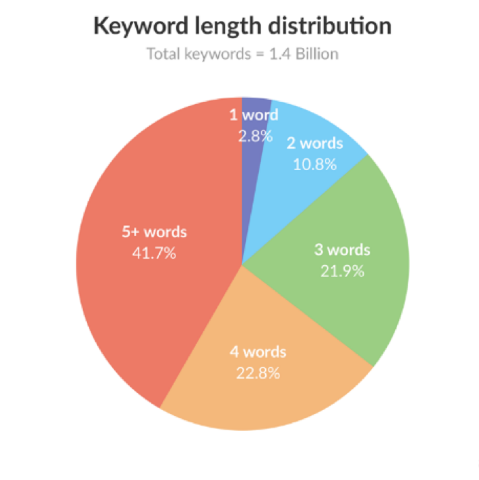
Just look at the average keyword length distribution based on a study of over 1.4 billion keywords:

keyword length

Over 64% of searches contain at least four keywords.

Producing topic clusters related to these keywords will not only improve your SEO ranking but also help ensure your traffic comes from qualified leads.

Create content based on these themes

Your keyword research is complete. Your pillars and subtopics have been defined for the clusters.

Now it’s time to create the supporting content.

You have many different options to choose from. I recommend using a diverse approach to creating highly relevant content.

Create landing pages that would be available in the learning center or resources section of your site. Something like this could be used as a hub for pillar content. You’ll use that to link to supporting clusters.

Write blog posts. Produce videos. Build infographics.

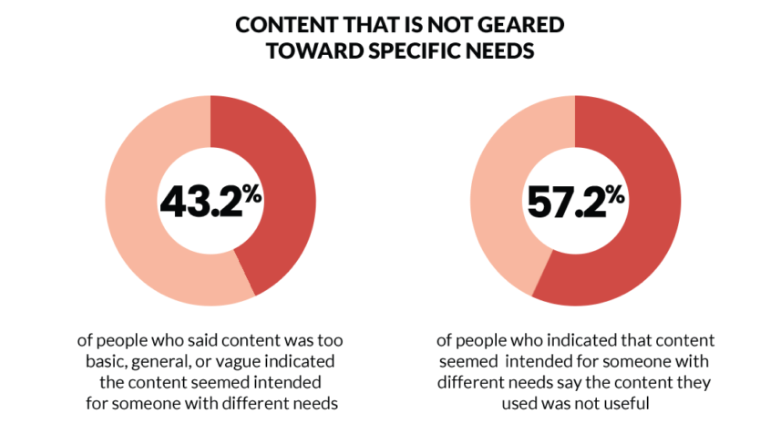
All of these will help you create more relevant content geared toward the specific needs of your target audience.

relevant content

If you can’t do this effectively, your audience won’t find your content useful.

This will defeat the whole purpose of your strategy. That’s why I’ve emphasized the importance of high quality content throughout this post.

Build your pillar pages

Once all your content has been produced, it’s time to publish everything.

Start by building your pillar pages. This will be the main spot where you’ll link to the supporting clusters.

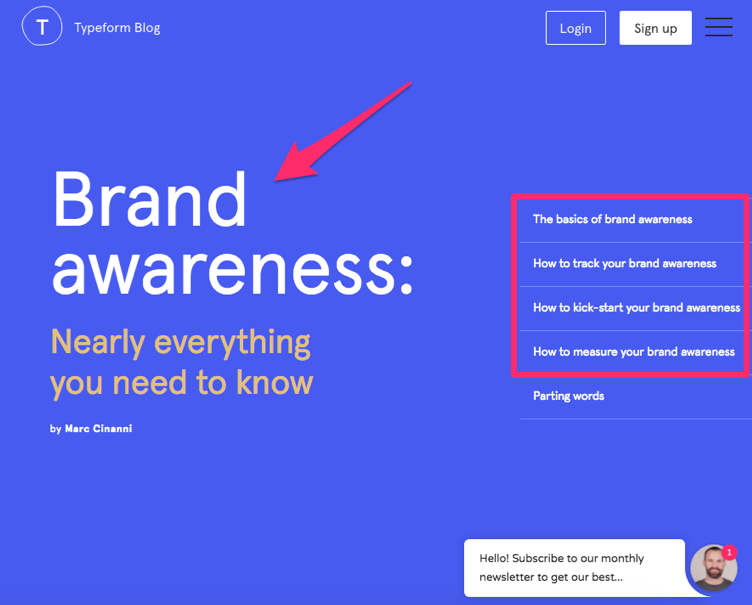
Take a look at this example from Typeform:

typeform

This landing page follows everything I talked about so far in terms of linking, keywords, site structure, and relevant content.

Brand awareness is the pillar.

Each topic cluster on the right side of the screen links to a more specific subtopic of brand awareness.

The landing page is very simple, which is perfect.

In fact, websites with simple designs have higher conversion rates.

Don’t feel you need to design a complex pillar page. A simple approach will be very effective.

Distribute your content

As you now know, your topic clusters will help SEO.

However, that doesn’t mean you should be publishing content without doing anything else with it.

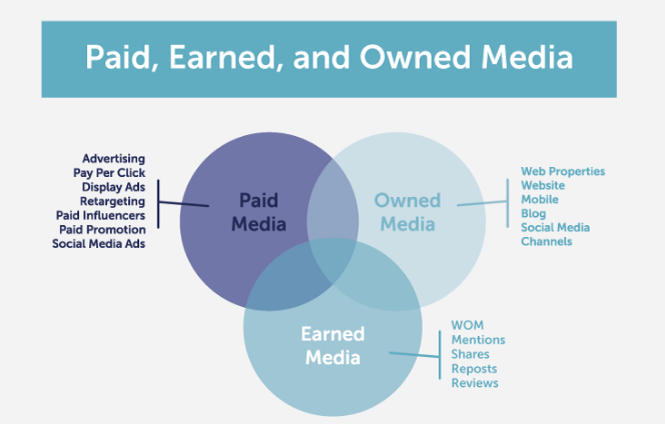
You need to focus on your distribution strategy. You can approach it in several different ways:

types of media

You should be taking advantage of all three different types of media.

This will help you distribute your content effectively across multiple channels.

Conclusion

Digital marketing is constantly evolving. Your business needs to keep up with these changes if you want to be successful.

Looking toward the future, it’s important for you to start improving your SEO strategy today.

One of the best ways to do this is with topic clusters.

First, you need to find the most popular topics relevant to what your audience is searching for. Then, you need to conduct keyword research to determine your cluster subtopics.

After you produce and publish your content, you need to make sure your site architecture is formatted for SEO purposes and sitelinks.

Once this process is complete, distribute all your content across as many different channels as possible.

Topic clusters aren’t re-inventing content marketing, but they are revolutionizing the way marketers create new content.

What types of topic clusters is your business using to improve your content strategy?


from Quick Sprout https://ift.tt/2PVZsNu

Friday, November 9, 2018

11 Metrics Every Marketing Manager Needs to Track

How successful are your marketing campaigns?

Believe it or not, this seemingly simple question puzzles many marketers and business owners I work with.

You’re running ads, and customers are buying what you’re selling, so your marketing efforts must be working, right? Not necessarily.

Don’t get me wrong. I’m not saying this means your strategies have failed. In fact, some of your campaigns may be working great. But you can’t make any assumptions.

The only way to know for sure whether your campaigns are working is to measure the results.

By tracking certain metrics, you’ll also be able to save some money. You don’t want to dump money into campaigns that aren’t working.

Here’s the problem. Sometimes it’s difficult to directly tie one promotion to a sale.

That’s why you need to track several metrics and infer based on the results.

This statement holds true for all marketers, regardless of your industry or the size of your business. It doesn’t matter if you’re running expensive campaigns or using tactics to market your company on a budget. You need to track the results.

As I’m sure you know, there are dozens of business metrics you could be tracking. But not all of these will benefit your marketing strategy.

That was my inspiration for this guide. I narrowed down the top 11 metrics every marketing manager needs to track to be successful.

Use this guide as a reference to measure the success of your marketing campaigns moving forward. Based on the results, you’ll be able to tell what’s working and which strategies need improvement.

1. Average order value

The average order value, or AOV, is one of the first things you need to prioritize as a marketing manager.

This metric will help you figure out how to get your existing customers to spend more money each time they shop. It’s arguably the most important number to track when trying to understand consumer spending habits.

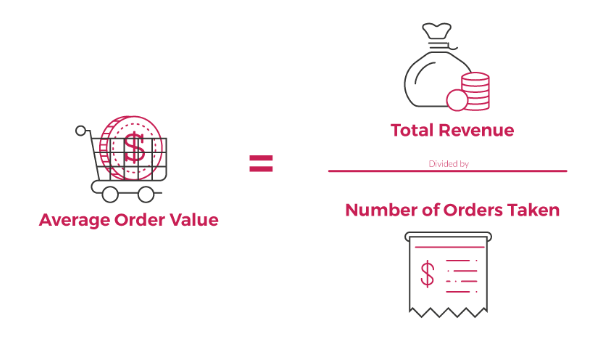
The average order value formula is quite simple:

AOV 1

Just divide your total revenue by the total number of transactions.

You don’t need to look at it every day or after each campaign. AOV is a metric that you need to keep an eye on over time.

If it rises at certain times, you could potentially connect it to campaigns run during that time.

But if it falls, you’re obviously doing something you want to avoid. These issues need to be addressed.

In my consulting work, I see many businesses using only their number of transactions to gauge success. Is it great to make 100 sales in a day? It depends.

I’d rather make 50 sales for $2,500 than 100 sales for $1,000. Or even better, 100 sales for $6,000.

Do you see the difference? That’s where average order value comes into play.

You want to try to get as much money as possible from your existing customers. To do this, you’ll want to encourage them to add more items to their carts or buy other products of higher values.

Both of these will increase your AOV.

2. Customer lifetime value

The concept behind customer lifetime value is simple.

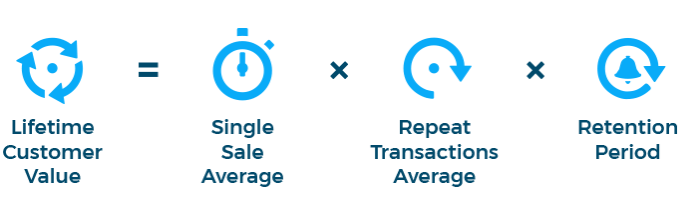
This metric will tell you the amount of money a customer will spend before leaving your business. Here is the formula to calculate it:

CLV

Customers who stay with your business for a long time become more profitable.

As a marketer, you need to make sure the lifetime value of your customers is as high as possible.

The best way to do this is by focusing on customer retention as opposed to customer acquisition, which I’ll talk about in greater detail shortly.

Yes, you want new customers. But it’s easier to market to people already familiar with your brand, products, and services.

Research shows that your existing customers will spend 67% more than new customers. This will also increase your average order value, which I just talked about.

Keep in mind customer lifetime value when thinking about your acquisition strategies as well. All too often I see businesses make the mistake of shying away from certain strategies because they don’t seem profitable.

But that’s only because they’re using the AOV to make this decision. If the AOV is less than the acquisition cost, they won’t use that acquisition strategy.

However, they’re not accounting for how much that customer will spend over time. That’s why this metric is so important to track.

Plus, you can also learn how to use lifetime value to create a Facebook audience that actually converts.

3. Sales conversions

This connects to a point I made earlier.

How can you tell if the number of sales you have each day, week, or month is sufficient?

To a certain extent, the number of transactions isn’t that important. What’s much more telling when measuring the success of your marketing efforts is your sales conversion rates.

To calculate this, divide the number of sales by the number of visitors to your website.

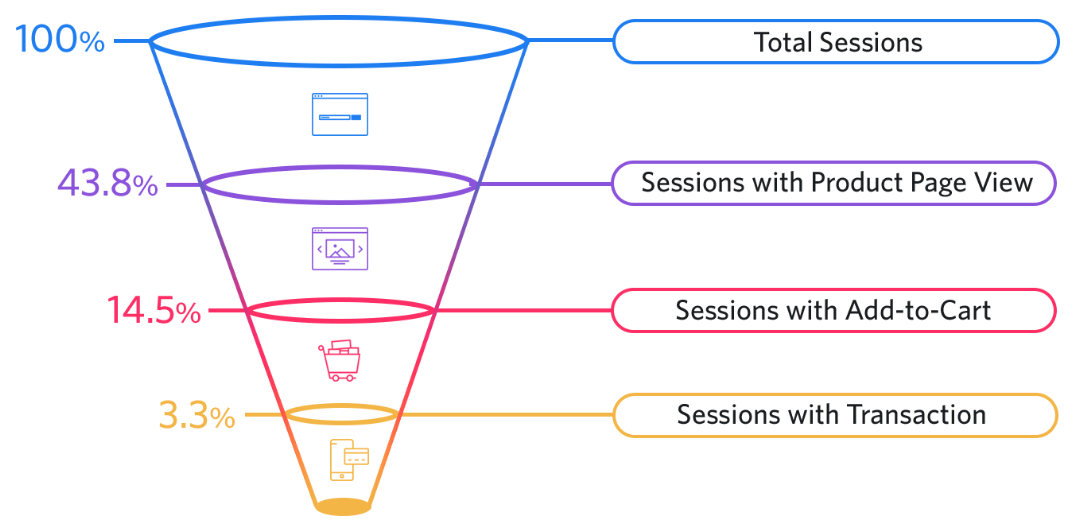
Here’s a look at the average sales conversion rates for ecommerce shops.

sales conversions

Based on this information, 3.3% is adequate. But who wants to be average?

By regularly tracking your sales conversion rate, you’ll be able to determine how much of your traffic is actually converting.

Having low conversions does not mean your marketing efforts are at fault. If people are navigating to your site at a high rate, something else could be preventing them from converting.

That’s when you need to analyze your web design. Websites with simple designs have higher conversion rates.

You’ll never get a 100% sales conversion rate. But you should always try to increase this number.

These people are already on your website. Sometimes they are just a click or two away from buying. It’s your job to make sure that happens.

4. Cart abandonment rates

Calculating cart abandonment rate is simple.

Divide the number of transactions by the number of carts created. You want this metric to be as low as possible.

As I just pointed out, when someone adds something to a shopping cart, they are only a step or two away from converting. You need to identify what stopped them from finalizing the purchase.

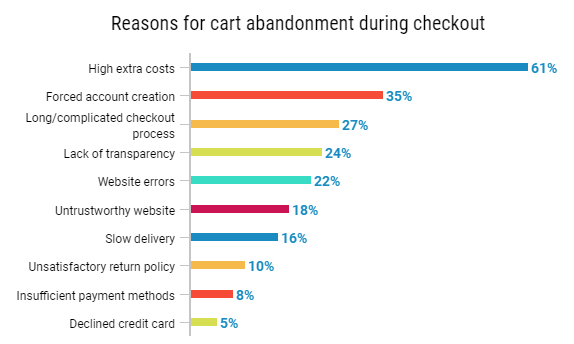
These are the top reasons for shopping cart abandonment during the checkout process:

cart abandonment

Similar to sales conversions, your cart abandonment rate may not be a marketing issue.

There could be a problem with your site. But you don’t want to let your marketing efforts go to waste.

Change your promotions if you have to.

As you can see, high extra costs ranked first on the list of reasons for cart abandonment. Don’t charge your customers for shipping, and highlight that in your marketing campaigns.

You’re doing a great job of getting people to visit your site and add items to their carts. Now you just need them to convert.

5. Revenue by reference source

So, you’ve got lots of website traffic. But where is it coming from?

By tracking the revenue by referral source, you’ll be able to determine which channels are the most profitable for your business.

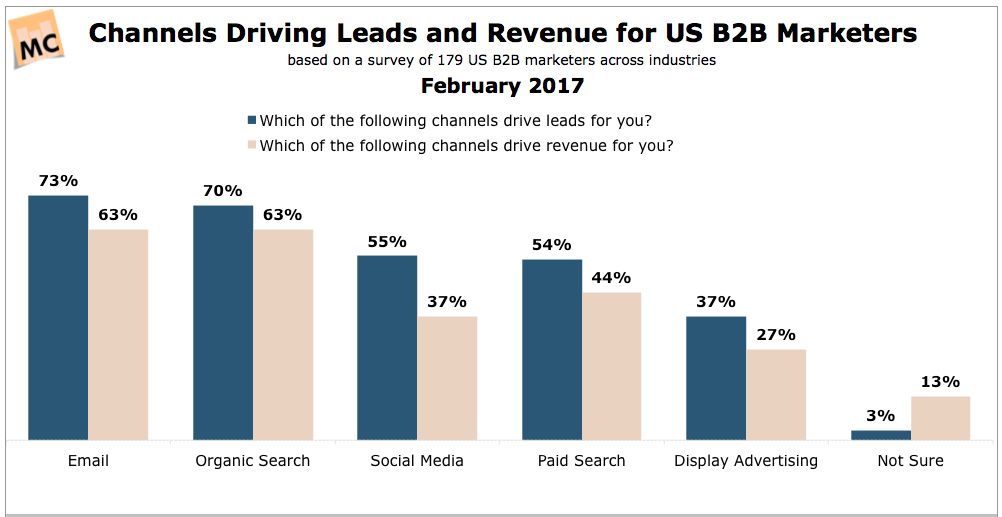
This is important for both B2C and B2B companies. Here’s a look at the top channels for leads and revenue on the B2B side:

revenue by source

You might be getting tons of traffic from one source, but if you’re not making money from those leads, you need to reevaluate your strategy.

On the flip side, maybe traffic from a certain source is not high, but the revenue from that channel is the highest.

You need to figure out how to get more traffic from your marketing channels yielding the highest revenue. At the same time, you must learn how to increase conversions and the AOV from your distribution channels resulting in the most traffic to your site.

6. Social media engagement

I’m sure social media is a huge part of your company’s marketing strategy, as it should be.

You’re posting content on all your social channels each day. That’s great. But how effective are those posts?

Again, the only way to find out is to measure the results.

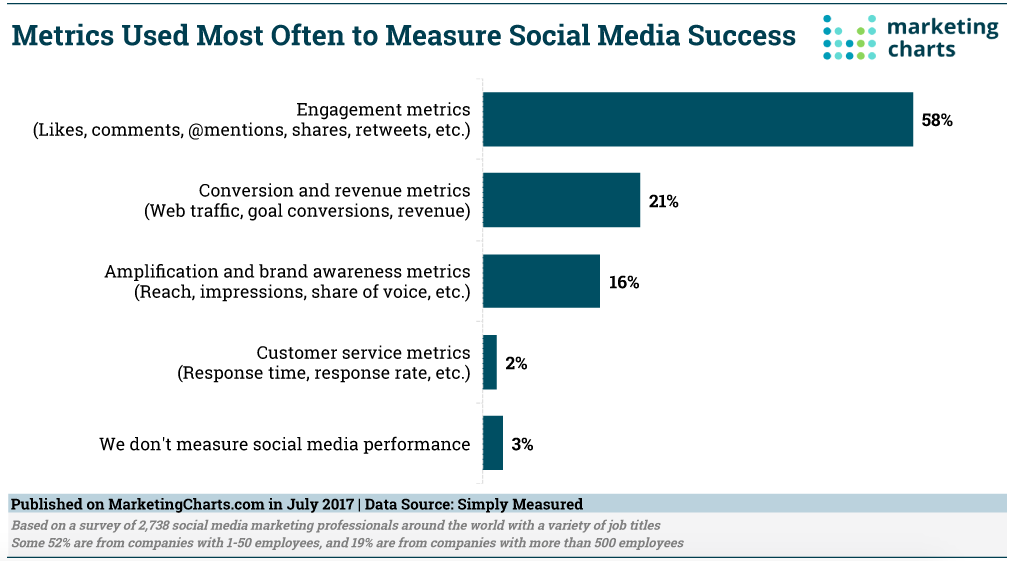
These are the top metrics used to measure success on social media:

engagements

The information you get from tracking these metrics will be extremely beneficial to your marketing strategy.

You need to analyze the difference between your top performing content and the posts with lower engagement. Figure out why certain posts do better than others.

For example, you may find out your videos get more comments and shares than your photos.

Obviously, you’d want to run more video campaigns on social media once you know that.

7. Email open rates

Your email open rates should be easy to track. I doubt you’ll have to do any manual calculations for this metric.

Whichever software you’re using for email marketing should automatically do this for you.

That said, don’t just look at these numbers. Analyze them.

Are your open rates fluctuating? Do they stay consistent?

Find out what you need to do for your open rates to improve.

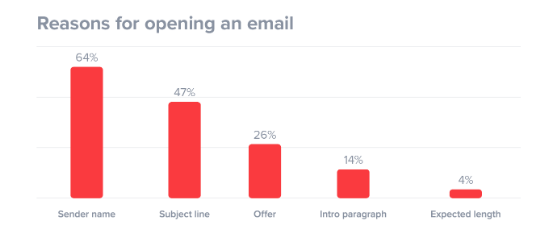
These are the top reasons why people open emails:

open rates

If your open rates are low, I recommend reading my guide on how to increase open rates with your subject lines.

You spend much time building your email list and segmenting your subscribers accordingly.

Then, you send various email campaigns to each group of subscribers. Don’t let those efforts go to waste.

Your message is useless if nobody reads it. That’s why you need to track your open rates for every campaign and compare those percentages over time.

8. CTA click-through rates

Customers can’t spend money unless they click on your CTA.

It’s necessary to track the click-through rates of all these buttons.

It doesn’t matter what landing page the button leads to or what channel it’s on, you have to track it. Your ads, emails, website, and social media campaigns will all have CTAs.

Compare these rates to each other. Which buttons have the highest CTR?

Based on these metrics, you can hypothesize which wording or types of offers people are more likely to click on.

Then, you can run A/B campaigns to check your theory: test CTAs’ wording, color, size, placement, etc. This strategy will give you the most optimal results for your CTA buttons.

9. Customer acquisition cost

Earlier, I briefly talked about customer acquisition when discussing customer lifetime value.

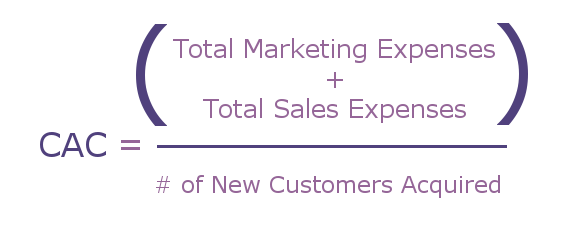
You need to know your acquisition cost, or you might run the risk of going broke. Here’s the simple formula for you to follow:

CAC

If your acquisition costs are too high, you’ll need to change your marketing strategy or potentially even raise your prices.

But a price increase could have its potential pitfalls as well.

Customer acquisition cost is crucial for all businesses, but it’s especially important for startup companies.

Those of you with a newer company know what it’s like to have to manage a tight budget. Simply put, if your acquisition costs get too high, you’ll run out of money before you have enough customers to give you a sustainable income.

That’s why investors always want to know your acquisition costs before they’ll consider giving you a dime.

Lower acquisition costs will result in a higher ROI for your marketing efforts and make it easier for your brand to grow exponentially over time.

10. Keywords that drive traffic

Marketing managers need to prioritize SEO.

You can’t just rely on traffic coming from your distribution channels and people navigating directly to your website. Your company needs to be visible and have a high ranking through organic search results as well.

That’s why you need to track metrics for keywords related to your brand. Then you’ll be able to use SEO tactics to drive ecommerce sales.

Find out which keywords are performing the best and which keywords are the most competitive. Once you start using these words and phrases, you’ll need to track the success of them as well.

This information will be useful for your on-page optimization efforts as well as your PPC campaigns.

You don’t want to pay for keywords that aren’t driving traffic and sales.

11. ROI of influencer campaigns

Influencer marketing is growing in popularity. If you haven’t tried this strategy yet, I highly recommend it.

But you need to approach this tactic like every other marketing campaign. If it’s not profitable, you need to abandon it.

Don’t just blindly throw money at influencers without knowing whether those efforts are working. Track the ROI of each campaign.

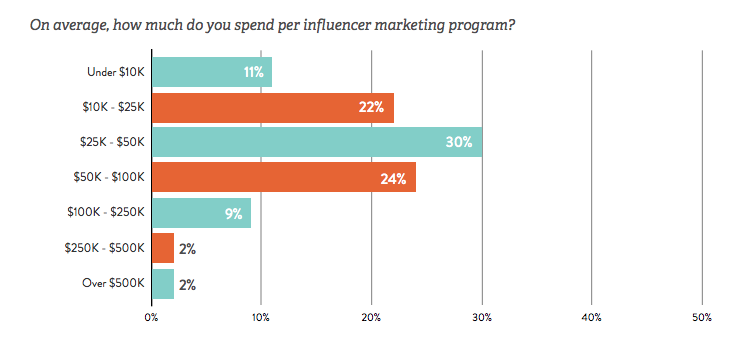
Take a look at how much businesses are spending on their influencer marketing programs:

influencer

Furthermore, 39% of marketers said they planned to increase their influencer marketing budget in 2018.

And 90% of these marketers say they use engagement metrics to determine the success of their influencer campaigns. I talked about the importance of tracking engagement earlier.

Basically, you need to find out whether the money spent on influencers is generating a return on your investment.

One of the best ways to do this is by giving each influencer a unique promo code. It will make it easier for you to track which influencers are driving the most sales.

You need to cut ties with influencers who aren’t profitable and continue working with the ones driving traffic and revenue to your site. But the only way to determine this is by tracking the ROI of each campaign.

Conclusion

Nobody said being a marketing manager would be easy. Anyone could just throw together a campaign and run it.

Successful businesses track metrics to ensure their marketing campaigns are profitable.

If you’re not doing this, you’re throwing away money.

If you haven’t been tracking metrics related to your marketing campaigns, it’s certainly not too late to start.

Don’t get overwhelmed. Start going through the list I’ve outlined above.

Some of these metrics will be specific to individual campaigns, while others should be tracked over time to help you identify patterns.

I’m confident your marketing efforts will improve and you’ll see higher profits once you start tracking these 11 metrics.

What metrics are you using to track the success of your marketing campaigns?


from Quick Sprout https://ift.tt/2JRoAzB

Wednesday, November 7, 2018

Podcast 142: Niche Site Project 4 Update for October 2018

This is the podcast episode for the most recent monthly report for Niche Site Project 4. You can read all the details in depth about what happened in Oct. 2018 right here.  Enjoy the episode!

The post Podcast 142: Niche Site Project 4 Update for October 2018 appeared first on Niche Pursuits.


from Niche Pursuits https://ift.tt/2PIJPcl

B2B Marketers’ AI Expectations 2018-19

Artificial intelligence has created a lot of buzz lately, and for good reasons.

Whether your company has adapted or not, this technology has already penetrated our world. Marketers are using AI to improve their businesses.

I know what some of you are thinking. Sure, some companies use AI, but you don’t need to yet, right? Wrong.

I see this mentality far too often when I’m working with business owners.

The reality is machine learning is reshaping marketing. Think about the marketing strategies you were using ten or even five years ago. I’m willing to bet they have changed over the years.

Well, those strategies will continue to change and evolve based on new technology. AI is the next big wave.

If you do some research on AI in marketing, you’ll see lots of information geared toward companies targeting mass consumer audiences. But what about the B2B industries?

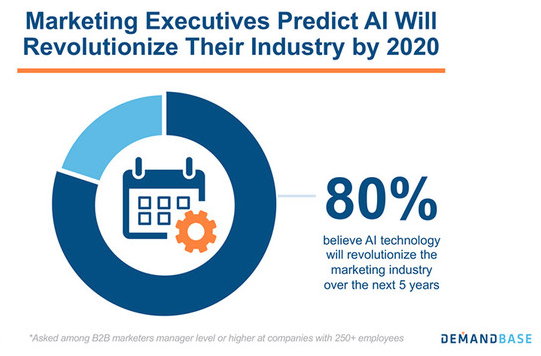
AI is penetrating the B2B world as well. In fact, 80% of B2B marketing executives believe artificial intelligence will revolutionize the industry by 2020.

2020

But this new technology comes with its fair share of challenges.

Even though the majority of these marketing executives know how much of an impact AI will have on their industries, only 26% of respondents say they are confident in their abilities to use AI for marketing.

That was my inspiration for this guide.

Artificial intelligence is a broad term with many different aspects. I’ve already shown you the marketing skills you need to survive in the age of AI.

Now, I’ll explain what B2B marketers are expecting from AI as we close out 2018 and enter 2019. You can find ways to leverage AI by applying the same strategies in your own business.

Anticipate prospective customers

Artificial intelligence makes it much easier for businesses to collect data.

As we continue through this guide, you’ll see multiple examples of how this information can be put to use.

With B2B marketing, it’s not always easy to find new customers. That’s because your target market is much more specific than that of most B2C companies.

Even if you’ve identified the types of businesses you want to target, you may not always be able to find them.

Plus, if you find a potential client, they may not be currently in the market for your products, services, or solutions. Maybe they already have existing relationships with another vendor they’re unwilling to break, or their budget could be too tight to afford what you’re offering.

I’m sure every phone call you make and every door you knock on doesn’t land you a customer overnight.

I am sure you can relate to this struggle as a B2B marketer. That’s where AI comes into play.

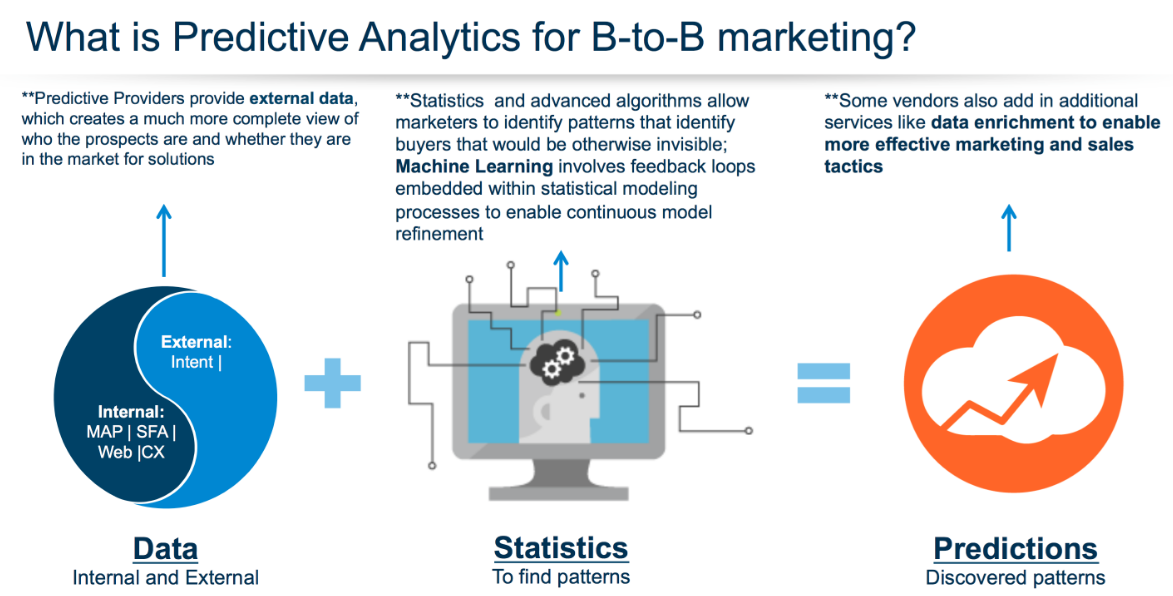
By using data to find patterns, AI software can help you create a predictive analysis model.

predict

These predictions can help you anticipate prospective customers.

As a result, your marketing efforts will be much more efficient. Using these prediction models will increase your chances of getting a potential customer to convert because you’ll be aiming at qualified leads.

These are B2B consumers who have a need for what you’re offering and have the ability to pay for it as well.

If you want to take advantage of it, you should check out Zilliant. What separates Zilliant from other AI solutions is this software is specifically designed for B2B marketers.

Distinguish visitors from buyers

I’m sure you’re closely monitoring your website traffic. But you can’t assume that everyone who lands on your website is a customer or prospective customer.

AI will help you tell the difference between actual customers and people who are just visiting your site. You can target those people accordingly.

By anticipating prospective customers, which I previously discussed, you can tell whether a site visitor has buying potential or if they are navigating to your site for another reason.

AI software can monitor browsing behavior to tell you which category each unique visitor falls into.

If someone, who is not a B2B buyer, visits your site after finding you from an organic search, you don’t want to waste your marketing efforts targeting that person.

If you’re running banner ads on third-party sites by using cookies to target anyone who ever visited your site, those impressions are a waste of money if they’re seen by an irrelevant audience.

On the other hand, you can’t assume that those who didn’t convert on your website are not qualified leads.

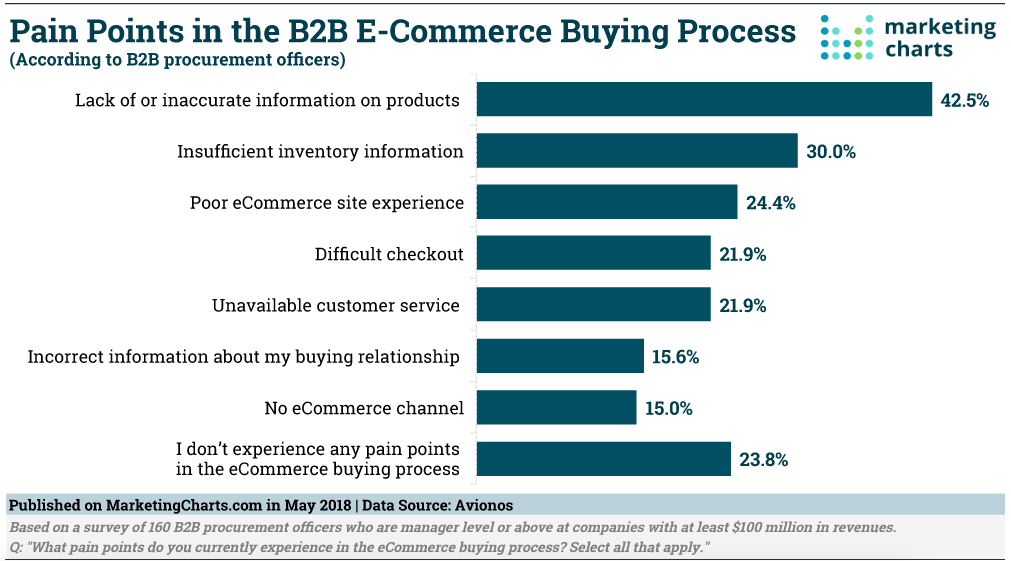
Other factors could have prevented a visitor from converting. Take a look at the top pain points in the B2B ecommerce shopping process:

pain points

With artificial intelligence software monitoring browsing behaviors and patterns, you’ll be able to tell whether consumers with buying power are converting.

If you discover that only a low percentage of actual buyers are spending money, you could conclude certain changes need to be made on your website.

Clearly, the right people are finding your business and navigating to your site. Those are the people you want to target moving forward.

Increase ROI

I’m sure you’re all familiar with this old business expression:

“You’ve got to spend money to make money.”

Artificial intelligence software isn’t free. So yes, you’ll need to dig into your pockets if you want to leverage these strategies.

If you are looking to save some money, consider reviewing my top tactics for marketing your company on a budget.

How much will AI implementation cost you? It depends.

The price will vary based on factors such as the application, scope, and complexity. But some types of machine learning can cost upward of $100k to $300k.

You’ll be able to find solutions for less, but the bottom line is you’ll likely be paying a premium for this type of technology integration.

It should come as no surprise that 48% of business owners aren’t interested in marketing solutions driven by AI because of the high costs. This is the number one reason why marketers are hesitant to adapt.

But you need to look at the big picture here. Spending money now can help you save much more in the long run.

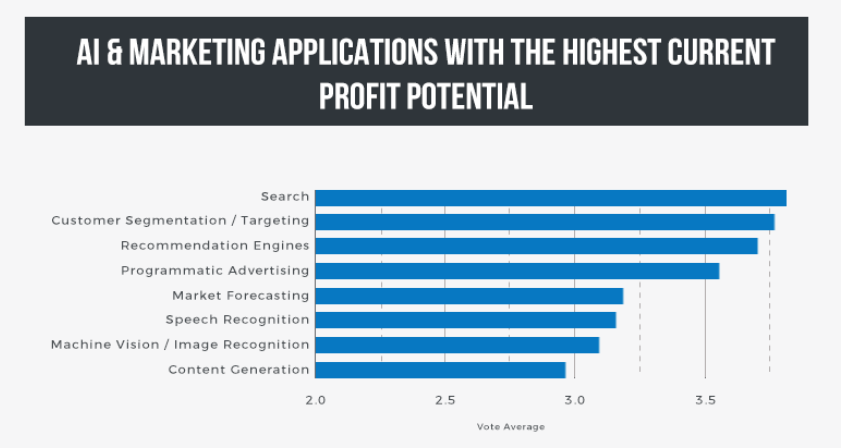
Here’s a look at the marketing applications with the highest profit potential from AI solutions:

ROI

Think about your current budget and expenses for these different categories and strategies.

How much are you spending on each one yearly?

If AI can help you reduce those costs by a significant percentage, the software will potentially pay for itself within just a few years or maybe even less.

After that, you’ll see a much higher ROI on these campaigns because the software you’re using will make it more efficient. I already gave some examples of this when I talked about targeting customers based on predictive analysis.

With the help of AI, IBM was able to reduce its average cost per click by 31%. In some instances, the cost reduction was as high as 71%.

Don’t be discouraged by the initial costs of AI implementation. Your B2B company will end up benefiting from a higher ROI in the long run.

Improve lead generation

Where are your leads coming from?

As I previously discussed, generating new leads isn’t always easy for B2B companies.

Some of your current lead generation strategies may not be working as well as you would like them to. You’re not alone.

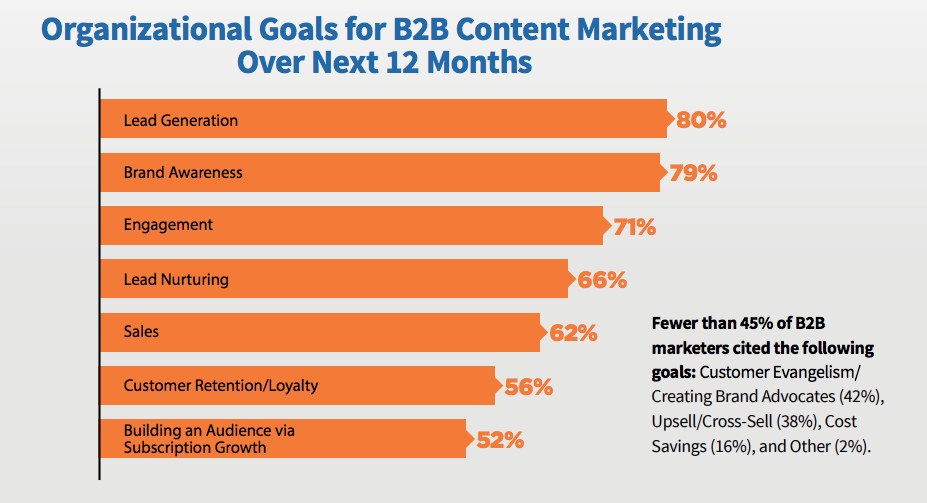
Improving lead generation efforts is the number one goal for B2B marketers in the coming year:

lead generation

If you fall into this category as well, you can expect AI solutions to improve your efforts.

As I said before, AI helps collect data and monitor habits.

The same way that Netflix recommends shows based on what you’ve already watched, AI can help recommend new leads. Or even better, it can help recommend your business to those leads.

If you’re starting from scratch, you’ll need to create a customer profile for your B2B clientele. The more detailed you make this profile, the more accurate your leads will be.

For example, you’ll want to use the following parameters:

  • age of the company
  • industry
  • number of employees
  • location

The criteria for this B2B customer profile are essentially limitless. AI solutions will use these parameters to select potential leads out of a larger pool of candidates.

By pre-qualifying your leads, you will increase your chances of turning them into customers.

Enhance the buyer’s journey

Even though the majority of what I’ve talked about so far involves getting new customers, that’s not the only way B2B companies are using AI.

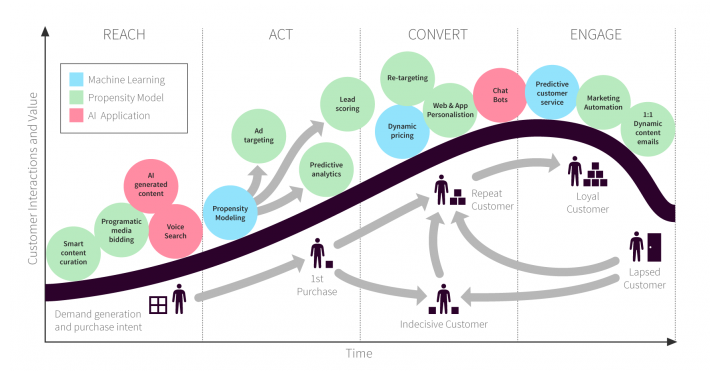
Artificial intelligence and machine learning can help your company enhance the customer experience during each stage of the customer lifecycle:

customer life cycle

As you can see from the graphic above, there are ways to implement this software throughout the entire buying process, including the post-conversion phase.

AI can help you reach customers by improving your content strategy.

Ad targeting, predictive analysis, re-targeting, and lead scoring can turn an indecisive consumer or a customer, who has only made one purchase, into a repeat customer.

Artificial intelligence can also help you implement a dynamic pricing model. You can generate more profits by focusing on your pricing strategy.

By improving your personalization tactics, AI can turn a repeat customer into a loyal customer, but I’ll discuss that in greater detail shortly.

Chatbots will help enhance the customer buying process. They can easily get their questions answered when browsing online.

And marketing automation will keep loyal customers buying and spending more money while knowing when and how to target lapsed customers.

More accurate personalized campaigns

As I just said, AI can help improve personalization throughout each stage of the buyer’s journey.

Are you currently running personalized campaigns? You should be.

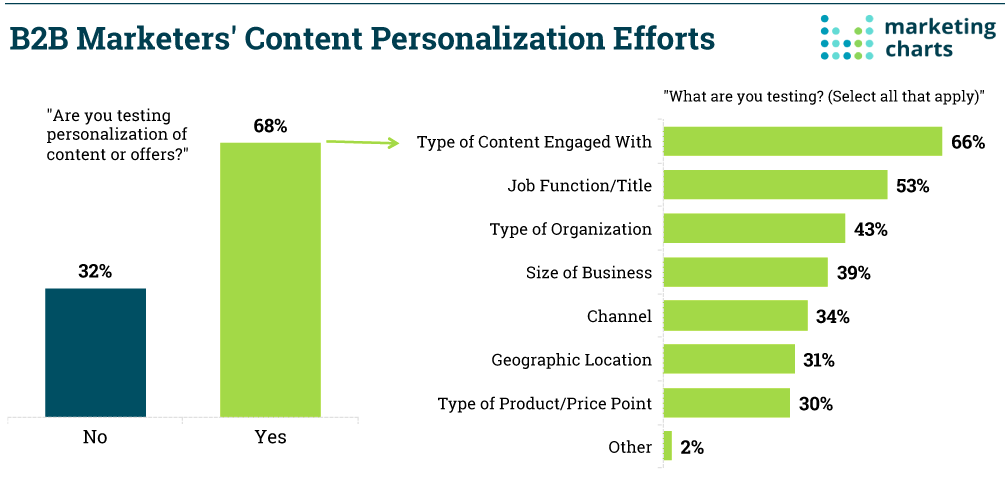
Studies show 68% of B2B marketers are personalizing their content:

personalization

Artificial intelligence will streamline this process and make it much easier for you to appeal to current and prospective customers. Here’s what I mean.

Let’s use your email marketing strategy as an example.

Right now, you’re probably segmenting your clients based on different factors such as location, industry, and size of the company. This is a great start and will definitely give you better results than non-personalized campaigns.

But you can take this process one step further with AI.

By monitoring the browsing behavior of the clients on your email list, you can send them enhanced personalized content that fits their needs.

Just segmenting your clients into lists based on factors such as geographic location won’t tell you who is browsing for products and services valued at $50,000 compared to $5,000. AI solutions can help you tell these customers apart so they can be targeted accordingly.

Artificial intelligence can personalize the web browsing as well as mobile app usage experience of your customers.

Generate high profits from top accounts

As I just finished explaining, you can use AI to help you identify the difference between customers based on how much they spend.

Every customer is important, but, obviously, you can’t treat a customer who spends $200k annually the same as a customer who spends $3,000.

This is crucial for your profit margins. Prioritizing your top accounts is one of the best ways to increase revenue without acquiring new customers.

In fact, 60% of B2B marketers say gaining better insights from client accounts is the top benefit of using AI for marketing.

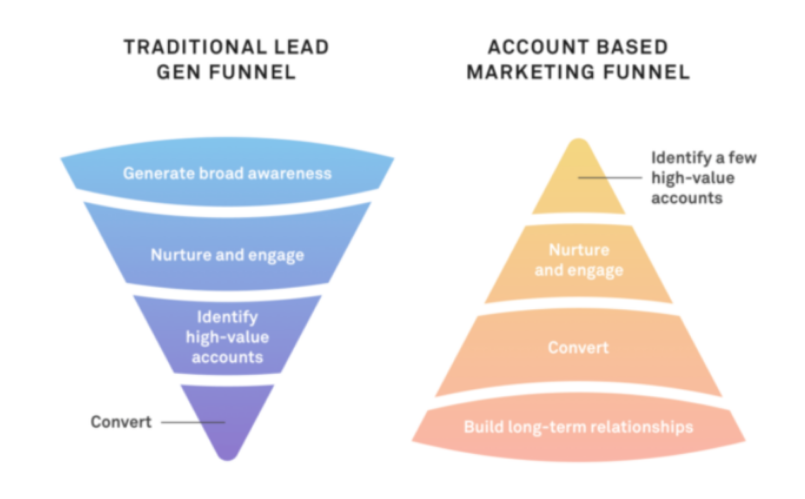
To get higher profits from your top spending customers, AI can help you improve your account-based marketing funnel:

accounts

As you can see from this image, that funnel differs from a traditional lead generation funnel.

I already explained how AI can help you identify those high-value accounts. But this technology can assist you with the other stages of the funnel as well.

You’ll use personalization tactics, previously covered, to nurture and engage with those clients.

By enhancing the buyer’s journey with AI, you will make it easier for yourself to get those customers to continue converting and spending more money. As a result, you’ll establish long-term relationships with those top accounts.

Conclusion

It’s no secret marketers are leveraging artificial intelligence to improve their businesses. This statement holds true for B2B companies as well.

As a B2B marketer, you need to recognize this and adapt accordingly.

AI can help you identify prospective customers and distinguish between buyers and website visitors.

It will improve your lead generation strategy and increase the ROI of your marketing campaigns.

Artificial intelligence will improve the buyer’s journey throughout each stage of the customer lifecycle. Ultimately, this will give your B2B clients a more personalized shopping experience.

Eventually, you can leverage AI to increase the profits from your top customers.

If you are not using AI, it’s not too late to jump on board. Even if you’re already using this technology to some extent, you can use this guide to help you take your strategies to the next level.

What expectations does your B2B company have for artificial intelligence in the coming year?


from Quick Sprout https://ift.tt/2PkvNyo

Tuesday, November 6, 2018

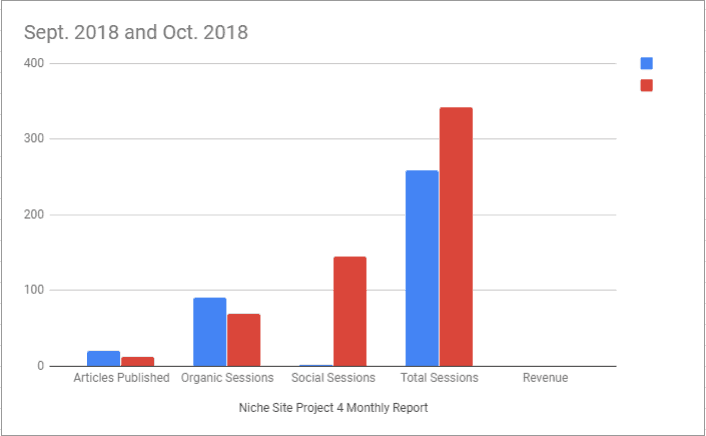
Niche Site Project 4: October 2018 Monthly Report

The time has come for another monthly report for the niche site project!  If you have been following along with this case study, this is a project where I built a new website from scratch with the goal of ranking…

The post Niche Site Project 4: October 2018 Monthly Report appeared first on Niche Pursuits.


from Niche Pursuits https://ift.tt/2OuQiD9