Wednesday, November 21, 2018

Which Is The Best WordPress Hosting? 7 Hosts – 6 Ruthless Tests

Choosing the best WordPress hosting for your site is critical.

And the most important thing you need to consider is…

How fast it is!

Why?

Because if your website loads slowly, you will suffer from-

  • Lower search engine rankings
  • Higher bounce rates
  • Lower page view numbers
  • Lower conversion rates

And last but not least…

 A SLOW WEBSITE = LOWER PROFITS! 

Your websites speed is critical to the bottom line of your business.

And all of that starts by making sure you choose the best WordPress hosting for you.

PRO TIP: With WordPress hosting- “best” does not mean “most expensive”

Keep reading and you’ll understand exactly what I mean…

Because the tests below will help you save $1,080 this year.

Which Is The Best WordPress Hosting?

Choosing the best WordPress hosting is easy.

You want to make sure that the host you choose-

  • Is super fast on the front and back end
  • Loads your website quickly globally
  • Takes security seriously (automatic backups & SSL)
  • Offers great support
  • Provides value for money

The problem is, that is much easier said than done.

So to find out who really offers the best WordPress hosting…

I setup 18 test blogs across 7 popular managed WordPress hosting providers.

And then I ran 6 tests across each of those 18 blogs-

  1. Speed of loading from different locations around the world
  2. Ability to cope with a plugin-heavy WP blog
  3. Ability to handle a heavy simultaneous traffic load
  4. How each hosts hardware benchmarks
  5. Support speed & quality
  6. Value for money (very surprising result!)

who is the best wordpress host?

Note: I chose the cheapest plan with multiple sites. Cheaper plans are available.
  1. Kinsta – Who are the current host of this blog
    • Cost: 2 websites, $60 monthly, $600 annually
    • CDN: Yes – KeyCDN included
  2. WPX Hosting – The previous host of this blog before Kinsta
    • Cost: 5 websites, $24.99 monthly, $249.99 annually
    • CDN: Yes – WPX Cloud included
  3. WP Engine – My host before WPX Hosting (it wasn’t great)
    • Cost: 5 websites, $115 monthly, $1150 annually
    • CDN: Yes – MaxCDN>Stackpath included
  4. SiteGround – Specifically their managed WordPress hosting option
    • Cost: unlimited website, normally $19.95 monthly, $239.40 annually
    • CDN: No – Free CloudFlare recommended
  5. Hostgator – The managed WordPress Hosting package
    • Cost: 3 websites, $27.95 monthly, $335.40 annually
    • CDN: No – Free CloudFlare recommended
  6. Liquid Web – Again, their managed WordPress hosting offering
    • Cost: 10 websites, $99 monthly, $1,188 annually
    • CDN: No – Free CloudFlare recommended
  7. Amazon EC2 – Not a managed WordPress host, but a DIY wildcard alternative
    • Cost: Unlimited websites, $14.99 monthly, $179.88 annually
    • CDN: No – Free CloudFlare recommended

So with WPEngine & LiquidWeb being the most expensive  of all of them by a long way.

You would expect them to be the clear winners…

Right?

 WRONG! 

Not even close.

How I Tested WordPress Hosting Speed

I setup a total of 18 test sites across each of the 7 hosts.

Hosts that included a CDN as part of their package had 2 sites installed on them (WPXHosting, Kinsta & WP Engine).

Hosts that ask you to use a free CDN like CloudFlare had 3 sites installed on them (Siteground, Hostgator, Amazon EC2 & LiquidWeb).

All of the sites are hosted in the USA.

Then I created 3 different types of blog on 1 host and cloned that across each host using this plugin–

Blog Type #1
Image Heavy

Cronus Theme
11 photos
2,000 words

Blog Type #2
Plugin Heavy

Cronus Theme
30 plugins
No text/images

Blog Type #3
CloudFlare

Blog Type #1
Plus Free CloudFlare CDN

And to help make things a little easier for you…

You can see the live versions of all of test blogs below-

Siteground

HostGator

LiquidWeb

Amazon EC2

WPX Hosting

 
Kinsta

 
WP Engine

Feel free to click through to any of them and run your own tests!

But if you’re too lazy to do that…

Here are the results of my 6 tests-

Test #1 – Image Heavy Site Loading Speed

In this test:

I took the Blog Type 1 (image heavy) install for each host and ran it through GTMetrix twice.

Often a sites content is cached on the hosting server and CDN.

So I ran 2 passes of GTMetrix to make sure all caches were primed.

Then I tested each site from 7 global locations and averaged out the results.

This is what it looks like-

Wordpress hosting speed test results

Test #1 Conclusions

 The clear winner here is WPX Hosting. 

But it’s fair to say that all of the hosts performed within acceptable levels in Canada and North America (except for Amazon EC2).

It’s only when you start taking a global look at things do you see dramatic differences in the load times.

But having globally fast loading times is critical in the modern economy.

Test #2 – Plugin Heavy Site Loading Speed

A plugin heavy site can cause huge problems when it comes to load times.

And it’s easy to get carried away!

This blog has 56 active plugins at the time of writing-

56 active plugins on the blog

And plugins can have such a big impact on load time…

WP Engine maintains a list of plugins that are banned on their platform.

So for the Blog Type 2 (plugin heavy) installs, I installed 30 popular plugins with no other content whatsoever.

This test is different because we are testing the computing power of the host, rather than the speed of delivering static image files.

Then I tested each plugin heavy install from 7 global locations & averaged out the results-

wordpress hosting plugin speed test results

Test #2 Conclusions

Like the first test, WPX Hosting is the winner here.

Although it is a marginal win over WP Engine.

It’s worth bearing in mind that the tested page had absolutely zero content.

And the slower hosts seem to have started choking with the higher number of requests.

Test #3 – WordPress Performance Tester Benchmarks

The WordPress Performance Tester plugin is specifically designed to stress test WordPress hosting servers.

It does that by running a number of tests-

  • Math – 100,000 math function tests
  • String Manipulation – 100,000 string manipulation tests
  • Loops – 1,000,000 loop iterations
  • Conditionals – 1,000,000 conditional logic checks
  • MySql – basic mysql functions and 1,000,000 ENCODE() iterations
  • $wpdb – 250 insert, select, update and delete operations

And then outputs 2 performance metrics-

  •  Execution Time    – how long it took to do all of those tests (lower is better)
  •  Queries Per Second    – how many queries per second processed (higher is better)

I ran each of the Blog Type 1 (image heavy) installs for each host through the plugin.

And these were the results…

wordpress hosting benchmark test results

Test #3 Conclusion

As you can see 2x of the more budget friendly hosts WPX Hosting & Siteground performed incredibly well here.

But interestingly:

 The more expensive hosts like Kinsta, LiquidWeb and WP Engine failed to perform. 

That is the exact opposite of what I would expect to happen…

You would think those extra $$$ translate into better hosting hardware and setups!

But the data is telling a different story.

Test #4 – Load Impact

Next I wanted to know:

How would each host perform under stress from 500 simultaneous visitors?

However I had a huge problem:

Most hosts automatically block tests like this because it reseambles a DDOS attack.

But it was critical  that I conducted anonymous testing because I didn’t want the hosts to know I was testing them.

So I created a new page on each Blog Type 1 (image heavy) install with 1,000 words-

Then I set Load Impact to work by sending 500 simulated visitors to load each page on each host.

This is how it played out-

wordpress hosting loadimpact test results

Test #4 Conclusion

From the tests I was able to complete-

 WPX Hosting was the hands down winner here   – it wasn’t even close.

And although WPEngine, Amazon and LiquidWeb were slower…

They did not collapse under the testing and remained online.

As for the other hosts I had problems testing with-

  • Kinsta – LoadImpact was reporting a problem with overloaded Amazon VPS’s
  • SiteGround – Either the hosting failed or they automatically blocked LoadImpact
  • HostGator – Fell down during testing , the site went offline with a 503 error

And while I would have loved to get a result for them…

It would have brought attention to my testing & I wanted to test anonymously.

Perhaps in the future I will be able to run this test again for the missing hosts.

Test #5 – Hosting Support

Speed of your website is one thing.

 But speed (and quality) of support is another. 

And given that the tested hosts are self proclaimed “WordPress Experts”…

I wanted to put that to the test.

So I opened an identical support ticket with each host to see-

  1. How long it took to respond
  2. If they would fix the problem for me

Here is the support ticket I sent to each host-

Hi Support,

I am not a very technical person and need help with the setup of this redirect on my site hosted with you thanks:

hostingtest2.space – all pages except hostingtest2.space/wp-admin

to redirect to

hostingtest2.space

Thanks in advance.

Matt

It’s not a super easy problem to fix…

But it’s not super difficult either.

Any WordPress expert should be able to tackle it.

In my opinion the easiest way to solve this problem is with a .htaccess edit like this-

RewriteEngine On

RewriteCond %{REQUEST_URI} !^(/wp-admin|.wp-login.php.) [NC]

RewriteRule (.*) http:/hostingtest3.space//$1 [R=301,L]

But:

There is always more than one way to skin a cat!

Test #5 Conclusion

As expected –  the test results varied wildly here. 

Some hosts took full control and deployed a solution on my behalf…

Where as others… didn’t.

Here is how they performed-

Wordpress hosting support test results

 Kinsta, LiquidWeb & WPXHosting solved the problem successfully. 

And out of those 3-

It was WPXhosting that solved the problem the quickest and with minimum fuss.

However:

 WPEngine & SiteGround seriously fell short here 

Their “WordPress experts” were not able to solve the problem.

Test #6 – The Free CloudFlare CDN

4x of the hosts I tested  did not include any kind of CDN-

  1. SiteGround
  2. LiquidWeb
  3. HostGator
  4. Amazon EC2

And it is common advice for hosting companies to recommend you setup the free version of the CloudFlare CDN.

Supposedly this will help increase site speed.

But is that really true?

To find out I cloned the Blog Type 1 (image heavy) install to a new domain on each host and then activated the free CloudFlare CDN-

Then I tested each of these installs with GTMetrix from 7 different global locations.

And the results were very interesting…

WordPress Hosting Features Compared

So far we have focused purely on speed, reliabiliy and support.

But what about other hosting features…

wordpress hosting features compared

As you can see:

There really isn’t that much difference between them on the face of it…

Except for price!

It’s only with the nitty gritty testing that you see huge differences in quality of service.

The Worst Things About Each Host

Regardless of which host you look at, each of them have their own cons.

The best wordpress hosting for me, isn’t necessarily the best WordPress hosting for you.

For example:

WPX Hosting is clearly the fastest, but if you need phone support…

They aren’t right for you.

So here is what I didn’t like about each of the managed WordPress hosting options-

WP Engine

WPX Hosting

  • No phone support
  • No Git support
  • Servers are only available in USA and UK
  • Back end control panel could be easier to use

Hostgator

  • Terrible trust score
  • No CDN on base plan
  • No free SSLs, only paid
  • No staging area
  • Long list of banned plugins
  • Automatic backups are a paid upgrade
  • Terrible loading speed from non-US locations (see above tests)

Liquid Web

  • Very expensive
  • Not exactly the quickest based on my testing
  • No CDN on base plan (but free Cloudflare CDN worked best of tested hosts here)
  • No free email, costs $10 monthly extra + $1-$3 per email address
  • No discounts for annual subscription
Kinsta
  • No phone support
  • Expensive for multiple websites
  • No email support – additional costs with Google Apps etc
  • List of banned plugins
  • No live chat for pre-sales questions
  • No free migration on the base plan

SiteGround

  • Pricing virtually triples in year 2
  • No staging area on base plan
  • After first month, no monthly payment option
  • No real CDN on base plan (free Cloudflare doesn’t count)

Amazon

  • Not really a WordPress host
  • You need to configure everything
  • Very technical, requires command line
  • No CDN
  • No automatic backups
  • Support is for their hardware only
  • No cost saving reason to choose Amazon over dedicated WP hosts

Wrapping It Up

While it is usually true that “you get what you pay for” in life..

That isn’t true when it comes to choosing the best wordpress hosting.

WP Engine ($115/mo) & Liquid Web ($99/mo) are the most expensive but also failed to perform.

HostGator were also consistently poor.

That leaves SiteGround, Kinsta and WPX Hosting to consider.

Kinsta and WPX Hosting performed consistently faster than Siteground.

But Siteground did hold steady throughout all of my testing.

I suspect if you added a quality CDN to SiteGround rather than the free CloudFlare suggestion they would perform much better.

But that’s an extra cost and Kinsta & WPX Hosting already include good CDNs for free.

So if I was going to rank them…

The Best WordPress Hosting Is…

  1. WPX Hosting – Cheap but also the fastest with the best support
  2. Kinsta – Solid performance, fantastic support & the current host of this blog
  3. SiteGround – Budget friendly and fast but support was lacking

best wordpress hosting final test results

The great irony of these results is that…

WPX Hosting used to host this blog (I famously ditched WPEngine for them).

Then 2 years ago…

I moved the blogs hosting over to Kinsta because I needed-

  • A server level backup/restore system
  • A staging area
  • Access to new technologies like HHVM (which is now deceased)

But:

Since I moved this blog to Kinsta…

The WPX Hosting team have added a bunch of new features such as-

  1. Their own backup/restore system
  2. A staging area
  3. A free custom CDN called “WPX Cloud”

In fact I still have 9 sites hosted with WPX Hosting including my SEO agency site and my black friday deals site (neither of which have WPX Cloud activated right now).

Where as Kinsta are currently hosting this blog and my SEO course.

But as they say:

The proof is in the pudding.

Save 95% With WPXHosting This Black Friday

Get instant access to all of the best Black Friday deals this year including a whopping 95% discount from the winner of this test – WPXHosting!
Sign Up To Get Notified First

And based on all of my testing and personal experiences…

 The best WordPress hosting is WPX Hosting 
(assuming you don’t need phone support)

And remember this:

A faster website will result in-

  • Higher search engine rankings
  • Lower bounce rates
  • Higher page view numbers
  • Higher conversion rates

And most importantly…

 HIGHER PROFITS! 

So don’t waste your time and money with a slower host.

Who do you think the best WordPress host is right now?

I would love to know!

Which Is The Best WordPress Hosting? 7 Hosts – 6 Ruthless Tests was originally published on Matthew Woodward


from Matthew Woodward https://ift.tt/2qVJQvs

Monday, November 19, 2018

How to Use Predictive Analysis to Improve Your Marketing Strategy

The world of technology is constantly evolving.

As a marketer, you need to stay up to date on new advancements that could benefit your company.

You don’t want to be left behind while your competitors forge ahead by adapting to the new world.

In my consulting work, I often see marketers and business owners who don’t believe these advancements are relevant to their marketing strategies. But this couldn’t be farther from the truth. New types of technology such as AI and machine learning are reshaping marketing.

While the technology is advancing rapidly, the basic concepts behind its applications remain unchanged. Everything is still focused on the customer.

Your marketing efforts need to reach your target audience. Your campaigns must find ways to speak to these people, and you can achieve that by personalizing and improving their experience.

Predictive analysis can make this possible.

Some of you may already be running campaigns and have strategies in place that focus on improving the customer experience and personalizing content.

However, predictive analysis technology will bring these ideas to the next level. You’ll see what I mean as I continue.

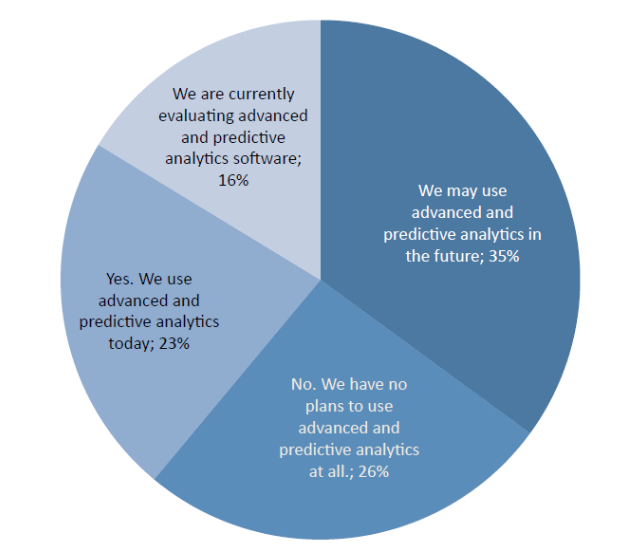
Surprisingly, only 23% of businesses are currently using advanced and predictive analysis tools:

currently using

That said, about 90% of businesses believe it’s at least somewhat important to implement predictive analysis tactics in their strategies.

What does this information tell you?

Well, it seems as though the vast majority of business owners and marketers recognize the need for predictive analysis, but they just haven’t proceeded.

Since you’ve navigated to this guide, I’m assuming you fall into this category. Or maybe you fall into the 16% of marketers currently evaluating advanced analytics software.

People want to use this technology, but they don’t know where to start or how to apply it. This was my inspiration for this guide.

You need to be able to adapt. In fact, adaptability is one of the top marketing skills you need to survive in the age of AI.

Making the decision to move forward with predictive analysis is the first step.

Now you need to figure out how this technology will improve your marketing strategy. If you apply the concepts I’ve outlined in this guide, you’ll have a huge competitive advantage.

Enhance your customer segmentation strategy

Your customers don’t fall into the same group.

Treating all people the same is not an effective marketing strategy. I hope you’ve already started segmenting your customers.

Marketers have been doing this well before the days of big data. But this can be drastically improved with predictive analysis.

Predictive analysis can make it easier for you to compile demographic data. I’m referring to parameters such as:

  • age
  • race
  • gender
  • location

Typically, it’s easy to learn this information about your customers. But segmenting them by those factors alone is not enough.

By using predictive analytics technology, you can identify trends for deeper segmentation.

You’ll ultimately pair demographic data with psychographics. This type of information can be obtained from social media, website analytics, surveys, and focus groups.

It doesn’t stop there. You can also collect behavioral data, such as how each customer uniquely uses your service or platform, e.g., your website or mobile app.

When you combine all the demographic, psychographic, and behavioral data about your customers, your predictive analysis model will create segmented groups with greater accuracy than it would if it used only one type of information at a time.

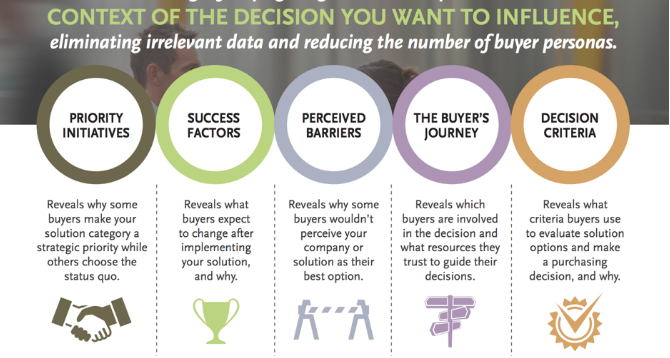
You can create customer personas once the data has been optimized from the predictive analysis formulas:

buyer persona

Once the segments have improved, your customer personas will be more precise and targeted accordingly.

Customer personas and customer segmentation are not quite the same although they’re often confused with each other. Ultimately, the two concepts work together.

With the information you get from your advanced segmentation strategy, you’ll be able to build a customer persona. These personas will be used for driving sales and conversions.

You can eventually use your predictive analysis software to improve lead scoring.

Once someone has been properly segmented, you can send them the right campaign, which will make it easier for them to convert. I’ll discuss lead scoring in greater detail later.

Improve automation

Customer personalization needs to be a key part of your marketing strategy.

But efficiency needs to be a priority as well.

It’s unrealistic for you to manually analyze every customer in your database. Most people leverage basic details with their automated platforms.

They use basic factors, such as the customer’s name, email address, location, and maybe their age.

For example, you could have an automated email go out to a customer on their birthday. This strategy is OK, but it can definitely be improved.

By using your customer segments and customer personas, you’ll be able to have a more advanced automation strategy.

With this type of data, you can create campaigns to show your customers you fully understand their wants and needs. Furthermore, you’ll know how to address those wants and needs.

Once your automation efforts improve, it will be much more profitable for your business.

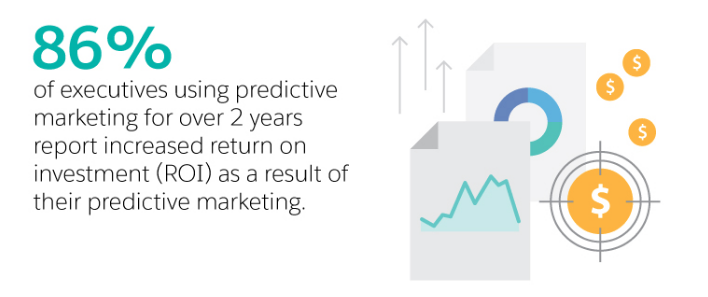
ROI

That’s why such a large majority of marketing executives who have been using predictive analytics to improve their marketing strategies are seeing a high ROI.

If the initial cost of this type of software is holding you back from investing in it, know that you’ll ultimately see a return on your investment.

Reduce churn

When businesses focus only on customer acquisition, allowing their retention strategies to become an afterthought, they underperform.

If this sounds like you, you’re making a big mistake. It’s much easier to sell to your current customers than to new ones.

In fact, you can even increase revenue without acquiring new customers.

These tactics should be a priority for your marketing department.

But even customers who have been with you for a while may eventually churn. What are your current churn rates?

We know that 70% of SaaS companies have an annual churn rate of about 10%.

Don’t think that’s a problem? I think that’s way too high.

Those of you with a high churn rate are missing out on much potential income.

If you can reduce your churn, you’ll have more money in your company’s bank account.

Predictive analysis can help show you when a customer will churn based on their behavior. Then, you can have targeted and automated responses in place to prevent that from happening. This will give them an incentive to stay.

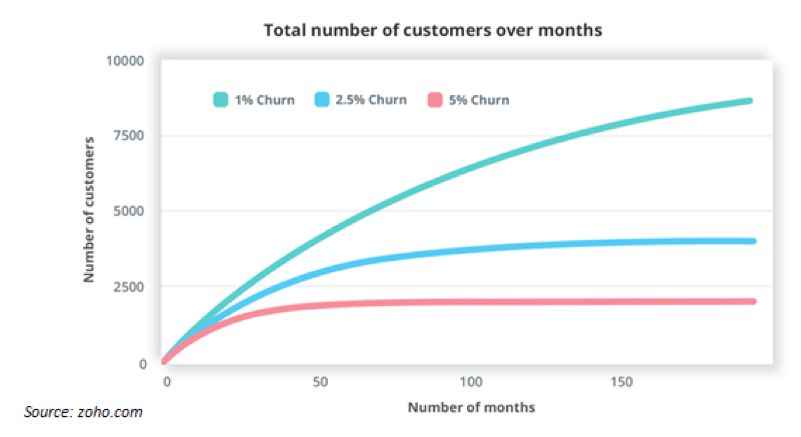
You may not realize it today, but your churn rates can be detrimental to your company over time. Just look at this graph:

churn

Notice the difference between the churn rates of 1% and 5%. That’s huge.

Check out the difference between 1% and 2.5%. I’m sure that’s not what you expected, given the small percentage number.

As you can see, improving your churn rate even by a percentage point or two will be a huge advantage for your company. This is especially true as you continue to acquire new customers over time.

Make decisions in real time

With predictive analysis tools, your company can benefit from speeding up the decision-making process.

That’s because you’ll get predictive results in real time.

The longer it takes for you to make a decision based on the information you’re given, the less effective that decision becomes.

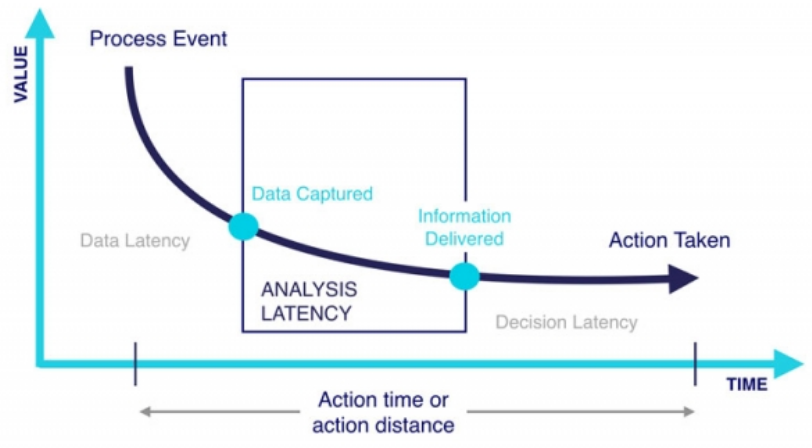
Here’s a great visual illustrating my point:

real time

The graph shows the way the value of something changes over time.

Without predictive analysis software, the gap in the analysis latency section is much larger. The gap is the time between when the data is captured and the information is delivered.

Obviously, this delay will make it more difficult for you to act in a timely manner.

Let’s revisit the customer churn problem. If you don’t get that data delivered right away, by the time you attempt to prevent a customer from churning, you might be too late. They already switched to a competitor.

But that’s not the only application for real-time decision-making.

Predictive analysis algorithms could determine when one of your customers might need a specific product you’re selling.

Let’s say they are going on vacation in two weeks. They need that specific product before they go.

If you wait too long to take an action to try to get that sale, you’ll be too late even if you did everything else right.

You identified their need and sent them a personalized, highly targeted campaign. But if that was not done in a timely fashion, it’s useless.

Create advanced regression models

Some of you might be currently using regression models in your marketing strategy.

Predictive analysis will improve this strategy.

Even if you’re not doing this, you can start to do so once you implement predictive analysis software. Regressions can help you measure and compare different variables.

For example, you could try to determine how social engagement relates to your website traffic. Or you could compare email open rates to conversions. And you can relate your page authority to the source of your leads.

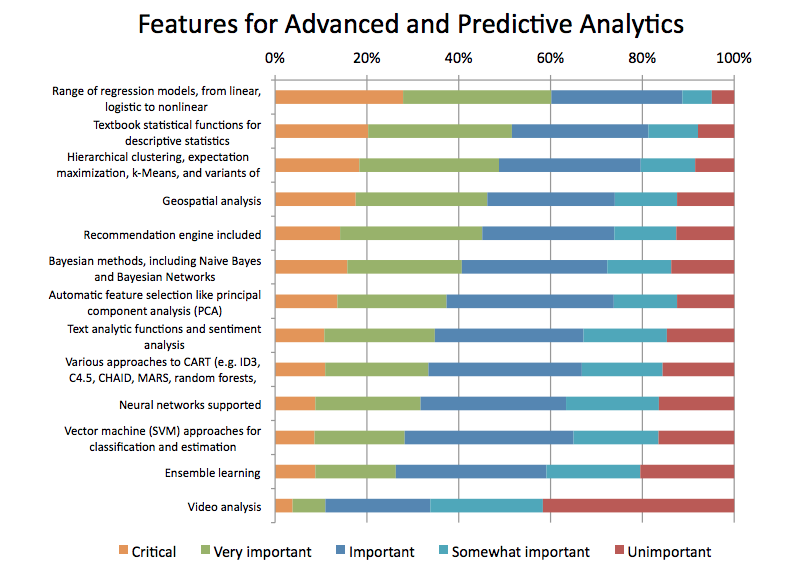
Improving the range of regression models was the most important feature according to a recent survey on the use of predictive analysis:

regression

The information gathered from a regression model can help you validate your marketing campaigns.

You’ll have a much better understanding of what’s working and what needs improvement.

Predict lifetime value (LTV)

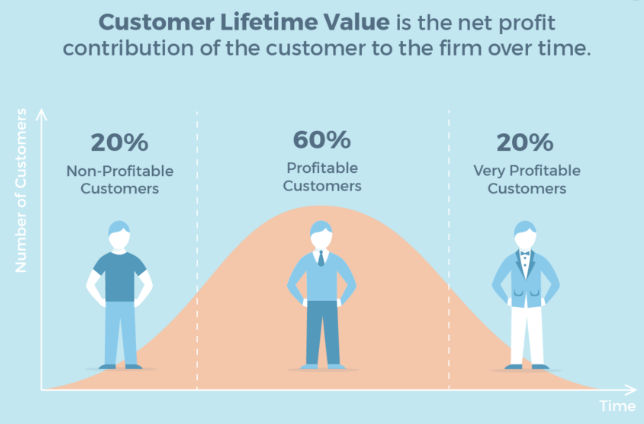
In addition to calculating when and if a customer would churn, predictive analysis software can estimate their lifetime value.

Although this value is often overlooked, it’s one of the most important metrics for marketers to track:

LTV

Simply put, lifetime value will show you how much a customer is worth over time.

From the very beginning stages of the customer journey, predictive analysis can help identify which customers will be the most profitable.

Segmenting those people accordingly will improve your targeting strategies. Now, you’ll be able to make even more money from your most profitable customers.

Furthermore, LTV will also help you calculate a more accurate ROI of your marketing campaigns.

I see companies make this mistake all the time. They stay away from certain acquisition strategies because they can’t justify the cost.

But that’s because they don’t measure LTV, or at least they’re not doing it accurately.

You need to look beyond the customer’s initial first purchase. Here’s a very simple example.

Let’s say it costs you $50 to acquire a customer based on the campaigns you’re running, but their average purchase is $20. It doesn’t mean you need to abandon those strategies—not if the lifetime value of that customer is $1,000.

Predictive analysis will make these figures much more accurate.

Prioritize qualified leads

You might be getting a ton of leads right now, but not all of them are qualified.

Qualified leads are more likely to convert, and you need to prioritize them.

But if you allow those leads to get lost in the shuffle, you won’t capitalize on them.

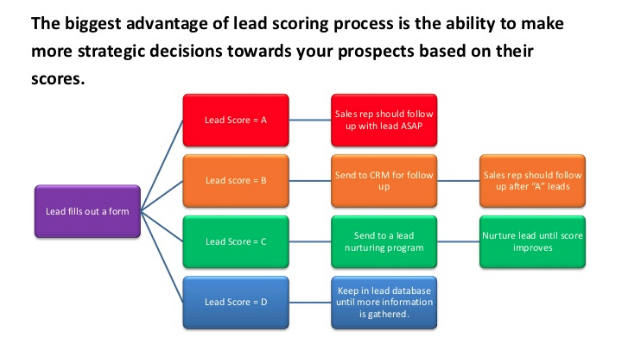
I mentioned lead scoring earlier. Based on your predictive analysis, you can improve your lead scoring system. If you don’t currently have a lead scoring system in place, this will be a great opportunity for you to create one.

Here’s a basic example of what a lead scoring system may look like:

lead scoring

Prospective customers with the highest lead scores get the most attention.

You can even target them with more expensive campaigns and acquisition strategies because they are more likely to convert.

Remember I said not all your customers are the same? Not all your prospects are the same either.

Predictive analysis will take this strategy to new heights.

You’ll get more insight into how to keep these people engaged. You can even learn predictions on their preferred price points and the types of products that will get new leads to convert.

This will help you generate more profits by focusing on your pricing strategy.

By applying predictive analysis to your lead scoring system and qualifying your leads, you will accelerate new leads through the conversion funnel. Ultimately, more conversions translate to more money.

Conclusion

Predictive analysis technology can drastically improve your marketing strategy.

Many businesses haven’t adapted to this yet even though they recognize its importance. This is a great opportunity for you to jump on board now to gain an advantage over your competition.

Your predictive analysis models will help with your customer segmentation strategy.

This software will improve your automation tactics and help you prevent customer churn by identifying it before it’s too late. You’ll also be able to make other important decisions in real time.

Predictive analysis is great for advanced regression models.

Use this technology to help you predict lifetime value of a customer and prioritize qualified leads.

Once you’re ready to start using predictive analysis to improve your marketing strategy, I suggest you apply the concepts I’ve outlined in this guide.

How is your business using predictive analysis to enhance your current marketing strategies?


from Quick Sprout https://ift.tt/2KeVhr5

Friday, November 16, 2018

How to Convert Free Trial and Free Plan Users into Paying Customers

If your business relies on subscriptions to generate revenue, you probably offer a free trial to test your product before you ask your subscribers to pay.

This is a great strategy. People may be hesitant to pay for your subscription initially, but if they can try it first, it gives you an opportunity to win them over and turn them into paying customers.

Some of you may even offer free plans for certain services. The idea behind this strategy is that these people will eventually upgrade to paid plans.

But you can’t assume every free trial or free plan user will become a paying customer.

I see this problem all the time in my consulting work.

Businesses don’t have a problem getting people to sign up for free plans and free trials, but when it comes to getting paid, their conversions are lower than expected.

Even you don’t use this business model yet but plan to generate recurring sales by implementing subscriptions, it’s important for you to get this strategy right from the start.

Certain tactics will help you increase the chances of getting these free trial and free plan users to convert.

I’ll explain what you need to know so you can apply these strategies in your business.

Make the transition as easy as possible

The first thing you need to do is analyze your current process. Go through the steps a user needs to take to become a paying customer.

If you’ve got too much friction, unnecessary form fields to fill out, and anything else that slows down the process, it’ll hurt your conversions.

Everything needs to be as smooth and easy as possible for the user.

For example, let’s say the free trial period is over. Now what? Do they need to pick up the phone and call a customer service representative to give their credit card information over the phone?

That’s way too complex.

If you run subscriptions through a mobile app, you can have the user scan their credit card with their camera. This is even easier than typing the numbers.

To make this transition easy for your users, don’t force them to commit to a long-term plan.

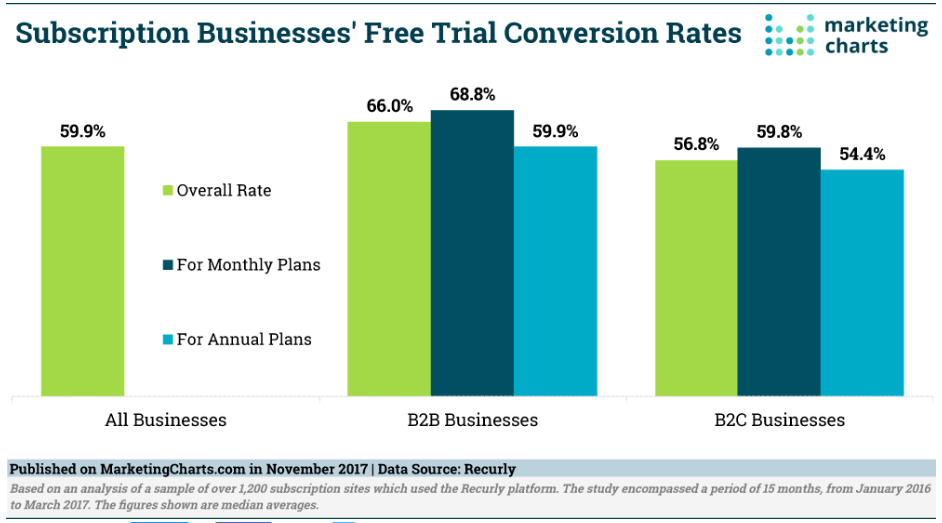
In fact, monthly subscriptions have higher conversion rates from free trials than annual plans do:

conversions

If you’re forcing someone to commit to a year, they’ll think much longer and harder about the decision. You don’t want that.

But if they need to pay only for one month at a time with the option to cancel at any moment, it will definitely be an easier decision for them.

I get your thinking behind trying to drive annual plans. But realistically, if your product is good enough, customers will stick with you for long periods even on a monthly plan.

Plus, you’ll likely make more money this way.

You can generate more profits by focusing on your pricing strategy. Customers who commit to a yearly membership or subscription will probably be paying less during that period than those who get billed monthly.

Give users a reason to end their free trials early

Here’s something else I see all too often with subscription businesses. They wait until the trial ends before trying to get users to convert.

By that point, it’s too late.

For example, let’s say you offer a 14-day free trial. Once the trial expires, you give the user some buffer time to decide whether they want to become a paying customer.

A week later, you send an email with a CTA to a paid subscription link.

If this sounds like a strategy you’re currently using, it’s probably why your conversions are so low. Waiting this long is not a good idea. By this point, your service is no longer on the minds of the consumers.

They’ve already gone a week without using it and realized it’s not something they need in their lives.

Instead of waiting until the trial is over, you can give the user an incentive to sign up while their trial is still going on.

But why would anyone want to end their free trial early? You need to make them an offer that’s worth it.

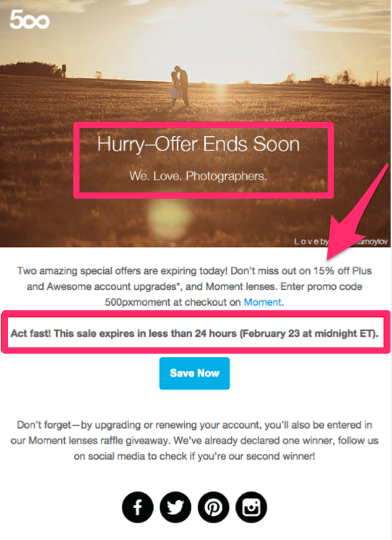
Discounts and other promotions will usually get the job done. Here’s a great example from 500px:

500px

This email uses FOMO—the fear of missing out. You can guide people’s emotions to drive sales with this strategy.

500px is offering 15% off its membership, plus additional account upgrades. However, this promotion won’t last long. As you can see from the highlighted bit, this offer lasted for only 24 hours.

Put yourself in the shoes of the consumer for a minute here. Let’s say they are on day 22 of a 30-day trial.

They like the product and are thinking about upgrading when the trial expires.

But why would they wait and pay the full price when they can get 15% off today? This type of offer gives them a reason to end their trial early and convert.

You want to target these users while they’re still hooked and your brand is fresh in their minds. If you give them an incentive to end the trial early, you’ll increase the chances of them becoming a paying customer.

Offer trial extensions

What happens if a user doesn’t take the bait of the incentive to end their trial early?

Does that mean you should give up on trying to get them to convert? Absolutely not.

Some people may need a bit more time to determine whether they want to use your product. Here’s what I mean.

Let’s say someone signs up for a free trial. The process was simple and hassle-free, so they completed this action without thinking twice about it.

But because of their circumstances, they didn’t get a chance to explore your product in full.

There are a number of different reasons for this. It’s possible they were busy at work, had a medical issue, were traveling, or simply forgot about the trial.

The reason why they need more time isn’t important. What is important is giving them the option to extend their trial.

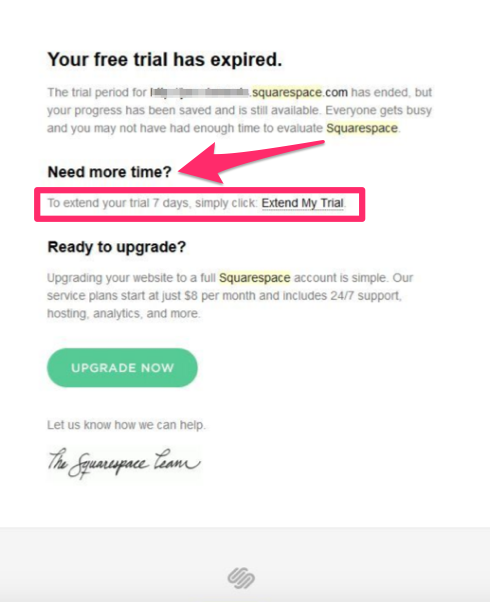
Here’s an example from Squarespace:

squarespace

Squarespace offers a 14-day free trial to anyone. But the team is willing to work with people who need more time to try its software.

As you can see from the email above, it’s easy for users to add a seven-day extension to their two-week trial.

This is a great way to get users who are on the fence to convert.

I know what some of you are thinking. You don’t want to lower the value of your product by giving it away for longer than necessary.

That’s the wrong mentality. The cost of an extra free week or two is well worth it if you can have this customer for years to come.

It’s bad business to let a prospective customer walk away because you’re unwilling to go the extra mile to acquire them. In this case, these users are already interested in your brand.

They’ve taken the steps to sign up, download your app, or start the process. It’s easier to turn them into paying customers than trying to market to someone else from scratch.

Furthermore, take another look at the email above from Squarespace.

To extend the trial, all the user needs to do is click on the link sent to them, making it super easy—one of the factors to aid conversions I discussed above.

If the user had to send an email or call a customer service representative to extend the trial, they would be less inclined to do so.

Run personalized promotions for the lowest tier plan users

Depending on the type of business you have, you may offer a free version of your product.

This version is free for anyone to use for an unlimited amount of time. Obviously, this is different from a free trial, which has an expiration date.

You should be coming up with marketing campaigns specifically designed to get these freemium users to convert.

Again, as in my last point, these people are already familiar with your product and use it on a regular basis. You need to ease their transition from a free membership to a paid service.

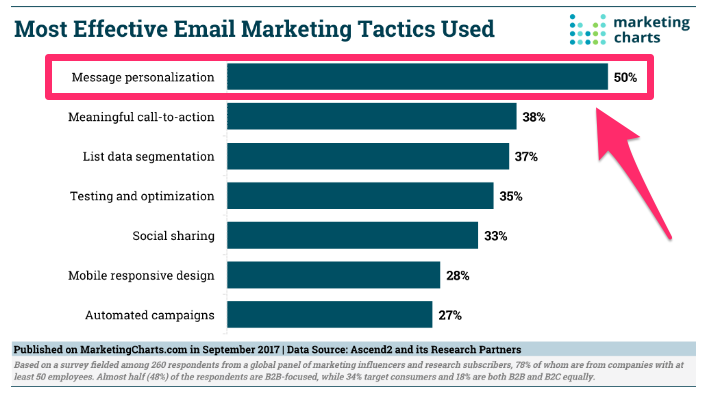
The best way to do this is with personalized content:

personalized

Personalizing email messages is the most effective tactic used by marketers. Take that into consideration when targeting freemium users.

Send them a personalized email about the type of content they’re currently consuming free.

Then, give them an incentive to convert.

Just because someone is using your lowest tier membership free doesn’t mean you can’t offer them a free trial of a premium membership. Let them see what features and benefits your other options have.

Once they try these upgrades, it may be difficult for them to go back to the freemium version now that they know what they’re missing out on.

Encourage inactive users to use your product

If you haven’t realized it yet, there is a pattern here with these strategies.

It’s much easier for you to market your paid subscription to people already familiar with your brand, products, services, and software. That’s because there is no learning curve.

You don’t have to explain yourself to people who have used your services in the past.

This holds true for people who used a free trial that expired or had a free membership plan they haven’t been taking advantage of lately. Don’t let that user churn.

Send them an email giving them an incentive to use your service again.

If you have a mobile app, send a push notification to their device. Here’s a great example of how Pokemon Go used this strategy to bring an old user back to life:

pokemon

As you can see, they are enticing this user with a gameplay incentive to come back to the app.

If the user opens the app within the next 30 minutes, they’ll have access to three active lures. Pokemon characters are drawn to these lures, making it easier to catch them.

If any inactive user stopped playing this game because they were struggling to catch more characters, this type of push notification can bring them back.

Contact customers with failed payments

Your business is likely on your mind 24 hours a day, 365 days a year. But that’s not the case for your customers.

The reality is they have other things to worry about.

If their credit card gets lost or stolen or expires, they may not think to update their payment information for their membership with your company.

In some cases, that card may be tied to their utilities, health insurance, car payments, or other recurring charges that will take priority over whatever you’re offering.

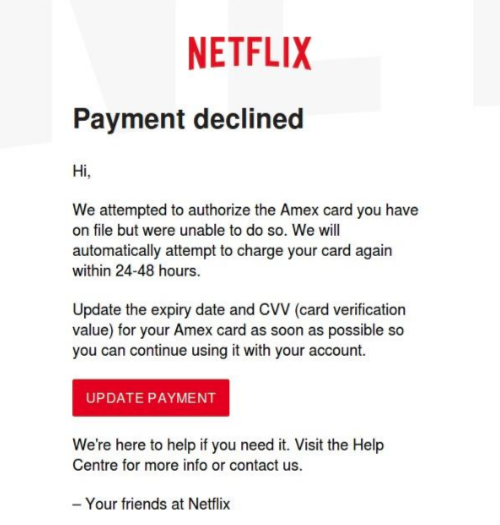
That said, you don’t want to do nothing. The user may never update their payment information unless you contact them.

Rather than losing a customer, send automated emails whenever a payment gets declined. It’s easy!

Just look at this example from Netflix:

netflix

It’s as simple as that.

By providing a CTA in the email that directs the user to a landing page where they can update their payment information, you will reduce friction in the process.

Without contacting these customers, you run the risk of them going back to the free plan or stopping using your service altogether.

Nurture free trial users with email campaigns

Email marketing is an effective way to communicate with your customers.

If you learn how to create an actionable drip campaign, you can target free trial users and entice them to convert.

This smooth process will help move the customer through the conversion funnel. It all starts with a welcome email.

Research shows that 75% of users expect to receive a welcome email after signing up for something. Give your prospective customers what they expect.

Here’s an example of how Spotify uses this strategy:

spotify

As you can see from this message, Spotify is simply confirming that the user has signed up for the service.

There is no pitch for them to upgrade to a paid plan. The message explains the user can play their favorite music free and get personalized recommendations.

Start slow.

Remember, the user just signed up for a free trial or free plan. They’re probably not willing to upgrade their membership within the first hour.

But that doesn’t mean you can’t start to nurture them with an email drip campaign. The subsequent emails will encourage them to upgrade down the road.

Conclusion

Free trials and free plans are both great ways for subscription-based businesses to get as many users as possible to try their products.

But ultimately, those users are useless if they don’t become paying customers.

Rather than focusing your marketing efforts on a new audience, you should be coming up with ways to get the free trial and free plan users to convert.

Make sure the transition process is easy for the user. If they have to jump through hoops to become a paying customer, your conversion rates will be low.

Give them an incentive to end their trials early. On the flip side, if they need more time to test your product, offer a trial extension.

Target your lowest tier membership and inactive users with personalized campaigns.

Don’t forget to contact your current customers when their payment methods don’t work anymore.

Leverage your email marketing strategy to nurture leads and free trial users. If you follow the tips I’ve outlined in this guide, you’ll have a much easier time getting free trial and free plan users to convert.

How are you encouraging free trial and free plan users to upgrade to paid memberships?


from Quick Sprout https://ift.tt/2FnRWqY