Sunday, April 26, 2020

The Best Domain Registrar

My quick take?

I prefer Domain.com over other top registrars. They have great prices and super easy to use. It’s the registrar that I personally use and always recommend.

Click here to get 25% off with my special coupon code: QUICKSPROUT

But in case Domain.com isn’t the best option for you, I’ve reviewed it along with six solid contenders based on years of experience. Over the course of my career starting, running, and selling businesses, I’ve bought hundreds of domain names. I’ll walk you through what makes the best domain registrars stand out from the rest, plus a few I would not recommend, how to skip the upsells you don’t need, and how to get your features up correctly.

This guide will help both the first-time and the experienced buyer pick which of the thousands of accredited domain registrars to use to buy a domain name.

Read on to learn more about each of my top picks for the best domain registrars of 2020.

The Top 7 Best Domain Registrars Ranked

  1. Domain.com — Fast checkout, limited upsells, and multi-year purchases *Get 25% off with my special coupon code: QUICKSPROUT
  2. Bluehost — Best option for getting a free domain name when you buy web hosting.
  3. Namecheap — Simple checkout, free privacy protection, and clear dashboard.
  4. NameSilo — Cheaper than Namecheap and super-easy bulk purchase process.
  5. Gandi — Beautiful interface, but not worth the price jump.
  6. Google Domains — Classic Google interface, but you’ll be giving more information to Google.
  7. Hover — Straight-forward purchasing process.

Pro Tip: How to Get a FREE Domain Name!

Get a free domain name when you bundle domain registration and web hosting together at BlueHost
Free domain name included
Plans start at $2.95/mo
24/7 phone and chat support
30 day money back guarantee
Get your FREE domain

Although you may be tempted to bundle domain registry with your web host, if you’re planning on buying more than one domain over time, you should keep them separate.

It’s not a big deal to go ahead and buy them together if you’re doing something simple, like starting a portfolio site or a small personal blog. But, domain names and web hosting are two different competencies and it’s best to use expert providers for each.

With that said, if you have a very specific need and don’t think that you’ll ever need more domain names, you can save money by registering with Bluehost when you start your website or blog.

Bluehost offers a free domain name with their web hosting plans. This is my recommendation for those of you who want to bundle these services from the same provider.

How the Best Domain Registrars Compare

#1. Domain.com
Straightforward and easy to use
Great for buying multiple domains
Easy domain transfers
Get 25% off with coupon code: QUICKSPROUT

Whether you’re a first-time or experienced buyer, Domain.com is the most logical place to start your domain name registration process. It’s my top overall pick due to the simplicity and quality of the service.

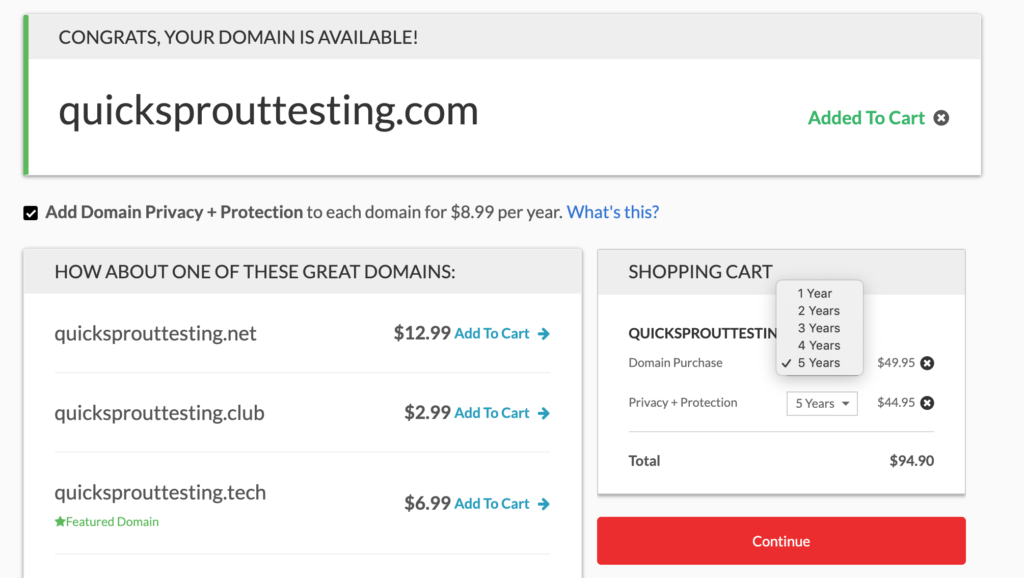
You can get a .com domain from Domain.com for just $9.99 per year. During the checkout process, you have the option to purchase your domain for up to five years, which is one of my favorite features offered by this provider. I can set it and forget it.
Domain

Privacy and protection overwrites your WHOIS information. The name and address of every domain owner is available publicly. Obviously, this can cause privacy issues. Domain registrars will offer to overwrite your personal info with their generic info to help protect your privacy. Some domain registrars offer this for free but Domain.com charges $8.99 per year per domain. I get around this by having my domains under a company name which I’m fine being publicly available. If you’re buying domains personally, I’d definitely protect your personal info even if it means paying a bit more.

As you continue through the checkout process, Domain.com will hit you with some additional upsells, which is standard procedure in the domain registrar industry. They offer things like G Suite, web hosting, SSL certificates, and SiteLock.

You can skip these add-ons. G Suite is something that you can purchase independently and directly from Google. SSL and SiteLock should come with your web hosting service.

The entire purchase process can be completed in a minute, at most. This is ideal for those of you who plan to purchase multiple domains. With helpful 24/7 customer support, Domain.com is a great option for domain transfers as well.

Overall, I can’t find anything bad to say about Domain.com. It should be one of the first places you look for a domain. Get 25% off with coupon code QUICKSPROUT

#2 Bluehost

Free domain name with any hosting plan
Hosting plans start at $2.95/mo
Easy domain manager
Free SSL certificate
Get your FREE domain

In most cases, it’s best to keep domain registration and web hosting separate. But if you’re starting a new website and want to bundle your domain and web host, Bluehost is the only provider that nails both of these services.

More than 2 million websites across the globe are powered by Bluehost. They are an industry leader in web hosting.

If you don’t plan on buying any more domains then you can save money by registering with Bluehost. A free domain comes with all of their hosting plans. With shared hosting plans starting as low as $2.95 per month, you really can’t find a better deal elsewhere. At least not from a provider that offers quality hosting and quality domains.

As soon as you select a hosting plan, you’ll be brought to this page to set up your domain:
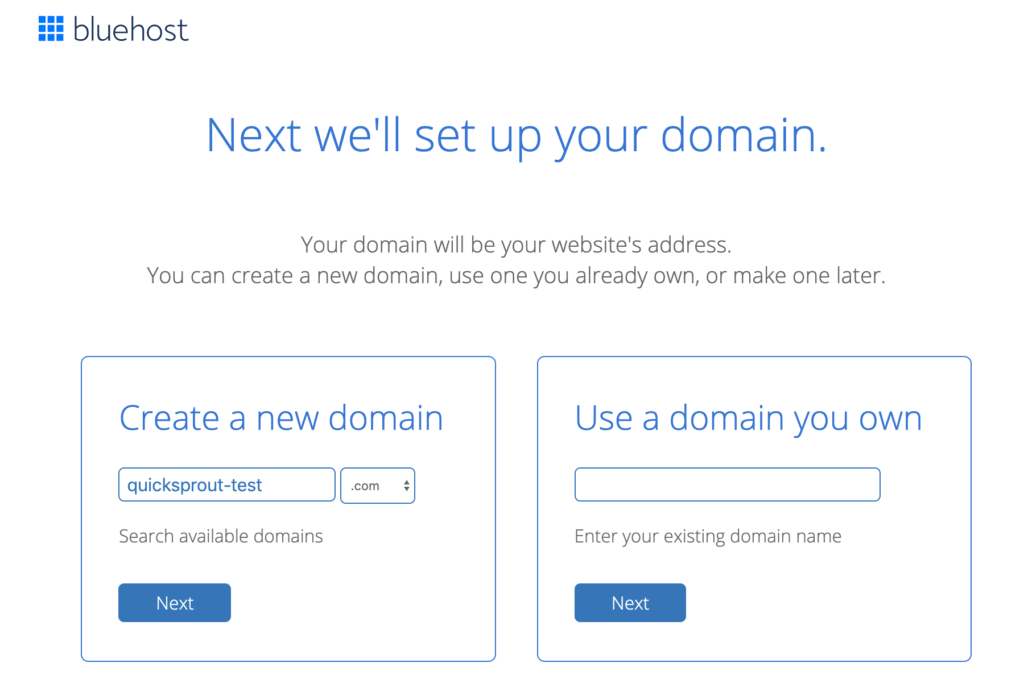
BlueHost

The Bluehost domain manager makes it easy for anyone to buy, track, transfer, and update domain names from a simple dashboard. You’ll also get a free SSL certificate, which is something that other domain registrars try to add-on as an upsell.

Bluehost also offers autorenewals for domains, so you won’t have to worry about your domain expiring because you forgot to renew every year.

Add domain privacy and protection to your registration for just $0.99 per month. You can also prevent any unauthorized domain transfers with domain lock, which is $1.99 per month.

#3. Namecheap
Free privacy protection
Simple checkout process
24/7 live chat support
Find and buy a domain name in 2 minutes
Search for your domain

Namecheap’s checkout process is simple, with very limited upsells. There’s nothing confusing about the process and nothing to slow you down either. It’s everything I want in a domain purchasing experience and nothing I don’t want. I’m able to search for a domain name and purchase it in under two minutes.
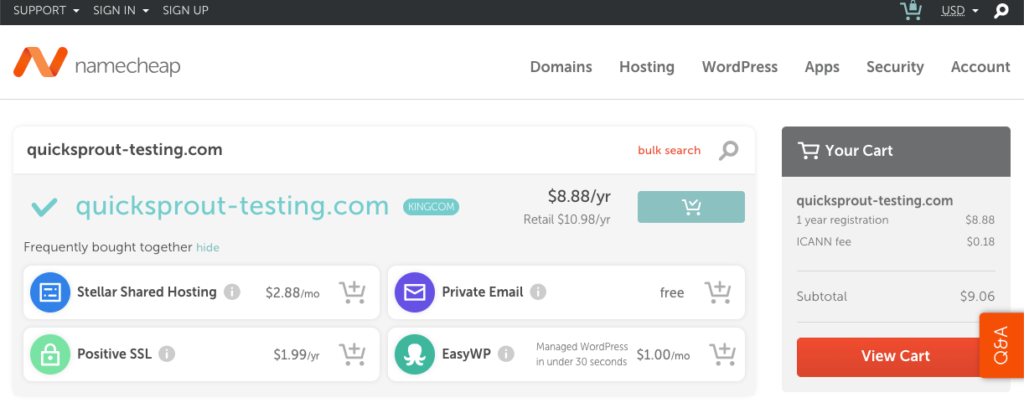
Namecheap upsells during domain registration

How to navigate the Namecheap upsells

During the purchase process, Namecheap will hit you with a few questions. You can blast through that section pretty quickly using this cheat sheet of which to add and which to skip:

  • Stellar Shared Hosting ($2.88/month) – Skip it

As I said before, web hosting and domain registration are very different. It’s tough to find a company that nails both. If you’re looking to bundle domain registration with hosting, then my recommendation would be Bluehost. Otherwise, you can get your domain from Namecheap and check out my guide on the best web hosts for alternative options.

  • Private Email (two months free, then $9.88–$49.99/year) – Skip it

If you want a business email, it’s always free to forward emails from Namecheap. If you’d like cloud storage for that email, or to send emails from your domain name, we recommend not buying it from your registrar. My universal recommendation is a no-brainer: G Suite ($6/user/month), which includes Gmail, Drive, Docs, Sheets, Calendar, and Hangouts.

  • Professional Gmail ($6/user/month) – Skip it

This is the going price for G Suite but I think it’s simpler to keep your billing for G Suite directly with Google. That way, if you ever leave Namecheap, you won’t have to get them to transfer your G Suite account back to Google. You don’t save much time (once you get your Gmail on autobill it’s the same amount of work — none). And you risk entangling things that you’ll have to detangle later. Build for the long term for the start by setting up best-in-class accounts across the board and separate their billing.

  • PositiveSSL ($1.99/year) – Skip it

You’ll need an SSL certificate if you plan to accept payments or collect other sensitive information on your website, but not this one. The PositiveSSL Namecheap is upselling here is just a Domain Verification. I recommend getting your SSL from your web host instead.

  • EasyWP ($1/month) – Skip it

You’re here to buy your domain name and only your domain name. If you want managed WordPress hosting, I recommend using a top web host that focuses on hosting. SiteGround and Dreamhost both have some good managed WordPress built into their shared hosting plans. But Bluehost will still be your best bet if you want to get WordPress hosting and domain registration in the same place.

Namecheap’s $0.18 Fee

That $0.18 ICANN fee is a mandatory charge from the Internet Corporation for Assigned Names and Numbers, for each domain registration, renewal, or transfer. It’s negligible, although noticeable, especially considering other registrars, including NameSilo, absorb it.

Free Domain Privacy

Namecheap provides a WhoisGuard subscription for free forever. You definitely want WhoisGuard. It’s a privacy protection that prevents your personal contact information from being displayed in the publicly accessible Whois database. As long as your domain is with Namecheap, you’ll never pay for WhoisGuard. GoDaddy, on the other hand, charges $10/year and most web hosts that offer domain registration charge $12/year.

Note: WHOIS Privacy is also free with NameSilo, Gandi, Google Domains, and Hover.
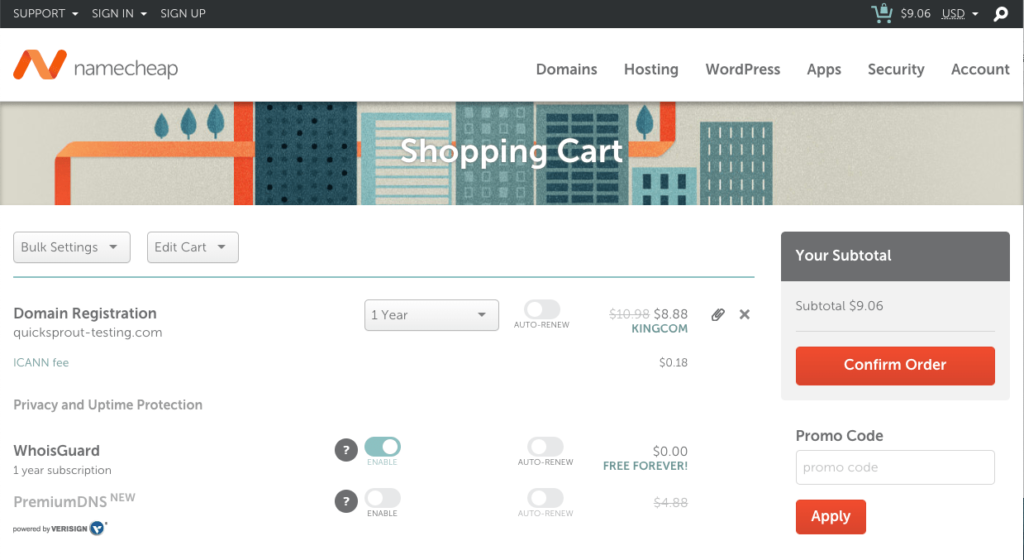
Namecheap final checkout screen with free WhoisGuard

Once you’ve purchased your domain, the dashboard is clearly laid out.

I’ve found Namecheap’s knowledge base to be thorough and helpful. Great documentation is key: buying and setting up a domain isn’t part of most people’s expertise. It’s just not something you do every day. If you need more support, Namecheap has 24/7 live chat help and a 2-hour ticket response time.

#4. NameSilo

  • Outdated site and aesthetic
  • Really cheap — cheaper than Namecheap
  • Free privacy protection
  • Bulk domain discount program
  • Visit NameSilo

At first glance NameSilo is laughable, especially compared to its competition. Its aesthetic seems to be late 90s PowerPoint — although a new site is thankfully in beta testing. I suspect this is in large part due to NameSilo being acquired in early 2018 by software company Brision Innovations.

It’s almost impossible to believe that it’s the second fastest growing domain registrar in the world (based on November 2018 sales). Even more impressive, NameSilo’s CEO says this growth isn’t fueled by marketing dollars:

“The fact that NameSilo is growing faster than nine of the top ten domain registrars in the world, most of which are public companies with at least a billion-dollar market capitalization and very large marketing budgets, is a testament to the team and the service we are providing our customers. This growth by NameSilo has been accomplished with a near zero marketing spend.”
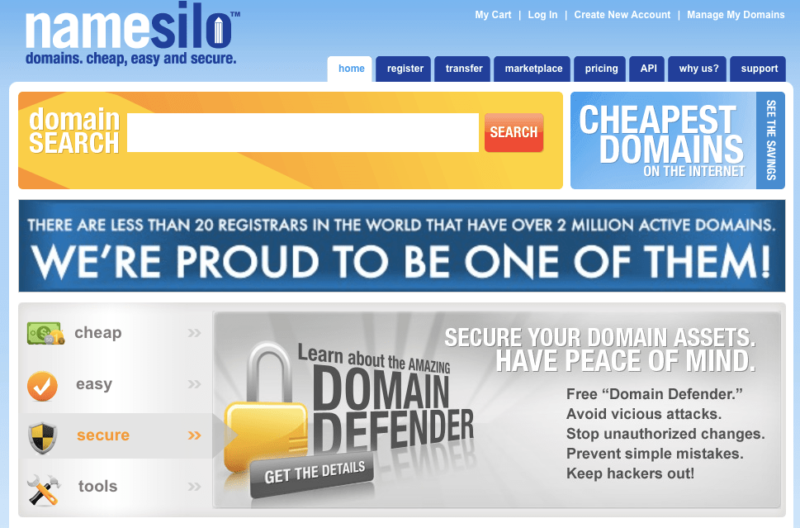
The NameSilo website is dated and belies its strength as a top domain registrar

NameSilo’s comically outdated site isn’t stalling growth.

What I appreciate about NameSilo

It’s a domain registrar and that’s it.

It’s really cheap (even cheaper than Namecheap), throws in domain privacy for free (though you’ll need to opt-in by selecting it in your cart), and offers a full-blown discount program for bulk domain purchases.

There are virtually no upsells and you can start configuring your domain in checkout — linking it to a third-party service (like a website builder) and entering custom NameServers.

Customer support is also comparable, with a rich knowledge base and 24/7 live chat.

So, if you don’t mind some (hopefully temporarily) outdated interfaces, NameSilo is a great option.
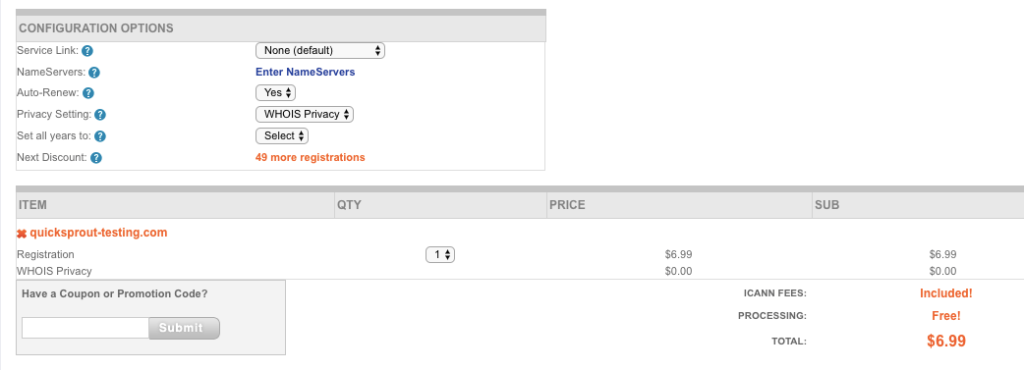
NameSilo checkout screen when purchasing a domain name

You can start configuring your domain name during NameSilo’s checkout flow. Don’t forget to opt-in to WHOIS privacy protection.

#5. Gandi

  • A few dollars more expensive than Namecheap ($15 vs. $10–$12)
  • Beautiful interface
  • Free domain privacy, free SSL for one year, email hosting
  • Good deals on multiple domain bundles
  • Visit Gandi

For over $15/year for the same domain we can get for $10–12/year from Namecheap, I want to see more from Gandi. It has a beautiful interface, and is well-regarded amongst developers, but there’s not much it offers that Namecheap or even Google Domains doesn’t: free domain privacy, free SSL for one year, email hosting. One standout is its domain bundles. You can score a deal if you want to buy multiple domains at once.
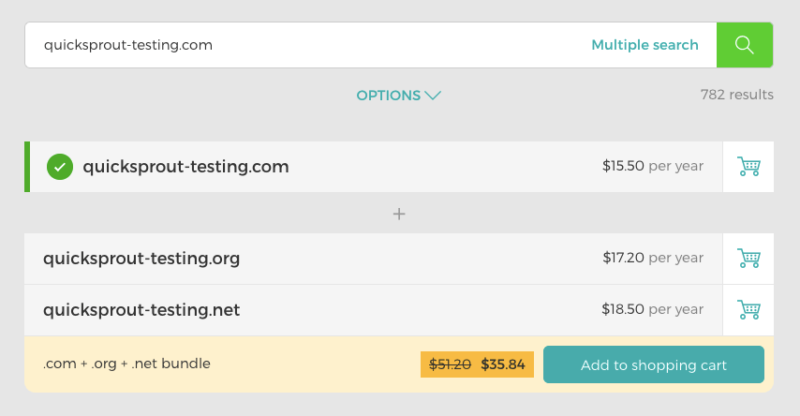
Gandi deals on multiple domain name bundles

If you want to bundle domain registrations, Gandi will give you a good deal.

#6. Google Domains

  • Familiar and simple Google-style interface
  • Literally zero upsells
  • But, you’ll be sharing even more information with Google
  • Visit Google Domains

I like the familiar and simple Google-style interface.
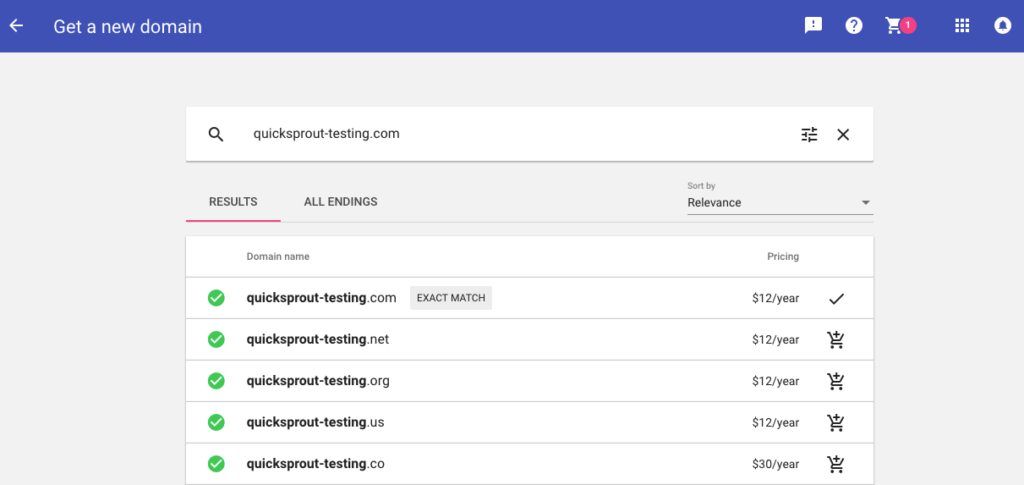
Google domain name registration process

It’s clean and there are literally no upsells and absolutely zero flourish.

But, most web developers prefer not to share more information with Google than is absolutely necessary. I felt the exact same way.

One huge downside with Google Domains: If you need help, you won’t be able to dig into a rich knowledge base.

However, there is chat, email, and phone support in English, 24 hours a day, and in French, Spanish, and Japanese with more limited hours.

In February 2019, Google hosted an early access program for users to pay extra to register a .dev domain through Google Domains through its early access program. As of February 28, 2019, these .dev domains are available without any additional fees — just the annual registration charge of about $12 to $15. Google has a filterable list of domain registrar partners.

(Namecheap, NameSilo, Gandi, and Hover are on that list.) If you buy a .dev url, you’ll be joining GitHub, Women Who Code, and Codecademy.
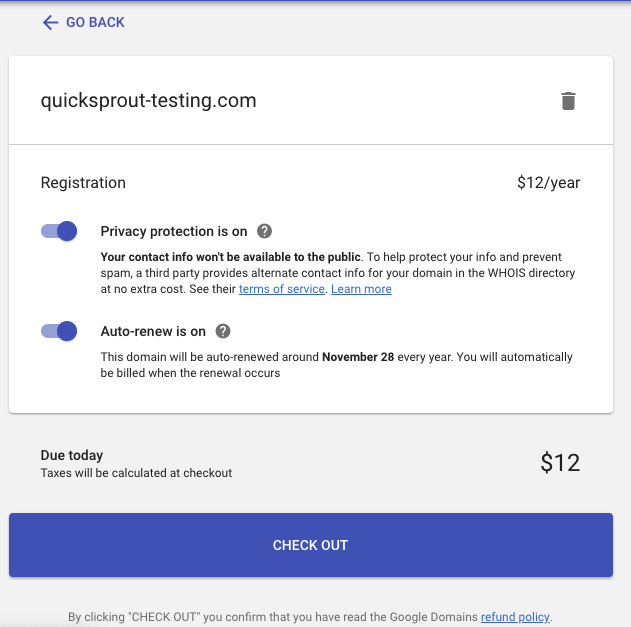
Google domain privacy protection and automatic renewal on

Google Domains makes no fanfare of its free privacy protection — make sure you turn it on.

#7. Hover

  • Fun automated name engine
  • Limited upsells
  • Privacy protection included
  • Some stability issues
  • Visit Hover

Hover domain name suggestions

Hover spit my domain name request through a thesaurus. We’ve all been there, desperately trying to find an available domain after hitting hundreds of dead-ends. Any tool that can offer new ideas when buying a domain name is super helpful.

I also like that there are limited upsells in Hover’s purchase flow, and privacy protection is included. Email forward isn’t free though, it’s $5/month.

My biggest worry with Hover ultimately is its backend. Browse through Hover’s outage history and you’ll find hours-long outages are frequent.

Domain Registrars I Don’t Recommend

  • 1&1
  • GoDaddy

I do not recommend 1&1 or GoDaddy. In terms of price, customer service, and overall value, you can do better elsewhere.

Avoid any domain registrar with a bad reputation or history of poor customer support. This includes any company on Spamhaus’ list of the worst domain registrars.

I’d also stay away from GoDaddy and 1&1. There are lots of unfavorable reviews of these registrars online. GoDaddy has even been suspected of throttling down outbound transfers, which is obviously not great.

My Methodology For Ranking The Top Domain Registrars

When I research and rank the best domain registrars I look for those that meet these criteria:

  • Quick to search
  • Easy purchase process
  • Simple configuration process
  • Intuitive dashboard for managing domains over time
  • Quality customer service, both live support and in a robust knowledge center
  • Limited upsells
  • Strong reputation

Why the reputation of your domain registrar matters

In mid-March 2019, the 9th largest domain registrar by volume went dark — out of nowhere. Customers could not renew expiring domains, couldn’t log into their accounts, and couldn’t buy new domains. Their domain registrar was out of business and their domains were in limbo.

When this happens, panic sets in. “Am I about to lose all my domains?”

In cases like this, ICANN steps in to de-accredit the registrar and bulk transfer the domains to an accredited registrar. The new location of the domains is announced on ICANN’s bulk transfer page.

Even though there’s an established process, the last thing any of us want is to be at the mercy of a bulk domain transfer to another register. Too many things can go wrong. And there’s too much at risk. Losing the wrong domain would kill my business.

Pro Tips For Buying a Domain Name

Before you settle on a domain registrar and buy a domain name, review these tips to make sure everything goes smoothly.

Don’t bundle domains and web hosting from just any provider

It’s common for domain registrars to offer web hosting services. It’s also common for web hosting providers to offer domain registration. These bundles might seem tempting, but in most cases, you should keep each service separate.

This gives you a lot more flexibility with changing web hosts and/or domain registrars in the future. It also improves the quality of service on both.

I’d only recommend registering a domain and getting hosting with the same company if you’re not planning to buy more domains in the future. And if you’re going to bundle your domain and web host, you should use Bluehost. They are the only provider that is able to nail both of these services. This is a great option for something specific and simple, such as a blog or small personal site.

Always opt in to domain privacy

Most domain registrars include it for free. Those who don’t charge about $12/year. Buy it. It’s what keeps your personal information (including your name, phone number, email address, and mailing address) from being listed in the Whois public database — and therefore out of the hands of spammers. You can also use the your business info since it’s already publicly available. Definitely don’t use your personal info though.

Remember to turn on automatic renewal

In a lot of businesses, auto-renewal is sneaky way to charge you for something you never use and forgot you bought in the first place. But when it comes to domain names, I absolutely recommend it. If there’s anything you know your business will always need is its website. Forgetting to re-up means your site will go down, which happened to automated marketing powerhouse Marketo in 2017. Even worse, if you have a covetable domain name, it might get scooped up before you can rebuy it. That’s what happened to Google.com back in 2016. If someone else buys your domain, it could be gone forever. Don’t ever let you domain registrations lapse.

Prioritize your URL over your registrar

For the most part, if a name is available, you will probably be able to purchase it through any of the best domain registrars. But some accredited registrars only offer limited top-level domains (TLD). (A TLD is the stuff that comes after the dot.) This is especially common in smaller registrars or providers that offer domain registration as a secondary service, like a web host. (For example, InMotion Hosting, one of our favorite web hosts, can only register .com, .net, .org, .biz, .us, and .info domains.)

That’s because a registrar is different than a registry. Registries are who actually hold the TLD and their associated names — for example, VeriSign controls all .com and .net domains while PIR controls all .org and .ngo domains. Registrars manage the reservations of the names provided by the registries, and have to act in accordance with each one they are involved with. Not all registrars work with all registries, which is why some only have access to specific TLDs.

What matters here is that you get the URL you want — if it’s not available at the first place you check, look around. You may also be able to buy it with the help of a broker.

Don’t make a big deal of tiny price differences

Registrars are middlemen between you and domain registries that hold all the domains. It’s similar to how department stores are the middlemen between shoppers and clothing manufacturers. The registries set their prices — the equivalent of wholesale prices — and registrars add their fees on top. That’s how they make money. A registrar selling a domain for more money than its competitor is just making more money off the sale of the same product. (Some registrars are making headlines for registering domains “at cost,” including Cloudflare, the content delivery network provider.) If you are price-comparison shopping, take into account the renewal fee, the price of privacy protection, and the cost of your time should you need to wait on hold longer for worse customer service.

Recap of the Best Domain Registrars for 2020

Buying a domain name can be intimidating if you’ve never done it before. Finding a reliable domain registrar will make your life much easier. These are the best options for you to consider:

Regardless of your situation, budget, or website type, you’ll be able to buy a domain name from one of the registrars on this list.


from Quick Sprout https://ift.tt/2AVab1c

Thursday, April 23, 2020

The Best Blogging Platforms and Blog Sites for 2020

Want to jump straight to the answer? The best blogging platform for most people is definitely Wix.

When it comes to creating your own blog, you have two options.

The first option is to build a website and blog there. Building your own website and blogging on it is the old-school way to build a blog. To do this, you’ll need to use software like Wix or do everything yourself through WordPress.

This requires more work upfront but you’ll own and control your site completely.

The other option is to use a blogging platform like Medium, LinkedIn, Facebook, or Instagram. Even if some of these platforms aren’t technically blog platforms, you can get more success from them by treating them as blogs. It’s a lot easier to get in front of millions of people and takes less than 15 minutes to set up. The downside is that you’ll be beholden to their rules and algorithms.

In this guide, I’ll break down both ways to set up your blog and help you pick which blog site, software, or blogging platform is best for you. Let’s get to it.

How to Choose the Best Blogging Platform for You

To point you in the right direction, I need to ask you two questions: one about money, the other about your blog niche.

1. Do you plan to make money blogging?

If so, go with Wix.

Wix has all the features you’ll need to make money with your blog and is a lot easier to use than other platforms.

• 14-day free trial
• Drag and drop site builder
• Integrated payment processing
• 500+ ecommerce templates
Try Wix for Free

If you’re not trying to make money blogging, use one of the best blog sites I list below instead.

These blog sites are great if you aren’t trying to create an income: They have built-in audiences and you won’t have to pay anything. My recommendation of which one to choose is based on the outcome that you’re trying to achieve. Which leads me to my next question.

2. What is your blog like and who do you hope will read it? In other words, what is your blog niche?

  • If you’re in business, blog on LinkedIn.
  • If you’re creative, start your “blog” on Instagram.
  • The best classic blogging site is Medium, which can also serve as a syndication platform.
  • The biggest audience, of course, still lives on Facebook.

If you hadn’t thought about creating your blog on anything other than a website builder, it might be kind of hard to wrap your mind around these blog sites. I’m not saying they’re best for every blog, they’re a great way to go if your audience already spends time on those platforms.

In other words, a social platform might be a better fit for you than a true “blog.” That’s why I recommend that designers, photographers, and artists skip blogging entirely. Go start an Instagram account, you’ll build an audience much easier that way.

Reviews of the Top 6 Best Blogging Platforms and Blog Sites for 2020

Here are our in-depth reviews on the most popular blog platforms.

Wix – Best Website Builder for Blogging

I like Wix for blogging because it’s one-and-done. If you want to go the easy route for owning your own blog, this is it. It’s an easy runner up to WordPress for the best blog platform.

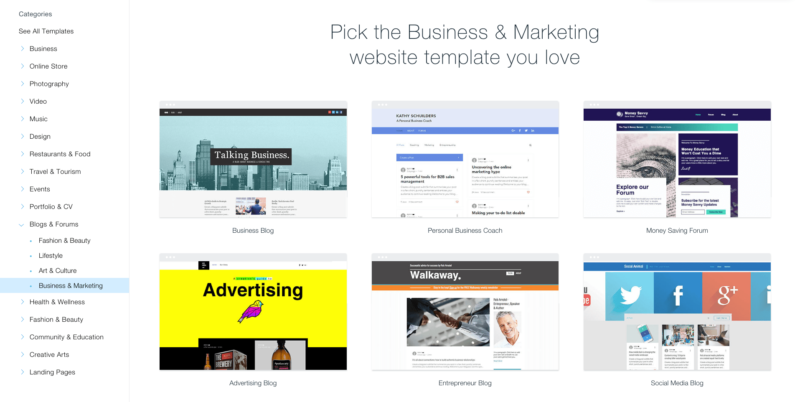
Wix Blog Templates

The templates are great looking and you can customize them with a drag-and-drop editor. The blog manager is simple and intuitive, and you’ll get analytics and SEO built right in. It’s simple to add the basic features you might want on your blog: social tools, likes, comments, hashtags, categories, and a subscriber forms.

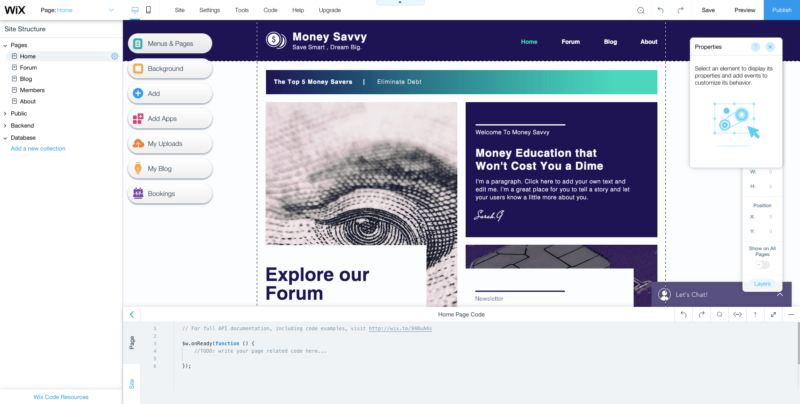
Editing a Wix Blog

All of the SEO features you need are easy to access too: alt tags for your images, internal links, SEO titles and descriptions (that are different from you post title), and nofollow tags for external links. Wix blogs have an automatic email subscribe feature and a social media bar beneath each article for sharing on Facebook, Twitter, and more.

To build a blog on Wix, you’ll sign into your account and pick a template. There’s a Blog template category, which is a great place to start. Once you have your template selected, I suggest updating the font, colors, and logo to personalize your template and help it stand out from the rest.

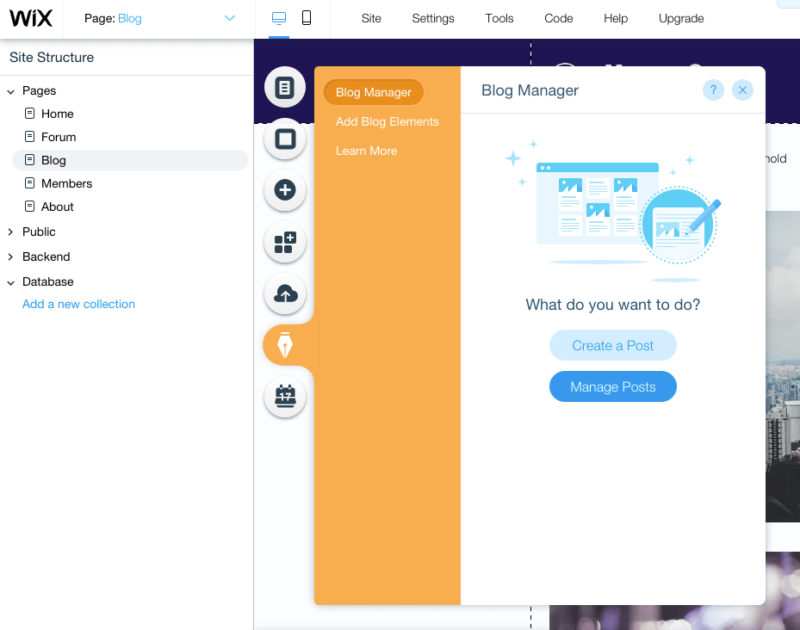
Create a blog post with Wix

Writing a post is as simple as clicking Create a Post, writing and adding images. You can save drafts, or even give other contributors writing privileges for you site. This is all just as easy from a mobile device as from a desktop — no app required.

Make sure that you update your SEO settings for every post: this is what’s presented in the search results page and is critical for ranking in organic search.

The resulting post will have an automatic read-time count, like a Medium post right next to the author’s name, which I also like a lot. I also like the ability to live-chat with your readers in the Wix app. If you build a real community in your blog or are open to answering reader questions in real time — say about an online course you’re offering or a webinar that’s coming up — then it’s a cool feature.

WordPress – Best Blogging Software for Flexibility

WordPress by far the most flexible option. No matter what you want from your blog, it can be done with WordPress.

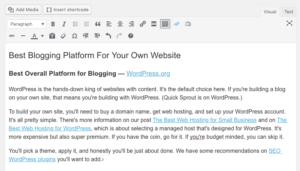
To build your own site, you’ll need to buy a domain name, get web hosting, and set up your WordPress account. There’s more information on our post The Best Web Hosting and on The Best Web Hosting for WordPress, which is about selecting a managed host that’s designed for WordPress.

Backend of WordPress blog post

You will need to spend time configuring your site, that includes picking a theme, configuring it, setting up your WordPress settings, adding SEO WordPress plugins, getting all your content uploaded. For first-time bloggers, it can be overwhelming.

That’s the trade-off with WordPress. It’ll do anything you want but it takes more time to learn than an easier platform like Wix.

Medium – Best Traditional Blogging Site

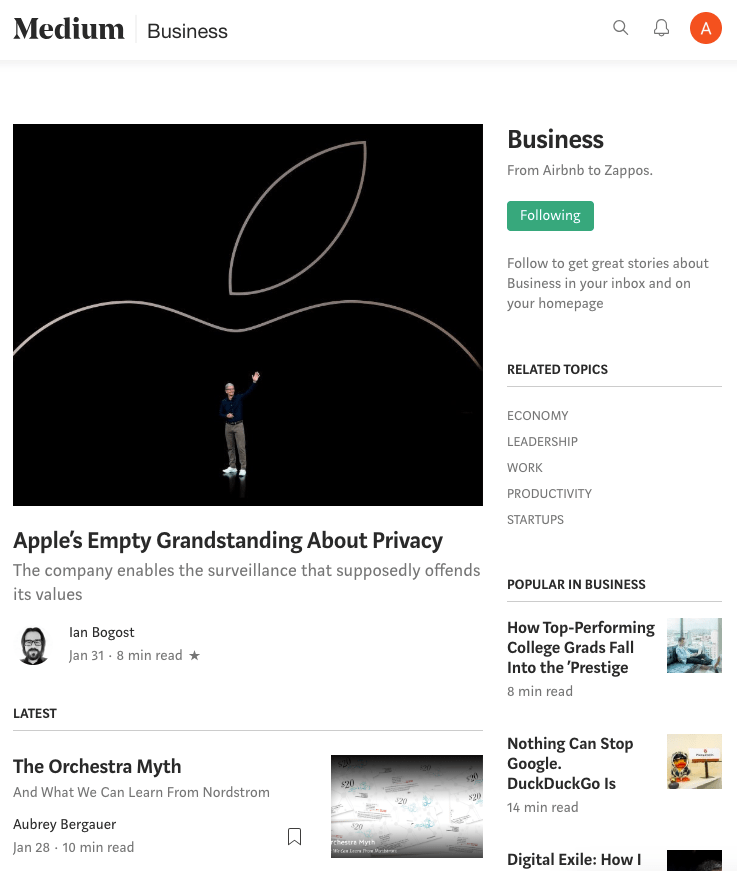
It’s hard to pin down how many users Medium has — they focus on sharing how much time is spent on the platform reading instead. I dig it. The platform, was founded by Twitter co-founder and former CEO Evan Williams as a response to the hyper-short limits of Twitter, hence the name Medium. Medium category page

At one point, there was some distinction between even longer blog platforms, but that’s dissipated by now.

In 2017, Medium had 60 million unique visitors. From personal experience, I know that when I read on Medium, I read with curiosity and intent. I’m ready to put in some time reading, and the read times on each article get me to commit to sticking it out for the whole thing.

Posting with Medium is super simple. There’s a clean, very white WYSIWYG (what you see is what you get) editor. Basically, as you type, you see what the post will look like when it’s published. There are a lot of tips and tricks to format your post that are a little hidden in the simplicity of the interface.

Don’t stop at this point though. Instead of just a profile, I recommend creating a Medium Publication. This gives you the option to add other writers and editors to your blog. More importantly, it gives you a lot more options for controlling what is essentially your blog homepage.

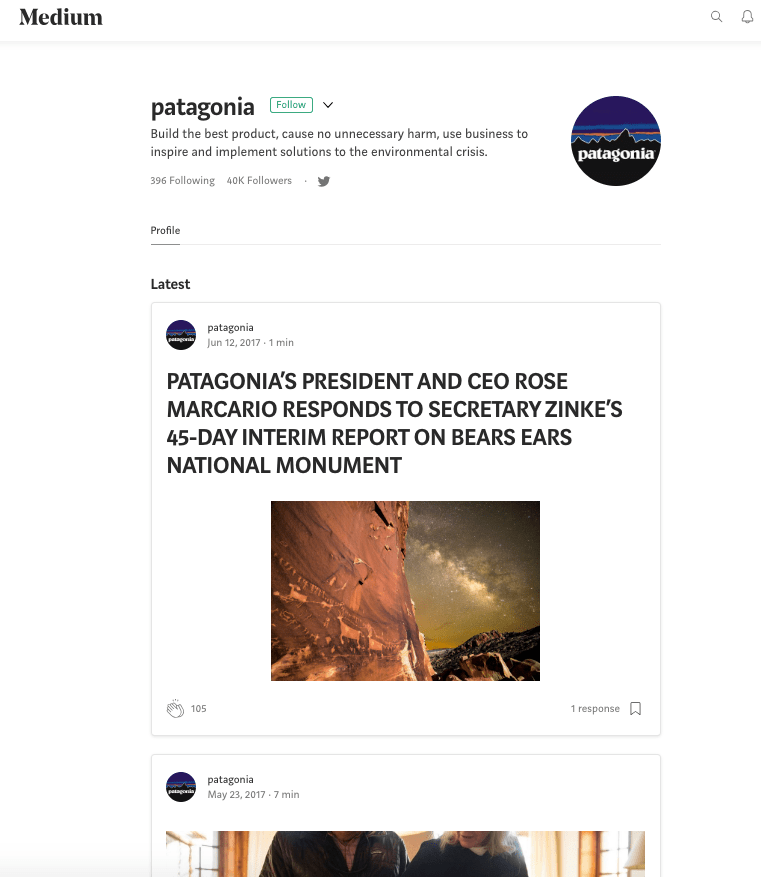
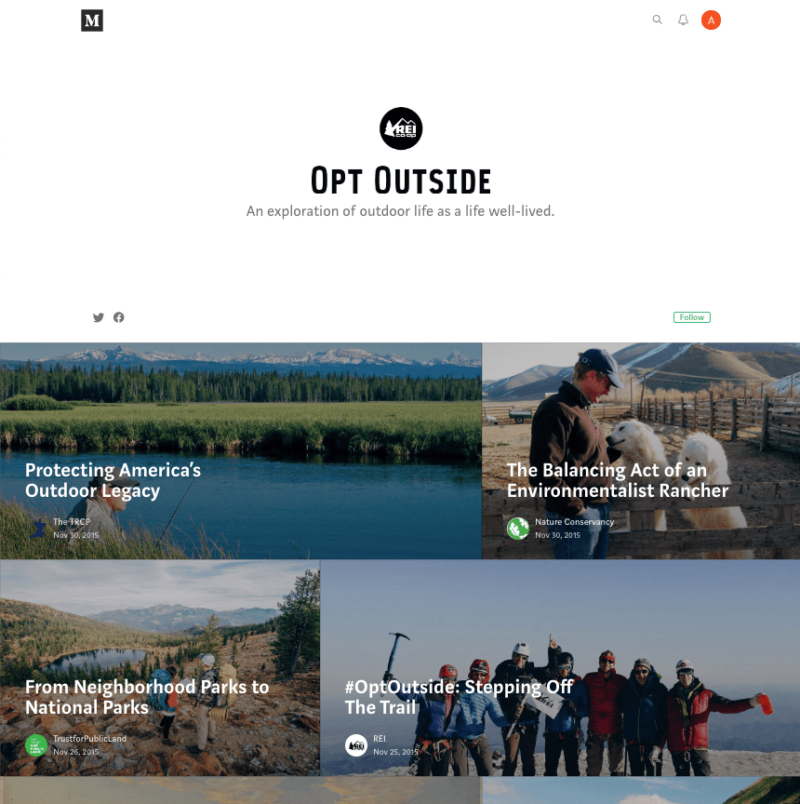
Take a look below at the difference between Patagonia’s basic Medium profile (top image below) and REI’s Medium publication (bottom image below).

Medium blog profile page

Above, a consecutive stream of your posts. This is all you’ll get with a Medium profile.
Below, the more magazine-style layout you’ll get with a Medium publication. 

Medium blog publication page

One is a simple chronological feed and the other is a designed page with useful menu options. When you create a publication like REI has you also unlock the ability to send a newsletter to all of your followers.

Pro Tips for Blogging on Medium

  • If you are syndicating your actual blog, use the Import feature. This is essential for SEO.
  • To start a bulleted list, simply type an asterisk or a dash.
  • There are two types of quotes. Use a block quote by clicking the quote icon once. Click it again for a pull quote.
  • Drop caps add a little editorial weight. To make the first letter of your paragraph larger, and give it that designed look, highlight the letter. The option will appear.
  • Use TK to leave yourself notes. This is an old journalism trick — there are no words with TK in them in the English language. If you’re writing something that needs a placeholder, use TK and Medium will alert you if you try to publish with one still in place.

LinkedIn – Best Blog Site for Business

There are 590 million LinkedIn users, 154 million of them in the US. And a lot of them are active: 44% are monthly active users. LinkedIn used to be basically a resume hosting platform. In a lot of ways it was like a job-hunting dating app: you’d go on if you were looking to hire or looking to get hired but not much else. In the last few years that has changed dramatically.

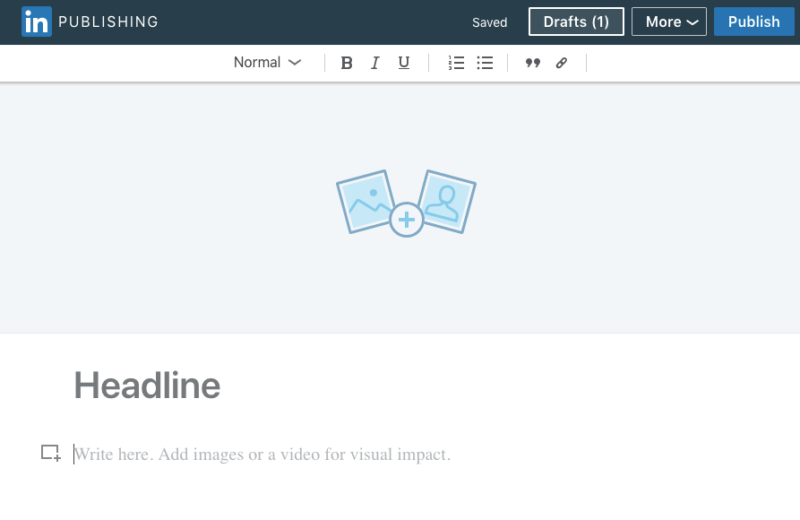
Publishing blog on LinkedIn

If you’re building a business blog, the audience on LinkedIn is premium: 45% of LinkedIn article readers are in upper-level positions (managers, VPs, Directors, C-level).

In an article for Forbes, “Is LinkedIn Poised To Be The Next Big Social Network … For Brands?”, Ryan Holmes nailed what’s great about the platform, “Hardcore LinkedIn users know that there’s a certain warm professionalism that underlies many exchanges on the platform. In short, LinkedIn offers a kind of stability, civility and real value that’s sorely needed on some social platforms.” I completely concur. The platform has a ready made culture and set of expectations that a business blogger would dream of creating on their own site. Why build it when it already exists?

LinkedIn is a social network. Your influence grows in proportion to the size of your network. The more posts you publish, the more connection requests and followers you’ll attract. Writing consistently not only expands your network, it also reinforces the message about the depth and breadth of your knowledge of the subjects that you write about. — Glenn Leibowitz, “10 Tips for Writing LinkedIn Blog Posts That Expand Your Influence” for Inc.

Publishing doesn’t make you a LinkedIn Influencer, unfortunately. That’s a hand-selected group of people that rotates throughout the year “to include only the most engaged, prolific, and thoughtful contributors and to ensure that their expertise matches our members’ interests,” according to LinkedIn.

An article isn’t a post and vice versa. A post is a smaller update you’d share with your feed and connections. Think quick anecdote or pro tip. They’re limited to 1,300 characters, which is about 5 lines. Articles are longer and more in-depth. They’re something that the broader LinkedIn audience would be interested in reading. A person who reads your article can also follow you from there, so they’ll be alerted when you publish your next article. Any articles you publish will appear in the Articles section of your LinkedIn profile.

Pro Tips for Blogging on LinkedIn

  • Be clear about who you are and what you’ll be talking about it. Stick to that topic and don’t stray. And post regularly. Even posting once or twice a month — consistently over time — will add up. Twice a month is 48 times a year. In five years, you’ll have nearly 250 posts. That’s huge.
  • You can share a draft with a colleague or friend for feedback.
  • Use the stats related to your posts as a tool: create more of what’s working, less of what’s not.

Want to improve? Check out LinkedIn’s own course on getting better at blogging on the platform, Writing to be Heard on LinkedIn. Because when they own the platform, what’s good for them is successful content that people want to read and engage with!

Instagram – Best Blog Site for Creatives

Instagram is primarily visual — the feed is all the images or videos, and very little of the captions. You can use the caption field for your text, and users like a long caption. You’ll be capped at 2,200 characters or about 300 words.

Instagram is perfect if what you’re sharing is visual: a lifestyle, art, dance. Or if there’s some way to share it visually like in a how to mini-video.

In fact, in a lot of ways, Instagram has killed the entire genre of lifestyle blogging.

It’s become a lot harder for upstart “bloggers” in the crowded yet lucrative fashion, beauty, wellness, and lifestyle spaces to build a following centered around their own blog. At the same time, social media platforms have given influencers more and more tools—including e-commerce, groups, and direct messaging—to keep them (and their followers) from going elsewhere online.

— Rosie Spinks, “Instagram Has Killed the Art of Lifestyle Blogging” on Quartzy

Instagram is so good now that it’s hard to want to go anywhere else. The downside is definitely that you’re beholden to the algorithm and the feed, and the changes the platform makes. On the flip side, you also don’t have to be the product manager, hire a developer, or build an audience from scratch. You’ll have to weigh the pros and cons yourself!

You can also host vlogs on Instagram Live — simply tap the camera icon (top left of the screen, or by swiping right from the Feed) and tap Live at the bottom. When you’re ready to actually go live, it’s as simple as tapping Go Live. You’ll be able to see the number of viewers you have at the top of the screen and comments will pop in at the bottom. When you’re done, tap End. From here, I recommend tapping Save to save it to your camera roll, and tapping Share to add it to your story. It’ll live there for 24 hours to be replayed by anyone who wasn’t around when it was actually live.

Pro Tips for Instagram Blogs

  • Pick a good name that’s catchy and easy to type — your name should make it clear what your whole feed is about.
  • Stick to a niche.
  • Have a visual point of view.
  • Don’t stray. If you’re an artist, don’t post pictures of your salad for lunch. If you’re a food blogger, think twice before you post photos of your doodles.
  • Post regularly! And engage.

You can only have one link in your profile, but with something like Linktree, you can add more links. I don’t think it’s a great idea to build a blog somewhere hoping to get your readers or followers to move from there to somewhere else on the regular. It’s feasible to get your Instagram followers to also subscribe to your newsletter, but it’s not really logical to hope they’ll leave Instagram after ever post and go read your blog. They’re scrolling through Instagram, not trying to read your website.

Think about your own behavior here — how much momentum does it take to get you to follow a link that leads away from the platform you’re in? For me, it takes a lot of work. There has to be something I really want to buy, or really, really want to read.

It’s more likely that I’ll follow someone on Instagram for a while and then one day I’ll buy something from that person, or follow them somewhere else. Instagram, and all blogging really, is about creating a relationship with the people who’re reading your posts. Once that relationship is strong enough, then people will be interested in going wherever you’re taking them. Until then, you’ll need to deliver on that relationship within the platform itself.

Facebook – Biggest Blog Audience

I mean, what’s 1.49 billion daily active users to you? It’s a huge number, and one that’s worth noting. How many of those active users will make it to your page or your post, now that’s another question.

Organic reach on Facebook was once not such a wild aspiration, but in 2016 there was a huge decrease in organic reach. SocialFlow found that brands saw a 42% decline in organic reach over Q1 and Q2 2016.

The easiest way to build a blog on Facebook is to create a group or a page for your business or brand. From there, your posts will literally be Facebook posts.

To make it easier to post and handle all your interactions in one spot, I recommend using the Facebook Creator Studio. It’s an all-in-one dashboard for publishing and analyzing your content. If you’re new to Facebook and are really using it as a classic blog platform, you’ll want to create Notes. These are the closest things to blogs: a header image, a title, and text down the middle.

From here you can also go live, post videos, gifs, polls, recommendations — any type of Facebook post you’ve seen you can create from this dashboard. You can even save, schedule, and backdate posts.

Pros and Cons of Each Blogging Platform or Site

Pros and Cons of Creating a Wix Blog

You can also build your blog using Wix. It’s an all-in-one drag-and-drop website builder. It’s an easy option if you’re looking to have your blog on your own site, rather than on a blog platform or service like Medium or another form of social media.

The downside is you’ll be paying a subscription fee and you’ll be locked into Wix’s themes and tools. So, you’ll trade some convenience for some flexibility. For most users, we think this trade-off is worth it.

Pros and Cons of Blogging with WordPress

The main reason to use WordPress is the complete flexbility. No matter what you want to build or how big you get, WordPress can handle it. This is the biggest benefit os using WordPress.

There is more set-up that you’ll need to do on your own, like buy a hosting plan, for example. This is the only downside in my mind, but you don’t have to be an expert — we have step-by-step guides on How to Start a Blog and How to Make Money Blogging. (And an entire blogging section with ideas for keeping the momentum going, gaining readers, coming up with blogging ideas and other pro tips.)

Pros and Cons of a Medium Blog

Medium is the best all-around traditional blogging platform. It’s where the majority of readers who’re looking to read classic blog-style posts are right now.

The downside is built into the choice of picking to create your own blog or build one an a platform — you won’t own the traffic and you won’t be able to do things like sell ad placements, for example.

Deciding to blog on WordPress vs Medium isn’t an either-or choice. You can also publish your site and re-publish some posts on Medium to take advantage of its benefits, just like you would any syndication deal. You can thoughtfully approach this, but there are some technical how-tos we’ll get into below. You’ll need to import your posts to Medium properly and set the canonical tag, so you’re not penalized by Google (at worst) or simply out-ranked by the Medium version of the post (at best). Overall, though, I prefer to see each channel as a separate channel and create and publish unique content for that channel.

Pros and Cons of Blogging on LinkedIn

If you’re blogging about business, or something related, like management, then I’d say to build your blog on LinkedIn. There’s a pre-existing community of people there talking about those topics and ready to read your posts too. You’ll be able to build business followers, which is different than a “connection.”

The audience on LinkedIn is premium: 45% of LinkedIn article readers are in upper-level positions: managers, VPs, Directors, and C-level. If you’re building thought leadership, brand value, or community, rather than trying to make money, I recommend going to where your audience is rather than trying to woo them over to where you are. Build content for them where they already are and they’ll love you for it.

You’ll be able to build your network and your business opportunities, but like all blog platforms, the cons here are that you’re beholden to the algorithm and don’t own the site or the traffic.

Pros and Cons of an Instagram “Blog”

If you’re a creative — especially in a visual field, then your blog should really be an Instagram account. You can post images of your work and use the caption field for your written post. If you’re not used to this idea, it might seem kind of zany: That’s not a real blog. But it is. People read Instagram captions of the accounts they follow like they’d read a blog — and your visual work will be well highlighted in your feed and the general feed. The cons are self-explanatory: you’ll have to follow the Instagram format, and are subjected to the feed’s algorithm. It’s not impossible to monetize your Instagram feed, but you’ll be limited to those that you can feature in an image or caption. All of the monetization opportunities will need to be natively integrated

Pros and Cons of Blogging on Facebook

Of course, Facebook is the juggernaut in the room. It has the largest audience of any of these platforms. Creating a Facebook page might be all you need to build a blog — post on Facebook like you would on your blog and build your audience right there on your page. The comments and interaction on Facebook are even better than a traditional blog. You can really focus on building true fans on Facebook.

The cons of Facebook have really been blasted through the media lately. There are privacy concerns, there’s the issue of an ever-changing and pretty secretive algorithm, and all of that. You probably already have an opinion of Facebook — let that inform your decision here.

There’s another warning due here. If you build your blog on a single platform that you do not own, well, then you’ve built your blog on a single platform you do not own. That means you’re beholden to another person’s business and their algorithm for your business. What’s good for their business and algorithm may not be what’s good for yours. That’s why I say if you’re here to make money, you should own your site. You’ll have more control.

Recap of the 6 Best Blog Sites and Blog Platforms for 2020

Best Website Builder for Blogging — Wix

If you want to have to your own site and keep things easy, go with Wix. It’s a drag-and-drop editor that’ll get you up and running quickly, and you’ll still be building your blog on your own website, not on someone else’s platform.

Best Blog Software for Flexibility — WordPress

I’d recommend going this route to anyone serious about customizing your site and need complete control

Best Traditional Blogging Platform — Medium

If you’re not creating your own site and your blog is a classic blog — long form posts about a topic that’s meaningful to you — I like Medium. It has a built-in audience that’s interested in reading and an interface that’s seamless.

Best Blog Site for Business — LinkedIn

Blogging about business or hoping to be a thought-leader in a certain industry? You could go with Medium, but a more rabid and useful audience might be waiting for you on LinkedIn. I know, it might not seem like a blogging platform, but LinkedIn users are really engaged and content hungry.

Best Blogging Site for Creatives — Instagram

If you’re doing anything with images, art, creativity, or lifestyle, you’ll probably find your audience on Instagram. There are already so many people there and it’s easy for new followers to discover you through hashtags, comments, and the other people you and they are following.

Largest Audience — Facebook

Lastly, the biggest audience is on Facebook. There are millions of people there, and though organic reach on the platform isn’t what it once was, it’s still a massive platform. It’s also a great spot for building a community page element to your blog.


from Quick Sprout https://ift.tt/2AgqjKQ

Goodbye Blog Comments! 6 Reasons Why I Turned Off Blog Comments Forever and You Should Too

I created my first blog in 2006, which is hard to believe, but that’s 14 years ago. It wasn’t until 2010, and several sites later, that I really created something that would stick. That’s when I created nichepursuits.com. When I…

The post Goodbye Blog Comments! 6 Reasons Why I Turned Off Blog Comments Forever and You Should Too appeared first on Niche Pursuits.


from Niche Pursuits https://ift.tt/35aIyAh

Tuesday, April 21, 2020

How to Start an Online Store That Drives Sales

Wix is our top recommendation for building your online store. If you want to skip all the other stuff and jump straight into building, start your free trial:

• 14-day free trial
• Drag and drop site builder
• Integrated payment processing
• 500+ ecommerce templates
Try Wix for Free

There’s a bunch of things to think about when starting an online store:

  • What tool do you build your store with?
  • What do you name your company and how do you get a domain?
  • Do you dropship or not?
  • How do you deal with taxes?

All of these are important decisions. For now, one thing matters more than anything else to get your first sale.

What’s that one thing?

Your marketing.

That’s right, how you choose to market your store completely determines how much money you’ll make. Get the marketing right, everything else falls into place. Get it wrong or neglect it, you’ll spend years on your store without selling a single item.

There’s 6 Steps to Starting and Launching Your Online Store

  1. Pick your marketing strategy
  2. Find the right product niche
  3. Pick a name for your brand
  4. Create your online store
  5. Do a 60-day marketing burst
  6. Build your marketing flywheel

Step 1: Pick Your Marketing Strategy

Before you open your online store, you need to pick your marketing strategy. Don’t even look at templates for your storefront, or color palettes, or logo designs, or anything yet. (We’ll get to the how to setup an online store stuff soon — I promise.) First, pick your marketing strategy.

If there’s one step that will make or break the success of your online store it’s this one. It’s not a hard choice, but it is one that you need to make thoughtfully and in advance.

Most online stores use one of three marketing strategies:

  1. SEO
  2. Paid marketing
  3. Platform marketing

Let’s go through each.

SEO for Online Stores

This marketing strategy is pretty simple: find keywords for products that you want to offer, then get your site to rank in Google for those keywords.

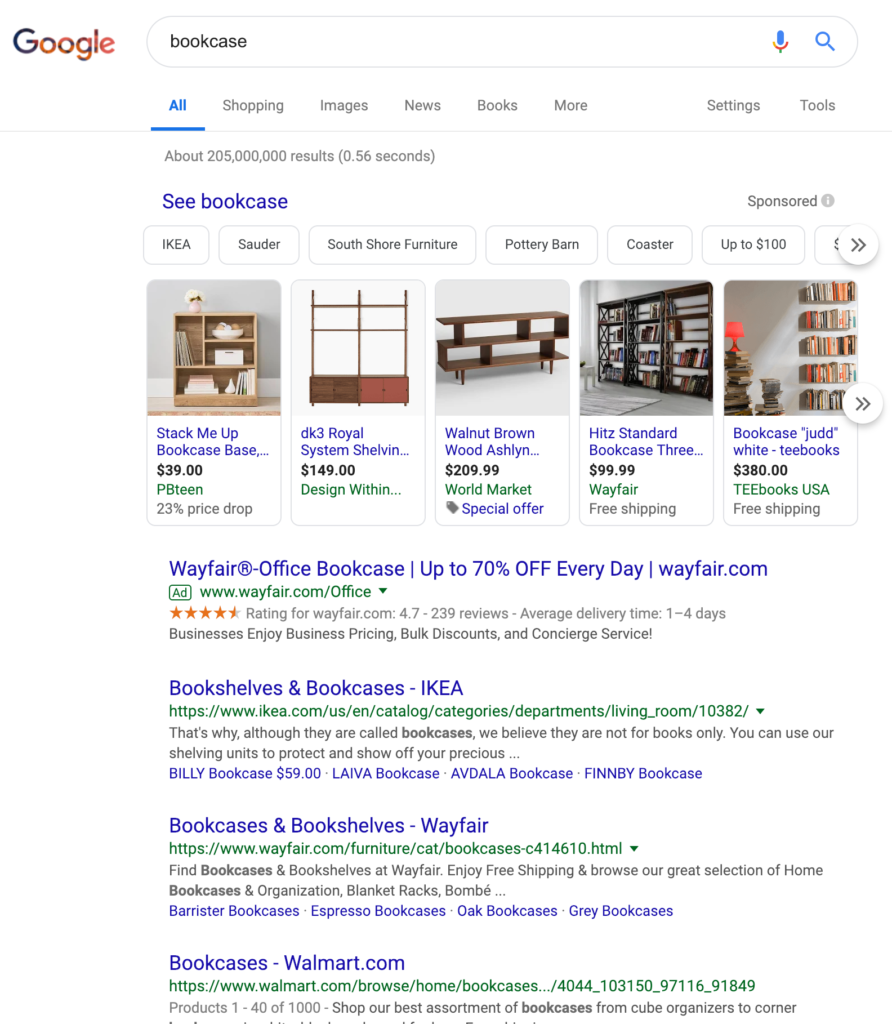
Google Search Marketing - Bookcase

In this example, IKEA, Wayfair, and Walmart.com are winning the organic spots (the ones underneath the carousel and the ads) SEO for the search term “bookcase.” If you get this strategy to work, you can make a lot of money with your online store.

SEO has a few benefits that are ideal for a businesses:

  • The traffic streams are very dependable, which means dependable revenue for your business.
  • Search traffic usually has the highest volume of traffic of any traffic source.
  • Even at scale, search traffic can be enormously profitable.

Dependable, high volume, and profitable. It’s everything you could want.

There is one major downside: SEO takes a lot of time and effort. Even if you’re pursuing a product category without any competitors, it can still take a good 3–6 months to see your site appear on the first or second page of search results for a keyword. The traffic volume will be pretty small until you get your page into the top 1–3 rankings on a keyword. If your category is even modestly competitive, it can take years of effort to get to that point.

If you go with SEO as the marketing strategy for your online store, you’ll focus on three things:

  1. Optimizing your product pages for product keywords.
  2. Building useful and engaging content for non-product keywords that are also in your category. This helps your product pages rank.
  3. Making your content so good that people will link to at as a resource.

When playing the SEO game, there are only two things that matter: content and links. So that’s where you’ll spend the bulk of your time.

Paid Marketing for Online Stores

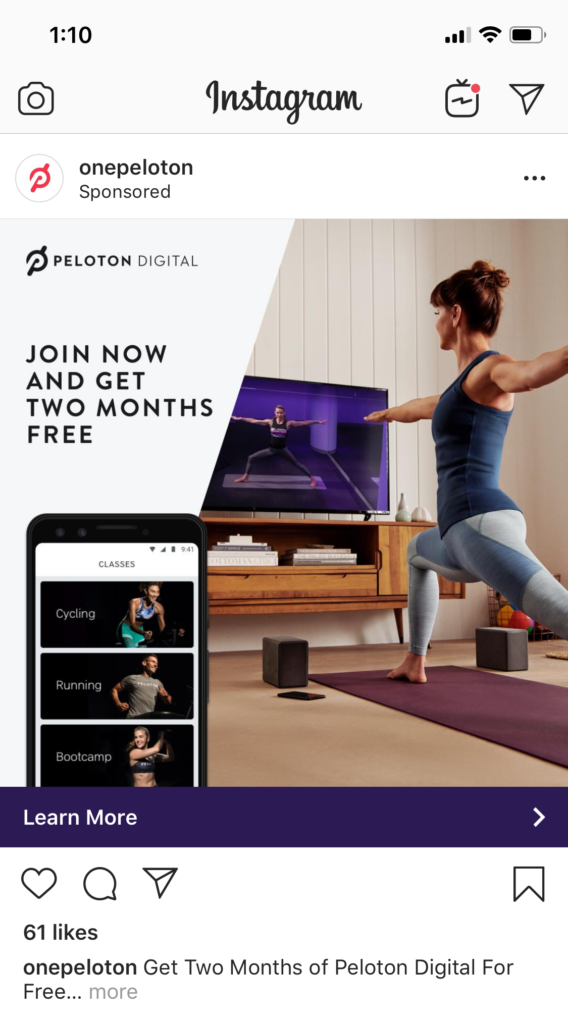
Some online stores do exceptionally well with paid marketing. This includes sponsored posts on Instagram and Facebook, and paid results in Google search. Paid marketing are ad placements you buy.

Instragram Paid Ecommerce Ad

But is paid marketing right for your business? My general rule of thumb: paid marketing is a great option if your product is the type of thing that could be featured in a mall.

Why?

The biggest paid marketing channels right now are Facebook and Instagram. Instagram in particular has gotten very popular for online stores in the last few years.

But think of the frame of mind that someone has while scrolling through a Facebook or Instagram feed. They’re relaxing for a few minutes, laughing at a few photos, and leaving quick messages for a few friends. They’re enjoying themselves. It’s a lot like how people shop at a mall. Sometimes, people are looking for a particular item, but a lot of people go to the mall to enjoy themselves. Malls have known this for a long time and stores have optimized around this browsing experience.

Products that sell effectively in a mall are also likely to do well with a paid ad in Facebook or Instagram. These products typically:

  • Consumer products. Business products have a much harder time in these channels.
  • Highly visual and eye-catching. This is why apparel companies do so well in malls and why apparel companies have been really aggressive on Instagram the last few years.
  • Simple to understand. The offer needs to be understood within 3 seconds. If you have a more complicated sales process that requires more explanation, people will have scrolled past your ad long before you have a chance to make the sale.
  • An impulse friendly price point. If the price is too high that people need to carefully think through the decision, they’ll skip your ad and quickly forget it.

If your product meets all these criteria, you should seriously consider going the paid marketing route.

Google Ads (formerly AdWords) is one exception to this. Since you’re bidding on keywords within Google, you put your ad in front of people who are already actively searching for that type of product. As long as the keyword has enough search volume and the ad bids aren’t too competitive, it’ll work very nicely.

The biggest downside to paid marketing is that you’ll have to invest a bunch of money up front before you know whether or not you can turn a profit. Many of us don’t have those thousands of dollars to invest without a reliable chance of getting it back.

Most paid campaigns don’t turn a profit initially; they usually take a lot of iteration and work before they start making a profit. Most professional paid marketers need 3–6 months before their campaigns become profitable. So be careful and make sure you don’t invest more than you can afford to lose here. If cash is too tight for you, choose one of the other marketing options.

Platform Marketing for Online Stores

This is a completely different direction than the two methods above.

Instead of creating your own store and using a type of marketing to acquire traffic, you’ll leverage one of the main ecommerce platforms:

  • Amazon
  • Etsy
  • eBay

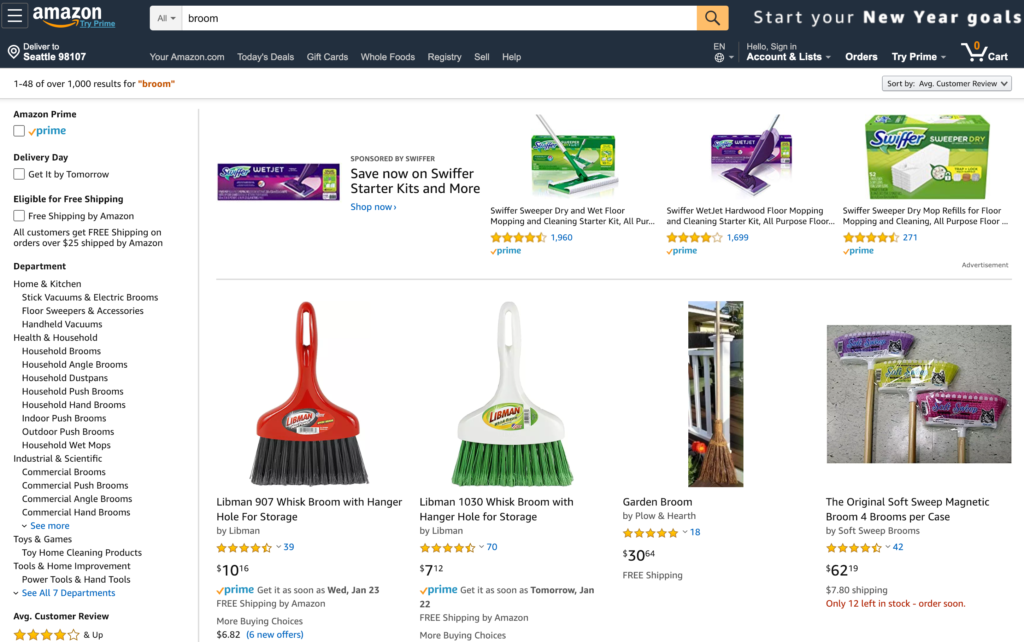
Amazon Platform Marketing - Broom

It’s definitely possible to be successful at any of these three. We recommend that most folks go after Amazon. Amazon’s audience is much larger which gives you more upside and just about every product niche already exists on Amazon.

The main exception is if you’re doing a craft business of some kind, like making your own bookends to sell to people. In that case, Etsy is a better fit since the audience expects more craft-oriented products.

eBay is still great if you’re doing a bunch of buying and reselling. But if you’re producing the same types of items consistently, the potential on Amazon is much higher.

You treat whichever platform you choose as your marketing channel. First, you’ll create your store on that platform and list all your products. Second, you’ll optimize your store to the best of your ability so the platform wants to feature your products.

Optimizing your store usually involves focusing on two areas:

  • Targeting your product pages to specific terms searched for within the platform
  • Getting as many 5-star reviews on your products as possible

As you improve your search terms and reviews, more people will see your products on that platform, which will produce more sales for you.

How to Choose the Best Type of Online Store for You

Let’s recap what we’ve covered so far. There are three types of online stores you can open. These types are based on the marketing strategy you employ.

The three marketing channels for an online store are:

  1. SEO — You’ll focus on content and links. Requires: time and patience
  2. Paid marketing — You’ll pay for placements. Requires: 3–6 months, money upfront, and a highly visual, simple-to-understand consumer product with an impulse-friendly price point.
  3. Existing platforms like Amazon, Etsy, and eBay — You’ll focus on winning the search terms within that marketplace and stacking up 5-star reviews. Requires: Committing to understanding that platform.

I strongly recommend that you pick one of these and build your entire business around it. That’s right, just one.

“Why can’t we do more than one? Wouldn’t we want to use multiple marketing channels for our store? More marketing means more sales right?”

I’ve made this exact mistake so many times myself. After a decade working in online marketing alongside some of the most well-respected marketers out there, I’ve noticed one overwhelming trend: folks that are good at one type of marketing are generally pretty bad at the others.

Why would this be?

A couple of reasons why it’s hard to be good at more than one kind of marketing:

  • Every marketing channel is completely unique. While some marketing principles apply across all channels, you’ll have to learn all the tactics from the ground up. Constantly trying to learn new channels really slows you down.
  • Online marketing channels constantly change. What works right now won’t work in 12 months. Even though I’ve spent a decade doing SEO, I still feel like I’m relearning it every year. If you’re focused on a single marketing channel, you’ll have a much easier time keeping up.
  • Online marketing channels are power laws. That means the majority of the profits go to a few big players — everyone else fights for scraps. If you’re not one of the winners, you won’t be making much.

If you stick with one marketing channel, you’ll get through the learning curve a lot faster. The faster you unlock your marketing channel, the sooner you’ll be making real money with your online store.

OK, step one is done. It was a long one, but it’s important that you spend time on it — it’s the very foundation of every other choice you’ll make in the process of setting up your online store.

Step 2: Find the Right Product Niche for Your Online Store

After choosing your marketing strategy, picking your product niche is the most important decision that you’ll make. Slow down and take your time to do some genuine research here.

A huge mistake that I’ve made in the past was jumping into hobby categories. Yes, being personally interested in the category really helps with building the business. But it’s also a common trap for picking a category that won’t support a thriving business. If there isn’t much demand in my niche, it doesn’t matter how great of a job I do, I’m doomed to fail from the beginning.

There are a few things I look for in a good product category for an online store.

First, avoid picking a category that’s too unique.

A common best practice in marketing is to differentiate yourself. And this is powerful advice — it’s a huge advantage when you have it.

It’s also tricky to find a genuine way to differentiate yourself that the market is willing to pay for. There are countless ways to differentiate any given product, but only 1–2 actually matter.

Does the top-rated toothbrush holder on Amazon need to do something wacky and unique? Not at all. It needs to be simple, easy to use, reliable, have a good price, and have a ton of reviews on Amazon. That’s it.

Instead of trying to differentiate yourself from every other product in your category, find a category with competitors that aren’t dominating their marketing channel. Are the Amazon reviews low for all the top products? Are the SEO results low quality? Are there no companies putting serious ad dollars behind a product? If the answer is yes, there’s an opportunity for you to out-compete them with your marketing.

A moderate price is also key.

Avoiding product categories with a low price makes a lot of sense. After all, if you only earn $1 in profit for each sale, you’ll have to sell 100,000 products every year to support yourself. After taxes and overhead, that’ll give you about $50–60K per year to live on.

Selling 100,000 of anything is a lot of work. No easy task.

Now let’s assume that you’re selling something for $80 and making $40 in profit on each sale. To make $100,000 per year, you’ll only need to sell 2,500 items. That’s much more manageable.

However, you also want to avoid selling something with a price that’s too high. As price goes up, so does buying behavior. Prospects demand more proof. They may even demand a completely different buying process. How many people buy cars without test driving them at a dealership? Most don’t. They want to see the car and talk to a real person before making a purchase that big. Cars require a lot of extra work and sales skill to sell effectively because of their higher price point.

We recommend finding a product that you can sell between $50 and $100 dollars. It’s high enough that sales will add up quickly for you. It’s also low enough that the buying process will be straightforward.

Lastly, make sure there’s demand.

You can usually tell if there’s demand by doing some category research on your marketing channel. For SEO, Google Ads (formerly AdWords) has a Keyword Planner that tells you how many times something is searched in Google every month. If the keyword for your product gets less than 1,000 searches per month, it’s probably too small to build a business on.

Same thing with Amazon, if you have trouble finding products in your category with more than 100 reviews, it’s probably too small.

These days, I’d much rather pick a category that I have zero experience in but has genuine demand. That’s much better than realizing that a passion category of mine has zero demand later on.

Step 3: Pick a Name for Your Brand

The bad news: everyone hates this step.

Trying to find a good name that’s not already taken gets really annoying. The websites are taken, the best names have been trademarked, and you’ll feel like you’re hitting dead-end after dead-end.

Good names are tricky to find.

Whenever I look for a new name, I feel a temptation to cut corners. After several full days of brainstorming names and hitting dead-ends, all I want to do is pick a less-than-ideal name just so I can move on to the next step.

I have to tell myself that it’s worth the effort to keep looking. It’ll pay off if I keep going and it always does.

Here’s the naming checklist I use:

  • Easy to spell. I never want any friction when people are trying to find my site.
  • 3 words or fewer. I like to keep it at short as possible so it’s easier to remember. 1 or 2 words is ideal, 3 is still good.
  • Pass the Bar Test. I should be able to say the name in a noisy bar without repeating it. That’s a great sign that it’s easy to understand. This is huge for word-of-mouth marketing later.
  • Can get the .com domain. Every online story needs a .com. It’s become too much of a standard. Some folks use weird domains like company.online or company.io. In my opinion, this causes problems later because whoever owns company.com will know how valuable it is once you try to buy it. I either buy the domain early or find one that’s instantly available.
  • Relevant to your category. Make sure the name relates to your product category in some way.
  • No trademark conflicts. Any corporate law firm can do a quick check for you on this. Since legal time is expensive, find 3–5 name options that check all the above items. Then have an attorney check for the trademarks all at the same time. It’s rare to not have at least one of them work.

We have an in-depth guide on how to pick and buy a domain name here.

Once you have your name picked, grab the domain using your domain registrar. Or if you’re buying the domain from someone, get it transferred into the domain registrar that you want to use for the long term.

Step 4: Open Your Online Store

If you’re pursuing an SEO or paid marketing strategy, this is a super important step. The quality of your site has a huge impact on how much of your traffic will turn into buyers.

First, we strongly recommend Wix for building your site.

• 14-day free trial
• Drag and drop site builder
• Integrated payment processing
• 500+ ecommerce templates
Try Wix for Free

There are other tools out there like Shopify and Bigcommerce — none of them compare to Wix. It’s super easy to use, has all the features that you’d ever want, and a very reasonable price.

The one exception to this is if you’ve already built out a blog with a large audience and want to add a small online store to it in order to sell a few items. In this case, adding WooCommerce to your WordPress is a good option.

Otherwise, always go with Wix.

We’ve put together a detailed guide on creating an ecommerce website here.

And if you’ve picked one of the platforms like Amazon, treat your company and product pages with great care. Make the copy as compelling as possible. Use every feature that they give you. Get the highest quality photos that you can. Do everything. Really make your pages stand out.

Step 5: Do a 60-day Marketing Burst

All of our stores start from scratch.

When we’re just getting started, any bit of momentum goes a long way.

That first review, that first page that ranks in Google, that first purchase using a paid ad — it’s life changing.

At this stage of the process, I never worry about systems, scalability, or trying to do things in an efficient way. I’m looking for momentum any way that I can get it, no matter how much outreach or personal work I have to do.

The goal at this stage is to put in a huge burst of personal effort and get some momentum. Even if you have to do things that you know aren’t sustainable over the long term.

Here are a few examples:

  • I might tap my personal network to see if anyone is willing to do an interview with me and publish it on their own site. This will help me get a few initial links to my site.
  • I could ask personal friends and relatives to leave the first couple Amazon reviews.
  • I’d try spending some of my own cash on paid ads to test if the offer produces revenue at all.

I’m looking for any marketing idea that involves my time but also allows me to quickly get my first few wins.

At this stage, do some research on your marketing channel and come up with a list of 50 ideas that you could personally do yourself. Then prioritize them and plan a 60-day Marketing Burst. Ship as many of those ideas that you can within those 60 days. Work long hours, drink too much coffee, and really push yourself during that period.

By the end of the 60-day Marketing Burst, some of your marketing ideas will have worked and you’ll have your first couple sales. You’ll also have a small but steady stream of sales coming in because you’ve focused on a single marketing channel. That steady stream is enough to start building your marketing flywheel on.

Step 6: Build Your Marketing Flywheel

Once you have some initial momentum, it’s time to start building the marketing machine that will grow your business around the clock without you having to personally accomplish every task.

In the early days on Amazon, you’ll need to personally ask for a lot of your first product reviews. But that’s not sustainable.

Instead, look for marketing tactics that help create Amazon reviews for you without you asking for them.

Here’s an example.

A popular tactic on Amazon is to ask customers to leave a review. Some will even promise a discount code on the next purchase if a review is published.

You can automate that tactic. Have an assistant send the same templated email to every new customer, asking for a review and promising a discount code on their next order. All the platforms allow you to message customers personally through the platform. So while you can’t email blast all your customers at once, you can have an assistant send messages out one-by-one every week on your behalf. That’s a repeatable flywheel that doesn’t take up your time.

A quick side note on this review tactic: Before you try something like this, make sure to check the guidelines and policies of the platform you’re on. There are always rules about these sorts of things and every platform is slightly different. Be careful to not push things too far, putting your store in danger of getting removed entirely.

Look for as many of these repeatable marketing flywheels as you can.

Instead of creating content yourself, can you pay someone for content? If you did the keyword research, made a list of requirements that you want on each piece of content, and hired someone else to write the post itself, you could create a lot more content to help you win with an SEO marketing strategy. That’s a flywheel.

Instead of optimizing your paid ads yourself, can you delegate that? If your conversion rates are consistently improving and your cost to acquire a customer is going down, that lets you buy more customers with the same amount of capital. That accelerates your business without your personal effort. Another flywheel.

Focus on your core marketing channel and then build a marketing flywheel that will keep your online store growing without any effort from you. This is the key to opening an online store, generating sales quickly, and accelerating its growth.

So what are you waiting for?

Start your free trial with Wix today and start your online store in just minutes. Then follow the rest of my tips above to get an edge on the competition.

• 14-day free trial
• Drag and drop site builder
• Integrated payment processing
• 500+ ecommerce templates
Try Wix for Free


from Quick Sprout https://ift.tt/2LgZlbe